

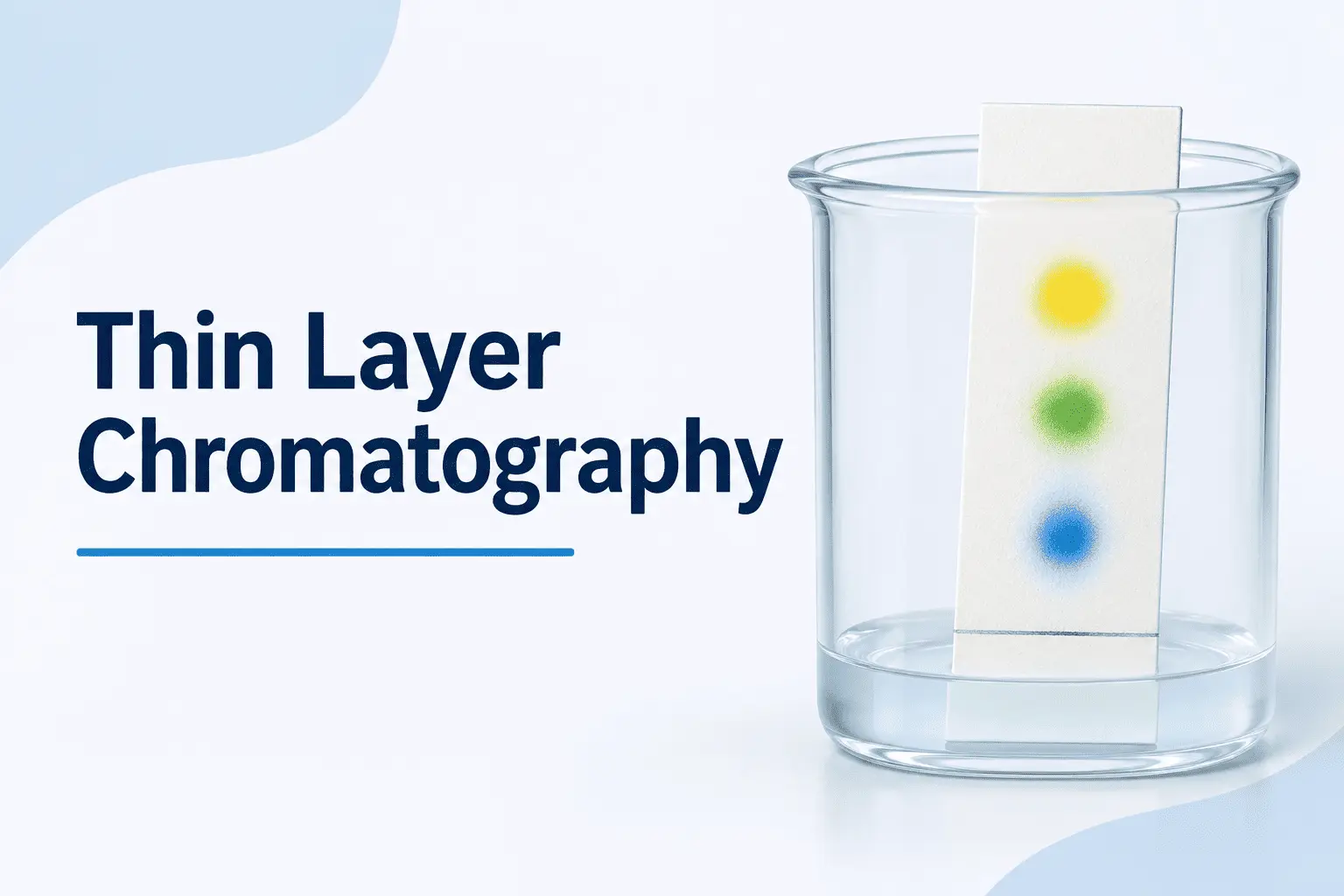
Thin layer chromatography (TLC) is a widely used analytical separation technique in chemistry, biochemistry, pharmaceutical sciences, and biological research. It allows researchers to separate, identify, and analyze the components of complex mixtures based on their interactions with a stationary phase and a mobile phase.
TLC is particularly popular because it is simple, inexpensive, rapid, and requires only small quantities of samples. It is commonly used to analyze plant pigments, lipids, amino acids, pharmaceutical compounds, and other organic molecules.
The technique involves applying a sample onto a plate coated with a thin layer of adsorbent material, usually silica gel or alumina. A suitable solvent then moves through the stationary phase by capillary action, carrying the sample components at different rates and allowing their separation.
1. What Is Thin Layer Chromatography (TLC)?
Definition of Thin Layer Chromatography
Thin layer chromatography is a planar chromatographic technique used to separate and identify the components of a mixture. It relies on the differential distribution of compounds between two phases:
- Stationary phase: A thin layer of adsorbent material deposited on a flat support.
- Mobile phase: A liquid solvent or solvent mixture that moves through the stationary phase.
As the mobile phase travels across the plate, compounds interact differently with the two phases. Those with a stronger affinity for the stationary phase move more slowly, while compounds with greater affinity for the mobile phase migrate farther.
Principle of Thin Layer Chromatography
The principle of TLC is based primarily on adsorption and, in some systems, partition mechanisms.
In conventional TLC, silica gel is commonly used as the stationary phase. Its polar surface contains silanol groups (Si–OH) that interact with molecules through hydrogen bonding, dipole interactions, and other intermolecular forces.
The mobile phase dissolves and transports sample components along the plate. Differences in compound polarity, solubility, and interactions with the stationary phase produce different migration rates.
Stationary phase: Common materials include silica gel, alumina, and cellulose. Silica gel is the most frequently used adsorbent because of its high surface area and polar properties.
Mobile phase: Common solvents include hexane, ethyl acetate, methanol, acetone, and chloroform. The solvent composition is selected according to the chemical properties of the compounds being separated.
How Does Thin Layer Chromatography Work?
The sample is applied near the bottom of the TLC plate. The plate is then placed vertically inside a developing chamber containing the mobile phase, with the solvent level below the sample application line.
Through capillary action, the solvent rises through the adsorbent layer and carries the sample components. Because each compound interacts differently with the stationary and mobile phases, the components migrate at different distances.
After development, the plate is removed, dried, and examined using suitable visualization methods. The resulting chromatogram reveals the separated compounds as individual spots.
2. Materials and Components Used in Thin Layer Chromatography
TLC Plates
TLC plates consist of a supporting material coated with a thin layer of stationary-phase adsorbent.
The support is generally made of:
- Glass: Provides mechanical stability and is suitable for laboratory analysis.
- Aluminum: Lightweight, flexible, and easy to cut.
- Plastic: Flexible and convenient for routine applications.
The adsorbent layer is responsible for retaining compounds according to their chemical properties.
Common Stationary Phases
Silica gel: The most widely used stationary phase in conventional TLC. It is suitable for separating lipids, pigments, steroids, and various organic compounds.
Alumina: Aluminum oxide available in acidic, neutral, and basic forms. Its properties make it useful for different separation requirements.
Cellulose: Particularly useful for separating polar compounds, including certain amino acids and carbohydrates.
Mobile Phase and Solvent Selection
The mobile phase consists of one or more solvents that transport compounds through the stationary phase.
Common solvents include:
- Hexane: A nonpolar solvent.
- Ethyl acetate: A moderately polar solvent.
- Methanol: A highly polar solvent.
- Acetone: A polar aprotic solvent.
- Chloroform: Traditionally used in lipid and organic compound analysis.
- Toluene: A relatively nonpolar aromatic solvent.
The choice of solvent is essential for obtaining good separation. If the mobile phase is too nonpolar, compounds may remain close to the baseline. Conversely, an excessively polar solvent may cause compounds to migrate rapidly toward the solvent front.
Researchers frequently optimize solvent composition by combining solvents with different polarities. For example, hexane and ethyl acetate mixtures are commonly used in normal-phase TLC.
TLC Chamber and Other Laboratory Equipment
The developing chamber is a closed container that holds the mobile phase and the TLC plate during chromatographic development.
Other required materials include:
- Capillary tubes or micropipettes for sample application.
- A pencil for marking the baseline and solvent front.
- Forceps for handling TLC plates.
- A ruler for measuring migration distances.
- An ultraviolet (UV) visualization chamber.
- Chemical staining reagents for detecting separated compounds.
Sample Preparation
Samples must be dissolved in a suitable solvent before application. Depending on the biological material, preparation may involve extraction, filtration, centrifugation, or concentration.
For example, plant pigments can be extracted using appropriate organic solvents before being analyzed by TLC.
The sample should be sufficiently concentrated to produce detectable spots without overloading the plate.
3. Thin Layer Chromatography Procedure: Step-by-Step
TLC is relatively straightforward to perform, but following a standardized procedure is important for obtaining reproducible results.
Step 1: Preparation of the TLC Plate
Using a pencil, draw a horizontal line approximately 1–2 cm from the bottom edge of the plate. This line is called the baseline or origin.
The baseline indicates where samples will be applied. Pencil should be used instead of ink because ink components may dissolve in the mobile phase and interfere with separation.
Step 2: Sample Application
Using a capillary tube or micropipette, apply a small volume of the prepared sample onto the baseline.
If several samples are analyzed, apply them at separate positions along the same line, leaving sufficient space between spots.
Allow the solvent to evaporate before development. Excessive sample application should be avoided because it can produce broad or irregular spots.
Reference standards can also be applied alongside unknown samples to facilitate comparison.
Step 3: Preparation of the Developing Chamber
Add the selected mobile phase to the developing chamber. The solvent level must remain below the baseline of the TLC plate.
Close the chamber for a short period to allow saturation with solvent vapor. This helps reduce solvent evaporation during development and improves reproducibility.
Step 4: Development of the Chromatogram
Place the TLC plate vertically inside the chamber, ensuring that the baseline remains above the solvent level.
The solvent gradually rises through the stationary phase by capillary action, dissolving and transporting the sample components.
Each compound migrates at a different rate depending on its interactions with the two phases.
Remove the plate when the solvent front approaches the desired distance from the baseline.
Step 5: Drying and Visualization
Immediately mark the solvent front with a pencil after removing the plate because the solvent evaporates rapidly.
Allow the plate to dry before detecting the separated compounds.
Common visualization methods include:
UV light: Many commercial TLC plates contain fluorescent indicators. Under UV light at 254 nm, compounds that absorb radiation appear as dark spots against a fluorescent background. Some compounds can also be detected at 365 nm.
Chemical staining: Specific reagents are used to detect different classes of compounds.
- Ninhydrin: Detects amino acids and certain amines.
- Iodine vapor: Visualizes many organic compounds.
- Potassium permanganate: Detects compounds susceptible to oxidation.
- Anisaldehyde-sulfuric acid: Used for various natural products, including terpenoids and steroids.
The appropriate detection method depends on the chemical properties of the target compounds.
Step 6: Recording Results
After visualization, examine the chromatogram and record the number, color, and positions of the spots.
The migration distances can then be measured to calculate Rf values and compare unknown compounds with reference standards.
4. Thin Layer Chromatography Results and Rf Value Calculation
Understanding the TLC Chromatogram
A chromatogram is the final result obtained after developing and visualizing the TLC plate.
Each visible spot represents a detectable compound or group of compounds with similar chromatographic behavior.
A sample producing one main spot may contain one major component, whereas multiple spots generally indicate a mixture.
However, a single spot does not necessarily prove chemical purity because different compounds may have similar migration properties.
Retention Factor (Rf): Definition and Formula
The retention factor (Rf) is a dimensionless parameter used to describe the migration of a compound relative to the solvent front.
It is calculated using the following formula:
Rf = Distance traveled by compound / Distance traveled by solvent front
Both distances are measured from the baseline.
Rf values generally range between 0 and 1.
Example of Rf Value Calculation
Consider a TLC experiment in which the solvent front travels 8 cm from the baseline, while a compound travels 4 cm.
The Rf value is:
Rf = 4 / 8 = 0.5
Therefore, the compound has an Rf value of 0.5.
If another compound travels 6 cm under the same conditions, its Rf value is 0.75.
The second compound has migrated farther along the plate.
Factors Affecting Rf Values
Several factors influence Rf values and chromatographic separation:
- Mobile phase polarity: Increasing solvent polarity in normal-phase silica gel TLC generally increases the migration of many compounds.
- Stationary phase properties: Adsorbent type, activity, and particle size influence compound retention.
- Solvent composition: Changes in solvent ratios can significantly affect migration distances.
- Temperature: Temperature influences solubility, solvent evaporation, and molecular interactions.
- Sample concentration: Excessive sample loading can produce diffuse spots and inaccurate measurements.
- Chamber saturation: Variations in solvent vapor saturation can affect chromatographic reproducibility.
Common TLC Problems and Troubleshooting
Streaking and diffuse spots: Often caused by excessive sample concentration, large application volumes, or unsuitable sample solvents. Diluting the sample and reducing the application volume can improve spot quality.
Poor separation: Occurs when compounds migrate at similar rates. Adjusting the mobile-phase composition or changing the stationary phase may improve resolution.
Irregular solvent front: Can result from improper plate positioning, uneven adsorbent layers, or contact between the plate and chamber walls.
5. Applications, Advantages, and Limitations of Thin Layer Chromatography
Applications of TLC in Biology and Biochemistry
TLC is used in biological research to separate and analyze different classes of biomolecules.
Lipid Analysis
TLC is widely used to separate lipid classes, including phospholipids, triglycerides, cholesterol, and glycolipids.
These compounds differ in polarity and therefore exhibit different migration patterns on silica gel plates.
Researchers use TLC to analyze lipid extracts from biological tissues, microorganisms, and cell cultures.
Amino Acid Analysis
TLC can separate amino acids according to their physicochemical properties.
After chromatographic development, the plate is treated with ninhydrin, which reacts with many amino acids to produce colored spots.
The resulting chromatogram can be compared with reference standards for preliminary amino acid identification.
Plant Pigments and Natural Products
Plant pigments such as chlorophylls, carotenoids, and xanthophylls can be separated using suitable TLC solvent systems.
The technique is also used to analyze natural products, including alkaloids, flavonoids, terpenoids, and phenolic compounds.
Pharmaceutical and Drug Analysis
In pharmaceutical laboratories, TLC is used for preliminary identification of active pharmaceutical ingredients, detection of impurities, and monitoring drug synthesis reactions.
It can also help compare pharmaceutical formulations and assess their composition.
High-performance thin layer chromatography (HPTLC) provides improved separation and quantification capabilities for certain pharmaceutical applications.
Food Analysis and Quality Control
TLC can be used to investigate food additives, pigments, preservatives, and other chemical compounds.
For example, it can help separate synthetic food colorants and compare their migration with reference substances.
It is also applied in the analysis of vegetable oils, spices, and natural food products.
Advantages of Thin Layer Chromatography
The main advantages of TLC include:
- Low cost: Requires inexpensive materials and relatively simple equipment.
- Simple procedure: Can be performed without sophisticated instrumentation.
- Rapid analysis: Most separations are completed within minutes.
- Small sample requirements: Only a small quantity of material is needed.
- Multiple sample analysis: Several samples can be analyzed simultaneously.
- Versatility: Different stationary phases and solvents can be selected according to the compounds being investigated.
- Reaction monitoring: Useful for following chemical reactions and checking the disappearance of starting materials.
Limitations of Thin Layer Chromatography
Despite its advantages, TLC has several limitations:
- Limited quantitative accuracy: Conventional TLC is primarily qualitative or semiquantitative.
- Limited sensitivity: Some compounds may not be detectable at low concentrations.
- Reproducibility challenges: Changes in temperature, humidity, and solvent composition can affect results.
- Limited separation efficiency: Generally lower than advanced techniques such as HPLC.
- Identification limitations: Similar compounds may exhibit comparable Rf values.
- Solvent hazards: Some commonly used solvents are toxic, flammable, or environmentally hazardous.
Thin Layer Chromatography vs. Other Chromatographic Techniques
TLC vs. Paper Chromatography
Both are planar chromatography techniques. However, paper chromatography generally uses cellulose paper as its support, with separation commonly involving partitioning. But TLC typically uses silica gel or alumina as the stationary phase.
TLC generally provides faster separation, better resolution, and greater flexibility in stationary-phase selection.
TLC vs. High-Performance Liquid Chromatography (HPLC)
HPLC uses a liquid mobile phase pumped under high pressure through a column containing a stationary phase.
Compared with TLC, HPLC generally offers higher separation efficiency, sensitivity, and quantitative accuracy. However, it requires more expensive instrumentation and technical expertise.
TLC remains useful for rapid screening and preliminary sample analysis.
TLC vs. Column Chromatography
Both techniques can use similar stationary phases and separation mechanisms.
The main difference is their configuration: TLC uses a flat adsorbent layer, whereas column chromatography uses stationary-phase material packed inside a column.
TLC is mainly analytical, while column chromatography is frequently used for preparative separation and purification of larger quantities of compounds.
Conclusion
Thin layer chromatography is a simple, versatile, and cost-effective analytical technique used to separate and investigate compounds in complex mixtures. Its principle relies on the differential interactions of sample components with a stationary phase and a mobile phase.
The procedure involves sample preparation, application onto a TLC plate, chromatographic development, visualization, and interpretation of the resulting spots. The retention factor (Rf) provides a useful parameter for comparing compound migration under standardized experimental conditions.
With applications in biology, biochemistry, pharmaceutical analysis, and food quality control, TLC remains an important laboratory technique. Although it has limitations in sensitivity and quantitative accuracy, its simplicity and affordability make it valuable for routine analysis and preliminary investigations.


, its step-by-step procedure, Rf value calculation, applications, advantages, and limitations.)