

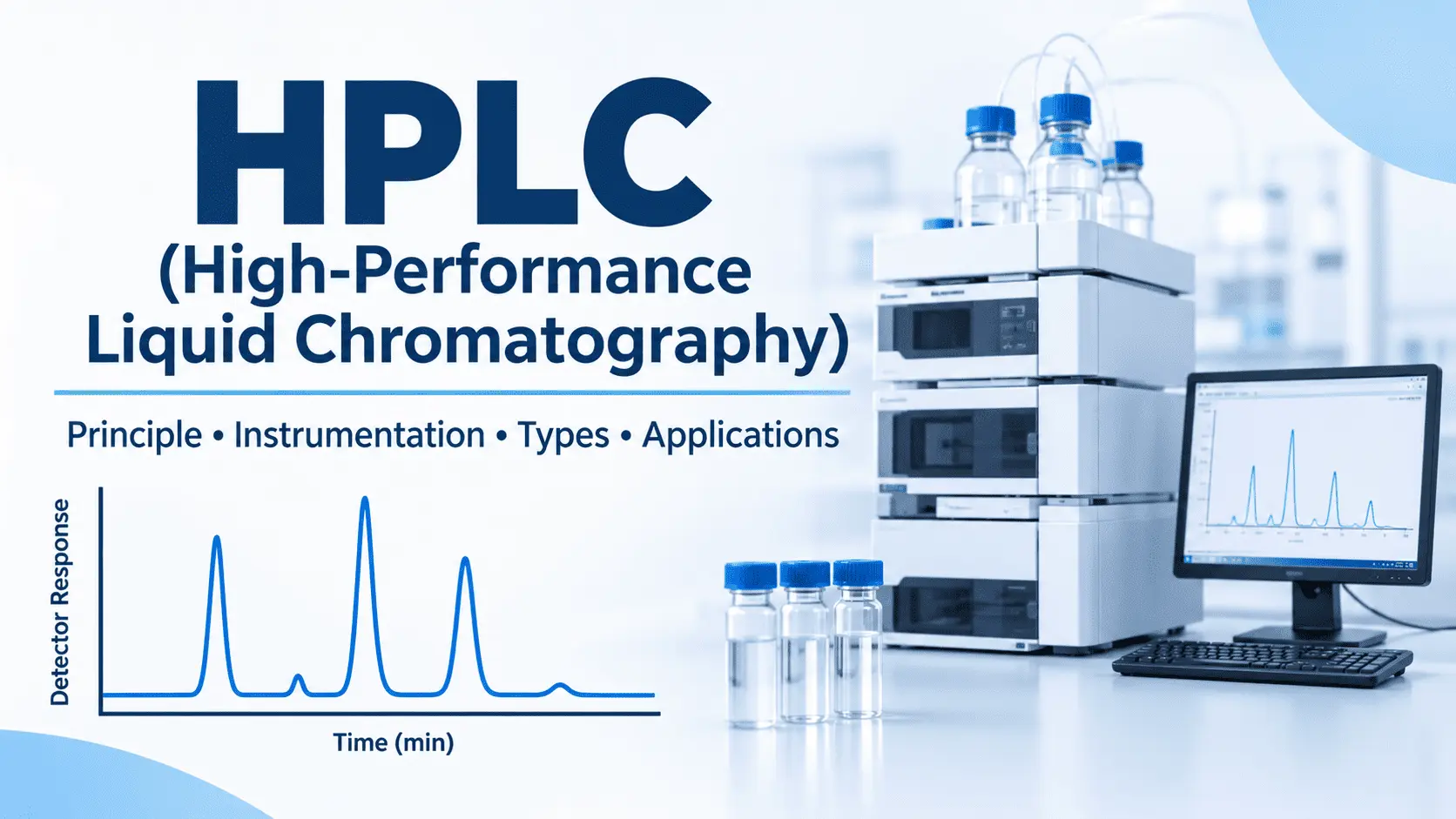
High-Performance Liquid Chromatography (HPLC) is one of the most widely used analytical techniques in modern biology, biochemistry, pharmaceutical sciences, and clinical laboratories. It is a powerful separation method that allows scientists to identify, separate, purify, and quantify individual compounds present in complex mixtures.
HPLC is particularly important when analyzing biological samples containing multiple substances, such as proteins, amino acids, peptides, hormones, vitamins, metabolites, and pharmaceutical compounds. By combining high-pressure pumping systems with specialized chromatographic columns and sensitive detectors, this technique provides excellent separation efficiency, reproducibility, and analytical accuracy.
Unlike conventional liquid chromatography, HPLC uses high-pressure pumps to force a liquid mobile phase through a column containing a stationary phase composed of finely packed particles. Differences in the interactions between sample components and these two phases cause compounds to travel through the column at different speeds, resulting in their separation.
This article explores the fundamental principle of HPLC, its instrumentation, different chromatographic modes, analytical procedures, and major applications in biological and biomedical sciences.
1. What Is HPLC (High-Performance Liquid Chromatography)?
Definition and Overview of HPLC
High-Performance Liquid Chromatography (HPLC) is a type of chromatography used to separate, identify, and quantify chemical compounds in a liquid sample.
The technique is based on the distribution of sample components between two phases:
- Mobile phase: A liquid solvent or mixture of solvents that transports the sample through the chromatographic system.
- Stationary phase: A solid material or chemically modified surface packed inside the chromatographic column.
When a sample enters the column, its components interact differently with the stationary phase. Compounds that interact strongly with the stationary phase generally move more slowly, whereas compounds with weaker interactions are transported more rapidly by the mobile phase.
These differences produce distinct retention times, allowing individual compounds to be detected and analyzed.
HPLC is commonly used for both qualitative analysis, which identifies compounds, and quantitative analysis, which determines their concentrations.
Principle of HPLC
The fundamental principle of HPLC is the separation of compounds according to their different interactions with the mobile and stationary phases.
The process begins when a liquid sample is injected into the flowing mobile phase. A high-pressure pump moves the mobile phase through the chromatographic column, carrying the sample components along with it.
Inside the column, each compound undergoes repeated interactions with the stationary phase and the mobile phase. Depending on its chemical properties, a compound may spend more time associated with one phase than the other.
As a result, different compounds travel through the column at different velocities.
For example, in reverse-phase HPLC, relatively hydrophobic compounds generally interact more strongly with the nonpolar stationary phase and therefore have longer retention times than highly polar compounds under comparable conditions.
The separated compounds eventually leave the column and pass through a detector, which generates a signal that is recorded as a chromatogram.
Main Components of HPLC Separation
The separation process depends on several important factors:
- Polarity: Influences the interactions between analytes and chromatographic phases.
- Molecular size: Particularly important in size-exclusion chromatography.
- Electrical charge: Determines separation in ion-exchange chromatography.
- Hydrophobicity: Influences retention in reverse-phase HPLC.
- Mobile-phase composition: Changes solvent strength and affects compound retention.
- pH: Influences the ionization state of many biological molecules.
Understanding these factors is essential for selecting appropriate chromatographic conditions and achieving efficient separation.
2. HPLC Instrumentation and Components
An HPLC system consists of several interconnected components that work together to deliver the mobile phase, introduce the sample, separate its components, and detect the resulting compounds.
Solvent Reservoir and Degassing System
The solvent reservoir contains the mobile phase used during chromatographic separation. Depending on the analytical method, the mobile phase may consist of a single solvent or a mixture of aqueous and organic solvents.
Common mobile-phase solvents include:
- Water
- Methanol
- Acetonitrile
- Phosphate buffers
- Formic acid solutions
Before entering the chromatographic system, solvents are generally filtered to remove particulate contaminants.
A degassing system removes dissolved gases from the mobile phase. Dissolved air can form bubbles inside the pump, detector, or flow system, potentially causing unstable pressure and baseline fluctuations.
Degassing is therefore important for maintaining reliable chromatographic performance.
HPLC Pump
The pump is responsible for delivering the mobile phase through the chromatographic column at a controlled flow rate and high pressure.
HPLC columns contain tightly packed particles that generate considerable resistance to liquid flow. The pump must therefore maintain sufficient pressure to move the mobile phase through the column.
Two major elution modes are used:
Isocratic elution: The composition of the mobile phase remains constant throughout the analysis. This approach is suitable for samples containing compounds with relatively similar retention characteristics.
Gradient elution: The mobile-phase composition changes during the analysis. For example, the proportion of an organic solvent may gradually increase to improve the elution of strongly retained compounds.
Gradient elution is particularly useful when analyzing complex mixtures containing compounds with widely different chemical properties.
Sample Injector
The injector introduces a precise volume of sample into the mobile-phase stream.
Modern HPLC systems commonly use automated injection systems called autosamplers. These devices can inject multiple samples sequentially, improving analytical reproducibility and reducing manual handling.
Before injection, samples are often filtered to remove particles that could block the column or damage the system.
HPLC Column and Stationary Phase
The chromatographic column is the central component responsible for separating sample constituents.
HPLC columns are usually made of stainless steel and packed with small particles containing the stationary phase.
Common stationary-phase materials include silica-based particles modified with different chemical groups.
Some widely used column types include:
- C18 columns: Contain octadecyl-bonded silica and are widely used in reverse-phase HPLC.
- C8 columns: Contain octyl-bonded silica and generally provide less hydrophobic retention than C18 columns.
- Phenyl columns: Provide additional aromatic interactions.
- Ion-exchange columns: Contain charged functional groups for separating ionic compounds.
Column dimensions, particle size, pore size, and stationary-phase chemistry all influence chromatographic performance.
HPLC Detectors and Data Acquisition
After separation, compounds pass through a detector that measures their presence based on specific physical or chemical properties.
Common HPLC detectors include:
UV-Visible detector: Measures the absorption of ultraviolet or visible light by compounds. It is widely used for analyzing pharmaceuticals, proteins, nucleotides, and other molecules containing light-absorbing groups.
Photodiode array (PDA/DAD) detector: Measures absorbance at multiple wavelengths simultaneously, providing additional spectral information that can help characterize compounds.
Fluorescence detector: Detects compounds that naturally fluoresce or have been chemically modified with fluorescent labels. It is particularly useful for highly sensitive analysis.
Refractive index detector: Measures differences in refractive index between the mobile phase and the sample components. It is useful for compounds that do not absorb UV light, such as certain sugars.
Mass spectrometry detector (LC-MS): Identifies compounds according to their mass-to-charge ratios. Coupling HPLC with mass spectrometry provides powerful analytical capabilities for metabolomics, proteomics, drug analysis, and biomarker research.
The detector generates signals that are processed by chromatography software to produce chromatograms and calculate analytical parameters.
3. Types and Modes of HPLC
Different HPLC modes are available depending on the properties of the molecules being separated and the interactions involved in the chromatographic process.
Normal-Phase HPLC
Normal-phase HPLC uses a polar stationary phase and a relatively nonpolar mobile phase.
The stationary phase is commonly composed of silica, while the mobile phase may contain solvents such as hexane or other relatively nonpolar organic solvents.
Compounds interact differently with the polar stationary phase depending on their polarity and functional groups.
More polar compounds generally interact more strongly with the stationary phase and are retained longer.
Normal-phase chromatography is particularly useful for separating certain lipids, isomers, and other compounds with different polarities.
Reverse-Phase HPLC (RP-HPLC)
Reverse-phase HPLC is one of the most widely used chromatographic techniques in analytical laboratories.
Unlike normal-phase chromatography, it uses a nonpolar stationary phase and a relatively polar mobile phase.
Common stationary phases include C18 and C8 chemically bonded silica particles.
The mobile phase typically consists of water or an aqueous buffer combined with an organic solvent such as methanol or acetonitrile.
Separation occurs mainly according to differences in hydrophobic interactions between analytes and the stationary phase.
Relatively hydrophobic compounds generally interact more strongly with the stationary phase and have longer retention times.
Reverse-phase HPLC is widely used in:
- Pharmaceutical analysis.
- Peptide and protein analysis.
- Vitamin quantification.
- Metabolite profiling.
- Environmental and food analysis.
Ion-Exchange HPLC
Ion-exchange HPLC separates compounds according to their electrical charge.
The stationary phase contains charged functional groups that interact with oppositely charged molecules.
Two major types are used:
- Cation-exchange chromatography: The stationary phase carries negatively charged groups that retain positively charged molecules.
- Anion-exchange chromatography: The stationary phase carries positively charged groups that retain negatively charged molecules.
The separation can be controlled by modifying the mobile-phase pH or ionic strength.
Ion-exchange HPLC is particularly useful for protein purification, amino acid analysis, and the separation of charged biological molecules.
Size-Exclusion HPLC
Size-exclusion chromatography separates molecules according to their size and hydrodynamic volume.
The stationary phase contains porous particles with pores of different sizes.
Large molecules cannot enter most of these pores and therefore travel through the column relatively quickly.
Smaller molecules enter the pores and follow longer pathways, resulting in longer retention times.
This technique is commonly used for protein characterization, molecular-weight distribution analysis, and polymer research.
Two important forms include:
- Gel filtration chromatography: Primarily used for separating biological molecules in aqueous solutions.
- Gel permeation chromatography: Commonly used for analyzing synthetic polymers in organic solvents.
Affinity HPLC and Other Separation Modes
Affinity chromatography uses highly specific biological interactions between a target molecule and a ligand attached to the stationary phase.
For example, an antibody may be used to selectively capture a specific antigen or protein.
Other specialized modes include hydrophilic interaction liquid chromatography (HILIC), which is useful for separating highly polar compounds, and chiral HPLC, which separates enantiomers.
These techniques expand the analytical applications of HPLC in biological and pharmaceutical research.
4. HPLC Procedure and Chromatographic Analysis
Successful HPLC analysis requires appropriate sample preparation, mobile-phase selection, chromatographic conditions, and interpretation of the resulting data.
Sample Preparation Before HPLC Analysis
Sample preparation is an essential step because biological and chemical samples may contain impurities that interfere with chromatographic separation.
Common preparation procedures include:
- Diluting samples to an appropriate concentration.
- Extracting target compounds from biological materials.
- Removing proteins through precipitation when necessary.
- Filtering samples using appropriate membrane filters.
- Centrifuging samples to remove suspended particles.
For example, plasma samples intended for drug analysis may require protein precipitation or solid-phase extraction before injection.
Proper sample preparation reduces contamination, protects the chromatographic column, and improves analytical reliability.
Preparation of the Mobile Phase
The mobile phase must be selected according to the chemical properties of the target compounds and the chromatographic mode.
In reverse-phase HPLC, commonly used mobile phases combine water or an aqueous buffer with methanol or acetonitrile.
Several factors must be considered:
- Solvent purity.
- Mobile-phase pH.
- Solvent compatibility.
- Ionic strength.
- Organic solvent concentration.
The mobile phase is generally filtered and degassed before use to prevent contamination and air bubbles.
HPLC Operating Procedure
A typical HPLC analysis follows several steps:
- Prepare and filter the mobile phase.
- Install the appropriate chromatographic column.
- Equilibrate the column using the selected mobile phase.
- Set the flow rate, detector wavelength, and other analytical parameters.
- Prepare and inject the sample.
- Allow the mobile phase to transport sample components through the column.
- Detect separated compounds and record the chromatogram.
- Analyze the chromatographic data.
The exact operating conditions depend on the sample type, column chemistry, detector, and analytical objective.
Interpretation of HPLC Chromatograms
A chromatogram is a graphical representation of detector response as a function of time or elution volume.
Each peak generally corresponds to a compound detected during the analysis.
Several parameters are important when interpreting chromatograms:
Retention time: The time required for a compound to travel through the column and reach the detector. It can help identify compounds by comparison with reference standards analyzed under identical conditions.
Peak area: Represents the integrated detector response and is commonly used for quantitative analysis.
Peak height: Measures the maximum signal intensity of a chromatographic peak.
Resolution: Indicates how effectively two neighboring compounds are separated.
Peak symmetry: Provides information about chromatographic peak shape. Tailing and fronting may indicate problems with column performance, sample loading, or analytical conditions.
For quantitative analysis, calibration curves are commonly prepared using reference standards with known concentrations. The peak area of an unknown sample is then compared with the calibration curve to determine its concentration.
5. Applications, Advantages, and Limitations of HPLC
HPLC has become an essential analytical technique across biological research, clinical diagnostics, pharmaceutical development, and industrial quality control.
Applications of HPLC in Biology and Biochemistry
In biological sciences, HPLC is widely used to analyze and characterize different classes of biomolecules.
Important applications include:
- Protein analysis: Separation and purification of proteins according to their chemical properties.
- Peptide analysis: Identification and quantification of peptides in biological samples.
- Amino acid analysis: Determination of amino acid composition in proteins and biological fluids.
- Lipid analysis: Separation and characterization of different lipid molecules.
- Vitamin analysis: Quantification of vitamins in biological samples and food products.
- Metabolomics: Analysis of small molecules and metabolic intermediates.
When coupled with mass spectrometry, HPLC becomes particularly valuable for identifying complex mixtures of metabolites and other biological compounds.
Applications in Medical and Clinical Laboratories
HPLC has several important applications in laboratory medicine and clinical diagnostics.
One major application is hemoglobin analysis, particularly the identification and quantification of different hemoglobin fractions.
HPLC can help detect abnormal hemoglobin variants associated with hemoglobinopathies, including sickle cell disease and thalassemias.
Other clinical applications include:
- Therapeutic drug monitoring.
- Measurement of vitamins and metabolic compounds.
- Analysis of hormones and steroid metabolites.
- Detection of drugs and toxic substances.
- Investigation of metabolic disorders.
For example, HPLC is commonly used to quantify hemoglobin A1c (HbA1c), an important biomarker for monitoring long-term blood glucose control in patients with diabetes.
Applications in Pharmaceutical and Food Industries
In pharmaceutical laboratories, HPLC is routinely used throughout drug development and manufacturing.
Its applications include:
- Determination of drug concentration.
- Assessment of pharmaceutical purity.
- Detection of degradation products and impurities.
- Stability testing of pharmaceutical formulations.
- Quality control of finished products.
In the food industry, HPLC is used to measure vitamins, preservatives, additives, organic acids, and other nutritional compounds.
These applications help ensure product quality, safety, and compliance with analytical standards.
Advantages of HPLC
HPLC offers several advantages that make it a preferred analytical technique:
- High separation efficiency: Allows the separation of complex mixtures containing multiple compounds.
- High sensitivity: Enables the detection and quantification of compounds at relatively low concentrations, depending on the detector and method.
- Reproducibility: Provides consistent analytical results when methods are properly developed and validated.
- Versatility: Different chromatographic modes allow the analysis of a broad range of chemical and biological compounds.
- Quantitative capability: Enables accurate determination of compound concentrations using appropriate calibration procedures.
- Automation: Modern systems support automated sample injection and data processing.
Limitations of HPLC
Despite its advantages, HPLC also presents some limitations.
First, HPLC instruments and their maintenance can be expensive, particularly when advanced detectors such as mass spectrometers are used.
Second, the technique requires high-purity solvents and careful preparation of mobile phases. Solvent consumption can also generate considerable chemical waste.
Sample preparation may be time-consuming, especially when analyzing complex biological matrices.
Finally, developing an effective HPLC method requires technical knowledge and optimization of several parameters, including mobile-phase composition, flow rate, column chemistry, and detection conditions.
Conclusion
High-Performance Liquid Chromatography (HPLC) is a powerful analytical technique used to separate, identify, and quantify compounds in complex mixtures. Its principle relies on differences in interactions between sample components, the mobile phase, and the stationary phase.
With its specialized instrumentation, multiple separation modes, and compatibility with different detection systems, HPLC has become indispensable in biological research, biochemistry, clinical diagnostics, and pharmaceutical analysis.
From protein purification and metabolite profiling to hemoglobin analysis and drug quality control, HPLC provides reliable analytical information that supports scientific research and medical laboratory investigations.


, including its principle, instrumentation, types, procedure, and applications in biology and medicine.)