

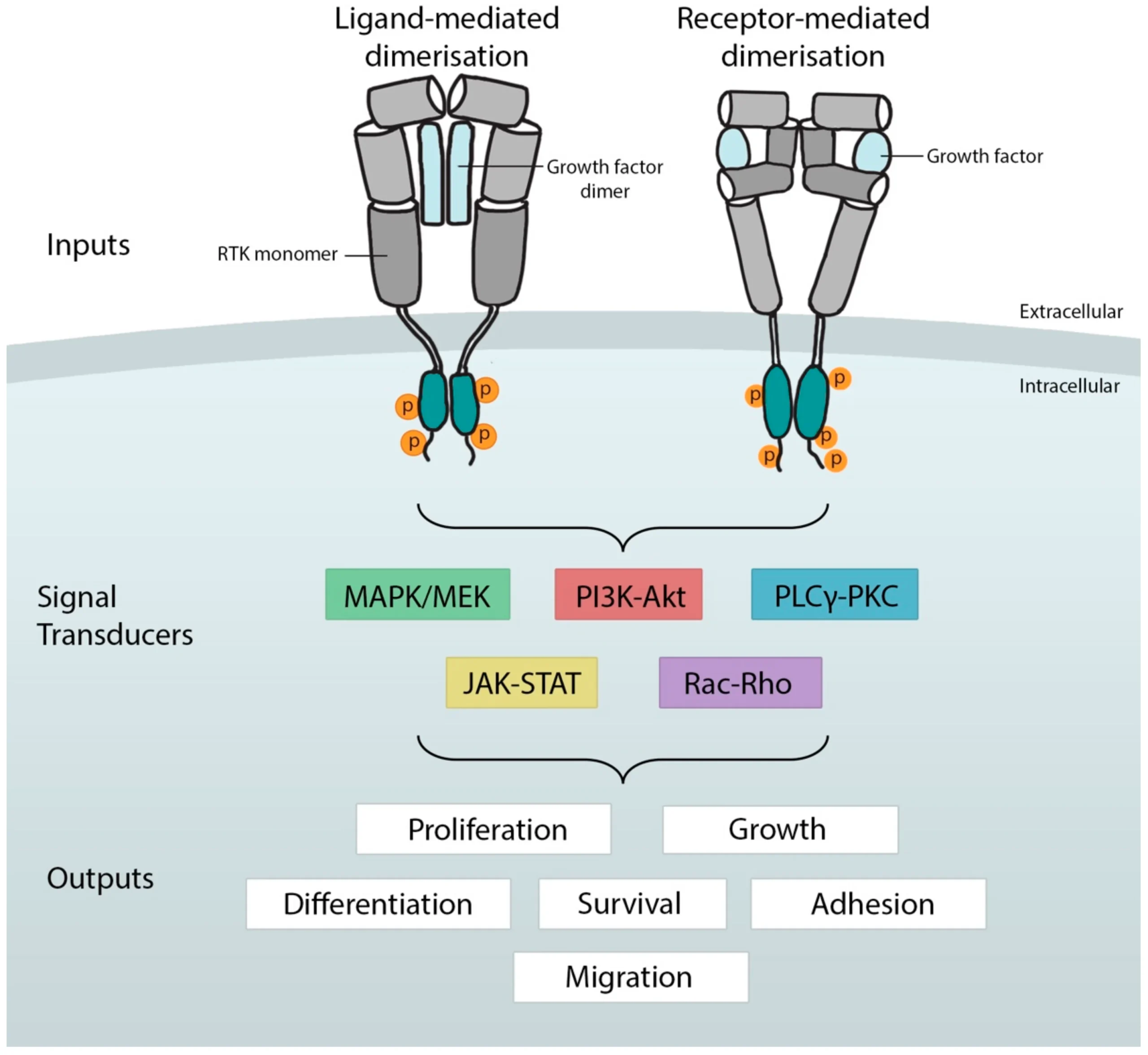
Cells constantly receive information from their environment — nutrients, growth factors, hormones, and signals from neighboring cells. To interpret these cues, they rely on specialized membrane proteins known as receptors. Among the most important of these are Receptor Tyrosine Kinases (RTKs), a major class of cell surface receptors that directly convert extracellular signals into intracellular biochemical responses.
RTKs play central roles in normal cell physiology, including cell growth, differentiation, metabolism, survival, and tissue organization. Unlike G-protein–coupled receptors (GPCRs), which signal through heterotrimeric G proteins, RTKs possess intrinsic enzymatic activity. When activated, they phosphorylate specific tyrosine residues, initiating highly coordinated signal transduction pathways inside the cell.
In this article, we will explore:
- The structural organization of receptor tyrosine kinases
- The molecular mechanism of ligand-induced activation
- The major downstream signaling pathways triggered by RTKs
- The mechanisms that regulate and terminate RTK signaling
1. Structural Organization of Receptor Tyrosine Kinases
Receptor tyrosine kinases are single-pass transmembrane proteins with a conserved structural design that allows them to detect extracellular signals and transmit them across the plasma membrane.
General Architecture
Despite diversity among family members, RTKs share three fundamental domains:
- Extracellular ligand-binding domain
- Single transmembrane α-helix
- Intracellular tyrosine kinase domain
This modular organization enables precise signal recognition and catalytic activation.
The Extracellular Domain
The extracellular portion of RTKs is responsible for ligand recognition. It varies significantly between receptor families, allowing specificity for different signaling molecules such as growth factors, peptide hormones, or cytokines.
For example:
- Epidermal Growth Factor Receptor contains multiple ligand-binding subdomains that undergo conformational rearrangement upon ligand binding.
- Fibroblast Growth Factor Receptor includes immunoglobulin-like domains that mediate interaction with fibroblast growth factors.
- Insulin Receptor exists as a pre-formed dimer linked by disulfide bonds and undergoes structural rearrangement after insulin binding.
The diversity of extracellular domains ensures that each RTK family responds selectively to its appropriate extracellular ligand.
The Transmembrane Domain
The transmembrane region is typically a single α-helical segment that anchors the receptor in the lipid bilayer. Though structurally simple, it plays an essential role in transmitting conformational changes from the extracellular region to the intracellular kinase domain.
Ligand-induced dimerization often stabilizes specific interactions between transmembrane helices, contributing to receptor activation.
The Intracellular Tyrosine Kinase Domain
The cytoplasmic domain contains the catalytic core responsible for transferring phosphate groups from ATP to tyrosine residues.
Key structural features include:
- ATP-binding pocket
- Catalytic loop
- Activation loop (A-loop)
- Multiple tyrosine residues available for phosphorylation
In the inactive state, the activation loop often blocks substrate access. Upon activation, phosphorylation of specific tyrosine residues induces conformational changes that fully activate the kinase.
Major RTK Families
Receptor tyrosine kinases are grouped into multiple families based on structural similarities. Examples include:
- Platelet-Derived Growth Factor Receptor
- Epidermal Growth Factor Receptor
- Fibroblast Growth Factor Receptor
- Insulin Receptor
Although structurally related, each family exhibits distinct ligand specificity and physiological functions.
2. Ligand Binding and RTK Activation Mechanism
The defining feature of receptor tyrosine kinases is their ability to become enzymatically active upon ligand binding.
Inactive State
In the absence of ligand, most RTKs exist as monomers distributed across the plasma membrane. Their kinase domains are inactive due to structural constraints that prevent catalytic activity.
Some receptors, such as the insulin receptor, exist as pre-formed dimers but remain inactive until ligand binding induces conformational change.
Ligand-Induced Dimerization
The first critical step in RTK activation is ligand binding to the extracellular domain. This triggers:
- Receptor dimerization (homodimers or heterodimers)
- Alignment of intracellular kinase domains
- Structural rearrangements that relieve autoinhibition
Dimerization brings the cytoplasmic kinase domains into close proximity, enabling cross-activation.
Trans-Autophosphorylation
Once aligned, the kinase domains phosphorylate each other on specific tyrosine residues. This process is known as trans-autophosphorylation.
Autophosphorylation occurs in two stages:
- Phosphorylation within the activation loop increases catalytic activity.
- Additional tyrosine residues in the cytoplasmic tail are phosphorylated to create docking sites.
These phosphotyrosines serve as molecular “switches” that recruit intracellular signaling proteins.
Creation of Docking Platforms
Phosphorylated tyrosines are recognized by intracellular proteins containing:
- SH2 (Src Homology 2) domains
- PTB (Phosphotyrosine-binding) domains
These adaptor and signaling proteins bind specifically to phosphotyrosine motifs, assembling large signaling complexes at the plasma membrane.
This step initiates signal amplification, as one activated receptor can recruit multiple downstream effectors.
3. Downstream Signaling Pathways Activated by RTKs
Once activated, RTKs function as central hubs that connect extracellular stimuli to diverse intracellular responses. Several major pathways are commonly activated.
The MAPK/ERK Pathway
One of the most well-characterized cascades downstream of RTKs is the MAPK/ERK pathway.
Steps include:
- Recruitment of adaptor protein Grb2
- Activation of SOS (a guanine nucleotide exchange factor)
- Activation of Ras (a small GTPase)
- Sequential activation of Raf → MEK → ERK
Activated ERK translocates into the nucleus, where it regulates transcription factors and influences gene expression.
This pathway is essential for regulating cell proliferation, differentiation, and developmental processes in normal physiology.
The PI3K–Akt Pathway
Another major pathway is the PI3K–Akt signaling pathway.
Upon receptor activation:
- PI3K binds to phosphotyrosines via its SH2 domain
- PI3K converts PIP2 into PIP3 in the plasma membrane
- PIP3 recruits Akt (Protein Kinase B)
- Akt becomes phosphorylated and activated
Activated Akt regulates metabolic enzymes, protein synthesis, and cell survival mechanisms.
This pathway is particularly important in coordinating nutrient sensing and metabolic homeostasis.
The PLCγ Pathway
RTKs can also activate phospholipase C gamma (PLCγ).
Mechanism:
- PLCγ binds to phosphorylated RTKs
- It cleaves PIP2 into:
- IP3 (Inositol 1,4,5-trisphosphate)
- DAG (Diacylglycerol)
IP3 stimulates calcium release from the endoplasmic reticulum, while DAG activates Protein Kinase C (PKC). Together, these second messengers regulate numerous cellular processes, including cytoskeletal rearrangement and secretion.
Signal Specificity and Integration
Although many RTKs activate similar pathways, cellular responses differ depending on:
- Cell type
- Receptor expression levels
- Duration of signaling
- Crosstalk with other receptor systems
For example, sustained ERK activation may produce different outcomes compared to transient activation. This highlights how RTKs function not merely as on/off switches but as integrators of complex cell signaling networks.
4. Regulation and Termination of RTK Signaling
Precise regulation is essential to maintain cellular homeostasis. Cells use multiple mechanisms to ensure RTK signaling remains controlled.
Receptor Endocytosis
After activation, many RTKs are internalized through clathrin-mediated endocytosis.
Internalization can lead to:
- Signal attenuation
- Receptor recycling back to the membrane
- Continued signaling from endosomal compartments
Endosomes can serve as secondary signaling platforms, adding another layer of regulation.
Dephosphorylation by Protein Tyrosine Phosphatases
Protein tyrosine phosphatases (PTPs) remove phosphate groups from activated receptors.
This reverses autophosphorylation and terminates signaling. The balance between kinase and phosphatase activity determines signaling intensity.
Ubiquitination and Degradation
Activated receptors can be tagged with ubiquitin, marking them for degradation in lysosomes.
This ensures:
- Removal of excess receptors
- Prevention of prolonged signaling
- Maintenance of receptor homeostasis
Feedback Inhibition
Cells also employ negative feedback mechanisms:
- Induction of inhibitory proteins
- Competitive adaptor binding
- Activation of phosphatases
These mechanisms create tightly regulated signaling dynamics that maintain physiological balance.
Conclusion
Receptor tyrosine kinases are central regulators of cellular communication. Their modular structure — consisting of an extracellular ligand-binding domain, a single transmembrane helix, and an intracellular tyrosine kinase domain — allows them to translate extracellular cues into precise intracellular responses.
Activation occurs through ligand-induced dimerization, followed by trans-autophosphorylation, which generates docking sites for intracellular signaling proteins. RTKs then activate major pathways such as:
- MAPK/ERK
- PI3K–Akt
- PLCγ
These cascades regulate essential biological processes including cell growth, differentiation, metabolism, and survival in normal cells.
Equally important are the mechanisms that regulate and terminate signaling, including receptor endocytosis, dephosphorylation, ubiquitination, and feedback inhibition. Together, these systems ensure that RTK activity remains tightly controlled and integrated within broader cellular signaling networks.
References
Textbooks
- Alberts, B., Johnson, A., Lewis, J., Morgan, D., Raff, M., Roberts, K., & Walter, P. (2022). Molecular biology of the cell (7th ed.). Garland Science.
- Cooper, G. M., & Hausman, R. E. (2019). The cell: A molecular approach (8th ed.). Sinauer Associates.
- Karp, G. (2021). Cell and molecular biology: Concepts and experiments (9th ed.). Wiley.
- Lodish, H., Berk, A., Kaiser, C. A., Krieger, M., Bretscher, A., Ploegh, H., Amon, A., & Scott, M. P. (2021). Molecular cell biology (9th ed.). W. H. Freeman.
Review Articles
- Lemmon, M. A., & Schlessinger, J. (2010). Cell signaling by receptor tyrosine kinases. Cell, 141(7), 1117–1134. https://doi.org/10.1016/j.cell.2010.06.011
- Schlessinger, J. (2000). Cell signaling by receptor tyrosine kinases. Cell, 103(2), 211–225. https://doi.org/10.1016/S0092-8674(00)00114-8
- Hubbard, S. R., & Till, J. H. (2000). Protein tyrosine kinase structure and function. Annual Review of Biochemistry, 69, 373–398. https://doi.org/10.1146/annurev.biochem.69.1.373
- Manning, G., Whyte, D. B., Martinez, R., Hunter, T., & Sudarsanam, S. (2002). The protein kinase complement of the human genome. Science, 298(5600), 1912–1934. https://doi.org/10.1126/science.1075762
- Downward, J. (2001). The ins and outs of signalling. Nature, 411(6839), 759–762. https://doi.org/10.1038/35081138
Receptor tyrosine kinases (RTKs) are transmembrane cell surface receptors that bind growth factors and other signaling molecules. They function as enzymes that phosphorylate tyrosine residues on proteins, initiating intracellular signaling pathways.
RTKs are activated when a ligand binds to the extracellular domain of the receptor, causing receptor dimerization and activation of their kinase domains. This leads to autophosphorylation of tyrosine residues and recruitment of signaling proteins that transmit the signal inside the cell.
RTKs regulate key cellular processes such as cell growth, proliferation, differentiation, metabolism, and survival by activating multiple intracellular signaling pathways.


 function in cell signaling. Explore RTK structure, ligand-induced dimerization, autophosphorylation, and key pathways.)