

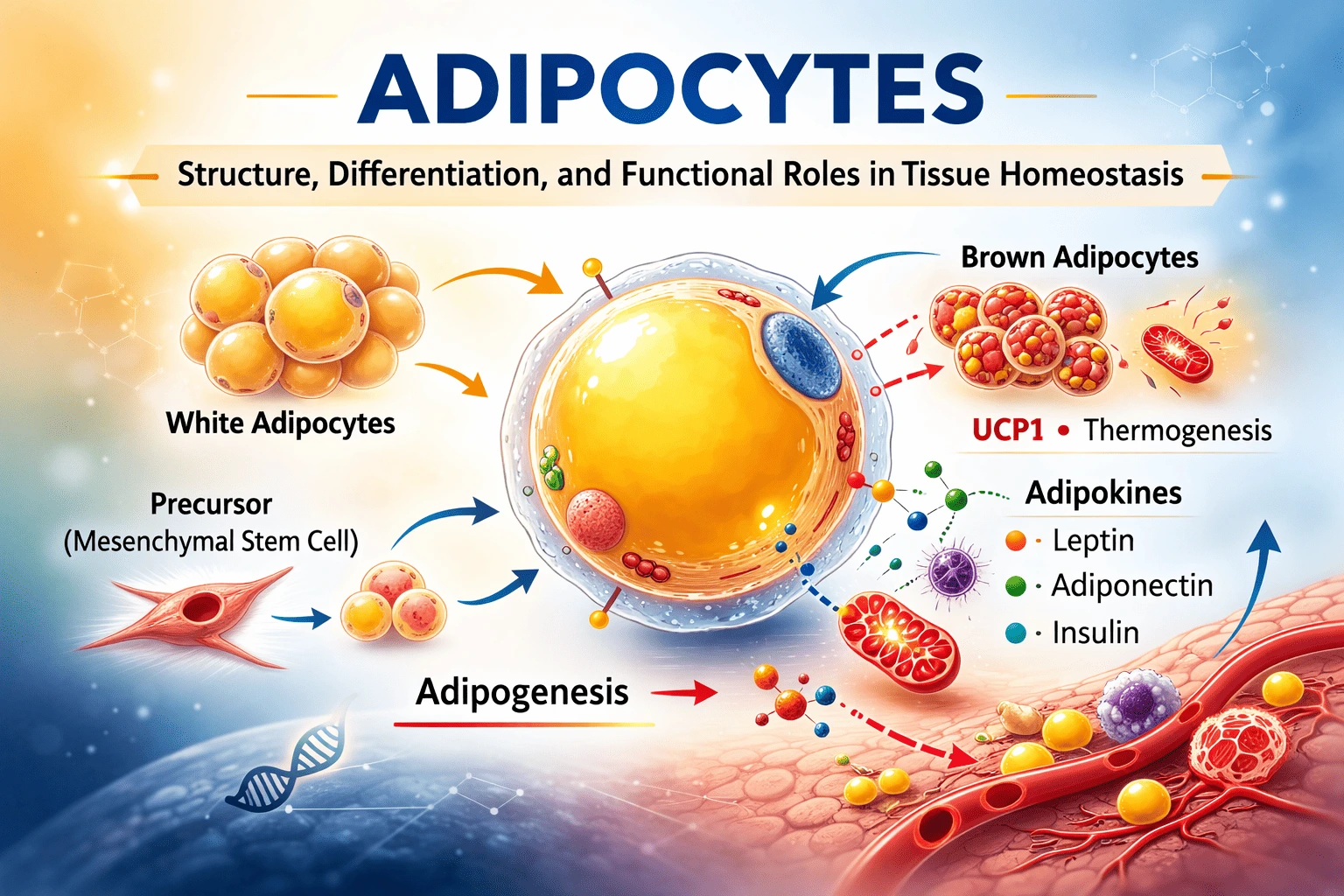
Adipocytes are specialized cells primarily known for storing lipids in the form of triglycerides. For decades, adipose tissue was viewed as a passive reservoir of energy, expanding and shrinking according to caloric intake. However, modern cell biology has fundamentally reshaped this perspective. Adipocytes are now recognized as highly active endocrine and metabolic cells that regulate systemic energy balance, inflammation, and tissue remodeling.
Derived from mesenchymal stem cells, adipocytes populate distinct adipose depots throughout the body. These depots are not uniform; instead, they contain different adipocyte subtypes with specialized functions, including white, brown, and beige adipocytes. Beyond energy storage, adipocytes communicate extensively with neighboring cells—such as endothelial cells, fibroblasts, immune cells, and even cancer cells—through secreted factors and extracellular vesicles.
Dysregulation of adipocyte biology contributes to metabolic disorders, chronic inflammation, fibrosis, and tumor progression.
This article explores:
- The structural organization of adipocytes
- The process of adipocyte differentiation (adipogenesis)
- Their functional roles in tissue homeostasis
- Mechanisms of adipocyte dysfunction and remodeling
1. Structural Organization of Adipocytes
1.1 Morphology of White Adipocytes
White adipocytes are the most abundant adipocyte subtype in adult humans. They are characterized by:
- A single, large unilocular lipid droplet occupying most of the cell volume
- A thin rim of cytoplasm
- A flattened, peripherally displaced nucleus
- Relatively few mitochondria
The large lipid droplet compresses other organelles toward the cell periphery, giving white adipocytes their characteristic “signet ring” appearance under microscopy. These cells are highly efficient at storing energy and can expand significantly during periods of caloric excess.
1.2 Brown and Beige Adipocytes
Brown adipocytes differ structurally and functionally from white adipocytes. They contain:
- Multiple small lipid droplets (multilocular)
- A centrally located nucleus
- A high density of mitochondria
The mitochondria in brown adipocytes express uncoupling protein 1 (UCP1), which allows proton leakage across the inner mitochondrial membrane. Instead of producing ATP, the energy from oxidative phosphorylation is released as heat—a process known as non-shivering thermogenesis.
Beige adipocytes are inducible thermogenic cells that arise within white adipose depots under specific stimuli such as cold exposure. They share features with both white and brown adipocytes, demonstrating the plasticity of adipose tissue.
1.3 Lipid Droplet Biology
The lipid droplet is the defining organelle of adipocytes. Far from being a passive fat depot, it is a dynamic structure composed of:
- A core of neutral lipids (triglycerides and cholesteryl esters)
- A phospholipid monolayer membrane
- Associated regulatory proteins, including perilipins
Perilipins regulate lipid mobilization by controlling access of lipases to stored triglycerides. Under basal conditions, lipid droplets remain stable. During energy demand, lipases are activated, leading to triglyceride breakdown (lipolysis).
1.4 Adipose Tissue Microenvironment
Adipocytes are embedded in a highly organized microenvironment consisting of:
- Extracellular matrix (ECM) proteins such as collagen and fibronectin
- A dense vascular network
- Fibroblasts and immune cells
Vascularization is essential because adipose tissue requires oxygen and nutrient supply proportional to its metabolic activity. Close interactions between adipocytes and endothelial cells regulate tissue expansion and remodeling. ECM composition also influences adipocyte size, mechanical stress, and metabolic function.
2. Adipocyte Differentiation (Adipogenesis)
2.1 Origin from Mesenchymal Stem Cells
Adipocytes originate from mesenchymal stem cells (MSCs), multipotent progenitors capable of differentiating into adipocytes, osteoblasts, or chondrocytes. Commitment to the adipogenic lineage produces preadipocytes, which undergo growth arrest and clonal expansion before terminal differentiation.
This early commitment stage is tightly regulated and determines adipose tissue expansion capacity.
2.2 Transcriptional Regulation
Adipogenesis is orchestrated by a well-defined transcriptional cascade. The master regulator is:
- Peroxisome proliferator-activated receptor gamma (PPARγ)
PPARγ activation induces expression of adipocyte-specific genes involved in lipid metabolism and insulin sensitivity. Members of the CCAAT/enhancer-binding protein (C/EBP) family cooperate with PPARγ to establish the adipocyte phenotype.
The sequential activation of these transcription factors ensures coordinated cellular remodeling.
2.3 Cellular Remodeling During Differentiation
As preadipocytes differentiate:
- Cytoskeletal organization changes
- Lipid droplets begin to accumulate
- Mitochondrial content adapts
- Gene expression profiles shift dramatically
These structural and metabolic adjustments transform fibroblast-like precursors into lipid-filled adipocytes capable of endocrine signaling.
2.4 Browning and Plasticity
Adipose tissue demonstrates remarkable plasticity. Under environmental stimuli such as cold exposure, certain white adipocytes acquire thermogenic features, becoming beige adipocytes. This browning process involves mitochondrial biogenesis and induction of thermogenic genes.
Plasticity allows adipose tissue to adapt to systemic energy demands.
3. Functional Roles of Adipocytes in Tissue Homeostasis
3.1 Energy Storage and Lipid Metabolism
Adipocytes serve as the body’s primary energy reservoir. In the fed state:
- Insulin stimulates glucose uptake
- Triglyceride synthesis is enhanced
- Lipid storage increases
During fasting or stress:
- Catecholamines activate lipolysis
- Free fatty acids are released into circulation
- Energy substrates become available for other tissues
This dynamic regulation ensures metabolic flexibility.
3.2 Endocrine Functions
Adipocytes secrete numerous bioactive molecules known as adipokines. These include:
- Leptin – regulates appetite and energy expenditure
- Adiponectin – enhances insulin sensitivity and has anti-inflammatory effects
- Resistin – associated with insulin resistance
Through adipokine secretion, adipocytes influence systemic metabolism, inflammation, and vascular function. Thus, adipose tissue acts as an endocrine organ.
3.3 Adipocyte–Immune Cell Interaction
Adipose tissue contains resident immune cells, including macrophages. Under physiological conditions, adipocytes and immune cells maintain balanced communication.
In metabolic stress, adipocytes produce pro-inflammatory cytokines, leading to macrophage recruitment. This interaction can shift the tissue toward a chronic low-grade inflammatory state.
3.4 Crosstalk with Other Cell Types
Adipocytes interact closely with:
- Endothelial cells (angiogenesis and vascular remodeling)
- Fibroblasts (ECM deposition)
- Cancer cells (metabolic support)
Through direct contact and secreted factors—including extracellular vesicles—adipocytes influence neighboring cell behavior and tissue architecture.
4. Adipocyte Dysfunction and Tissue Remodeling
4.1 Hypertrophy and Hyperplasia
Adipose tissue expands through:
- Hypertrophy – enlargement of existing adipocytes
- Hyperplasia – formation of new adipocytes
Excessive hypertrophy increases mechanical stress and disrupts cellular homeostasis. Large adipocytes are more prone to hypoxia and metabolic dysfunction.
4.2 Inflammation and Oxidative Stress
Chronic energy excess induces:
- Reactive oxygen species (ROS) production
- Increased pro-inflammatory cytokines
- Immune cell infiltration
This chronic low-grade inflammation contributes to insulin resistance and systemic metabolic disturbances.
4.3 Fibrosis and Extracellular Matrix Remodeling
Adipose tissue remodeling involves changes in ECM composition. Excess collagen deposition leads to fibrosis, which:
- Reduces tissue elasticity
- Impairs vascularization
- Limits adipocyte expansion
Fibrosis exacerbates metabolic dysfunction and compromises tissue adaptability.
4.4 Cancer-Associated Adipocytes
In the tumor microenvironment, adipocytes undergo metabolic reprogramming. Cancer-associated adipocytes display:
- Reduced lipid content
- Increased inflammatory signaling
- Enhanced lipolysis
They can transfer fatty acids to cancer cells, providing metabolic substrates that support tumor growth and invasion. This highlights the importance of adipocyte–tumor interactions in cancer progression.
Conclusion
Adipocytes are dynamic, multifunctional cells that extend far beyond their traditional role as fat storage units. Structurally specialized with large lipid droplets and adaptable metabolic machinery, they regulate systemic energy balance and endocrine signaling.
Through adipogenesis and cellular plasticity, adipose tissue adapts to environmental and metabolic changes. However, dysregulation of adipocyte biology leads to inflammation, fibrosis, and metabolic disease. In pathological contexts such as cancer, adipocytes actively participate in tumor–stromal interactions and tissue remodeling.
References
Textbooks
- Alberts, B., Johnson, A., Lewis, J., Morgan, D., Raff, M., Roberts, K., & Walter, P. (2022). Molecular Biology of the Cell (7th ed.). Garland Science.
- Lodish, H., Berk, A., Kaiser, C. A., Krieger, M., Bretscher, A., Ploegh, H., & Amon, A. (2021). Molecular Cell Biology (9th ed.). W. H. Freeman.
- Mescher, A. L. (2021). Junqueira’s Basic Histology: Text & Atlas (16th ed.). McGraw-Hill Education.
- Ross, M. H., & Pawlina, W. (2020). Histology: A Text and Atlas (8th ed.). Wolters Kluwer.
- Kumar, V., Abbas, A. K., & Aster, J. C. (2021). Robbins & Cotran Pathologic Basis of Disease (10th ed.). Elsevier.
Review Articles
- Rosen, E. D., & Spiegelman, B. M. (2014). What we talk about when we talk about fat. Cell, 156(1–2), 20–44. https://doi.org/10.1016/j.cell.2013.12.012
- Rosen, E. D., & MacDougald, O. A. (2006). Adipocyte differentiation from the inside out. Nature Reviews Molecular Cell Biology, 7(12), 885–896. https://doi.org/10.1038/nrm2066
- Kajimura, S., Spiegelman, B. M., & Seale, P. (2015). Brown and beige fat: Physiological roles beyond heat generation. Cell Metabolism, 22(4), 546–559. https://doi.org/10.1016/j.cmet.2015.09.007
- Sun, K., Tordjman, J., Clément, K., & Scherer, P. E. (2013). Fibrosis and adipose tissue dysfunction. Cell Metabolism, 18(4), 470–477. https://doi.org/10.1016/j.cmet.2013.06.016
- Dirat, B., Bochet, L., Dabek, M., et al. (2011). Cancer-associated adipocytes exhibit an activated phenotype and contribute to breast cancer invasion. Cancer Research, 71(7), 2455–2465. https://doi.org/10.1158/0008-5472.CAN-10-3323
- Blüher, M. (2019). Obesity: Global epidemiology and pathogenesis. Nature Reviews Endocrinology, 15(5), 288–298. https://doi.org/10.1038/s41574-019-0176-8
- Lee, Y.-H., Petkova, A. P., & Granneman, J. G. (2013). Identification of an adipogenic niche for adipose tissue remodeling and restoration. Cell Metabolism, 18(3), 355–367. https://doi.org/10.1016/j.cmet.2013.08.003
Adipose tissue is a specialized connective tissue composed mainly of adipocytes (fat cells) that stores energy in the form of lipids and functions as an endocrine organ regulating metabolism.
Adipocytes are primarily found in subcutaneous tissue beneath the skin and in visceral fat surrounding internal organs. They are also present in bone marrow and other specialized fat depots.
Adipocytes store energy as triglycerides, provide thermal insulation and mechanical protection, and secrete hormones such as leptin and adiponectin that regulate metabolism and inflammation.
The main types of adipocytes are white adipocytes (energy storage), brown adipocytes (heat production), and beige adipocytes (thermogenic cells that can develop within white fat depots).


