

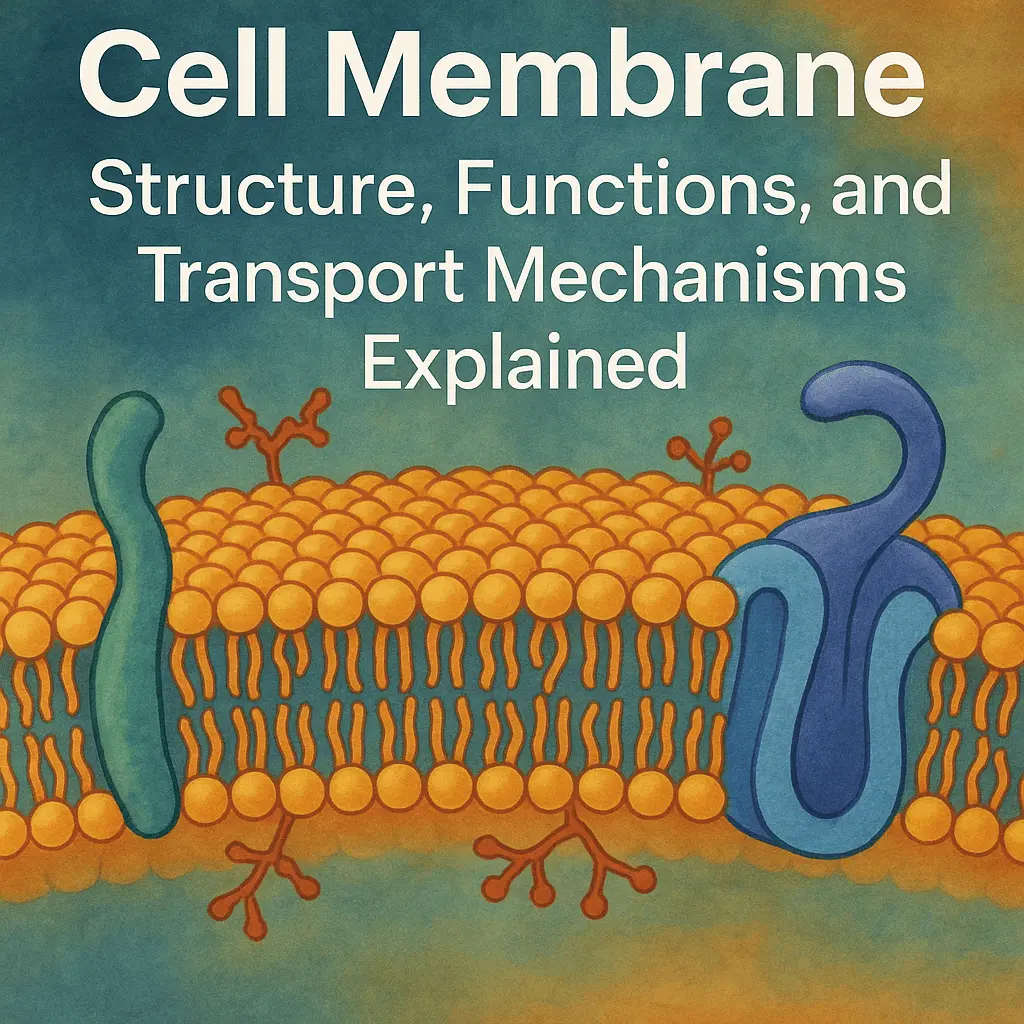
The cell membrane—also called the plasma membrane—is a thin, flexible barrier that surrounds every living cell. It protects the cell, regulates the movement of substances, and allows communication with the environment. Its structure is dynamic, enabling the cell to maintain balance and respond to change.
In this post, we’ll briefly review its structure, main functions, transport mechanisms, and how the membrane adapts to support cell activity.
I. Structure of the Cell Membrane
The structure of the cell membrane is best described by the fluid mosaic model, a concept that highlights its flexible nature and the diverse components embedded within it. Rather than being a rigid wall, the membrane behaves like a dynamic, semi-fluid sheet where lipids and proteins move laterally, allowing the cell to adapt to various conditions.
1. The Phospholipid Bilayer: The Foundation of the Membrane
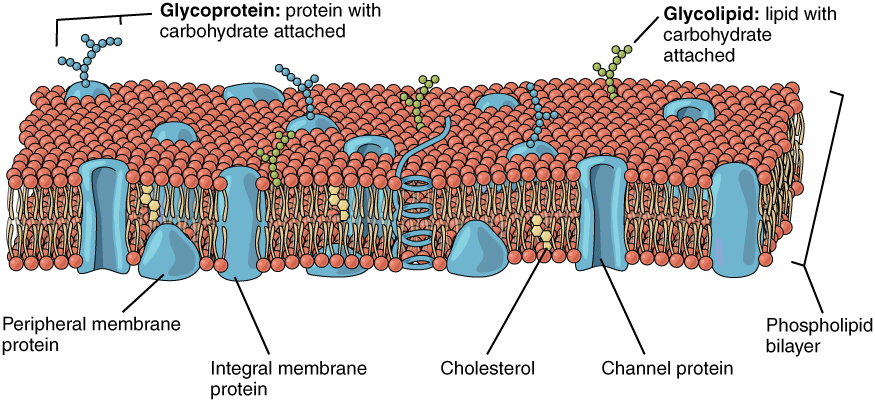
At the core of the membrane lies the phospholipid bilayer, composed of molecules with a hydrophilic “head” and two hydrophobic “tails.” In water-based environments, phospholipids naturally arrange themselves with their heads facing outward toward the watery surroundings and their tails pointing inward, away from water.
This arrangement forms a stable but flexible barrier that:
- Separates the internal environment from the external one
- Prevents random movement of most water-soluble substances
- Creates a fluid platform for membrane proteins
The bilayer’s fluidity depends on factors like fatty acid composition and temperature, which influence how tightly phospholipids pack together.
2. Membrane Proteins: Gatekeepers and Communicators
Proteins are essential components of the membrane, accounting for roughly half of its mass. They are classified into two types:
- Integral (transmembrane) proteins: Span across the bilayer and are firmly embedded. They function as channels, transporters, receptors, and enzymes.
- Peripheral proteins: Attach loosely to the membrane surface, playing roles in cell signaling, structural support, and interaction with the cytoskeleton.
These proteins give the membrane much of its functional diversity, allowing the cell to sense and respond to its environment.
3. Cholesterol: Regulator of Membrane Fluidity
Cholesterol molecules are interspersed among phospholipids, especially in animal cells. Their role is crucial for:
- Maintaining fluidity: Preventing the membrane from becoming too rigid at low temperatures
- Preventing excessive permeability: Restricting the movement of phospholipids at high temperatures
By balancing fluidity and stability, cholesterol ensures the membrane remains functional under varying conditions.
4. Carbohydrates and the Glycocalyx
Carbohydrates are attached to proteins (forming glycoproteins) or lipids (forming glycolipids) on the extracellular surface. Together they form the glycocalyx, a sugar-rich coating that:
- Facilitates cell–cell recognition
- Protects cells from mechanical and chemical damage
- Helps immune cells distinguish “self” from “non-self”
- Assists in cell adhesion
This carbohydrate layer is essential for communication and interaction between cells and their environment.
II – Key Functions of the Cell Membrane
The cell membrane is far more than a simple boundary—it is an active and highly organized interface that enables the cell to survive, communicate, and function within its environment. Its structure equips it with several essential biological functions that support life at the cellular level.
1. Selective Permeability and Transport Regulation
One of the most fundamental roles of the membrane is its ability to control what enters and exits the cell. This selective permeability allows the cell to:
- Take in essential nutrients such as glucose, amino acids, and ions
- Expel waste products and toxins
- Maintain precise internal ion concentrations
- Prevent harmful substances from freely diffusing in
This regulation is achieved through membrane proteins like channels, carriers, and pumps.
2. Cell Signaling and Communication
The membrane plays a central role in how cells sense and respond to external signals. Embedded receptors on the surface detect:
- Hormones
- Growth factors
- Neurotransmitters
- Environmental cues
Once a signal binds to its receptor, the membrane initiates a cascade of intracellular events—often involving second messengers such as cAMP or calcium ions. This signaling controls processes like cell growth, metabolism, and survival. In multicellular organisms, proper communication ensures coordination between tissues and organs.
3. Cell Adhesion and Interaction with the Extracellular Matrix (ECM)
Cells do not exist in isolation. The membrane contains specialized proteins—such as cadherins, integrins, and selectins—that mediate:
- Cell-to-cell adhesion
- Cell-to-ECM attachment
- Formation of tissues and structural integrity
These adhesion molecules help cells sense mechanical forces and adjust their behavior in response, contributing to processes like wound healing, migration, and tissue development.
4. Protection and Maintenance of Cellular Homeostasis
The membrane acts as a protective shield, preventing physical damage and blocking harmful substances. It also helps the cell maintain homeostasis by:
- Regulating pH and ionic balance
- Controlling osmotic pressure
- Maintaining the internal composition distinct from the external environment
Additionally, membrane-bound enzymes contribute to metabolic processes occurring at the cell surface.
III – Membrane Transport Mechanisms
The cell membrane regulates the movement of substances in and out of the cell through a variety of transport mechanisms. These mechanisms ensure that essential molecules enter, waste products exit, and ionic and osmotic balance is maintained. Transport across the membrane occurs through both passive and active processes, each tailored to specific cellular needs.
1. Passive Transport: Movement Without Energy
Passive transport relies on the natural tendency of molecules to move down their concentration gradient, from areas of high concentration to areas of low concentration. Because no cellular energy is required, passive transport is an efficient way for the cell to maintain equilibrium.
a. Simple Diffusion
Small, nonpolar molecules—such as oxygen, carbon dioxide, and some lipids—diffuse directly through the phospholipid bilayer. Their movement depends solely on concentration gradients.
b. Facilitated Diffusion
Larger or charged molecules cannot pass freely through the hydrophobic bilayer. Instead, they rely on transport proteins, such as:
- Channel proteins: Create hydrophilic pathways for ions (e.g., Na⁺, K⁺, Cl⁻)
- Carrier proteins: Change shape to move molecules like glucose or amino acids
Facilitated diffusion is selective, rapid, and essential for nutrient uptake.
c. Osmosis
Osmosis is the diffusion of water across a selectively permeable membrane. Water typically moves through:
- Aquaporins: Specialized water channels
- Direct diffusion (to a lesser extent)
Water flows toward areas with a higher solute concentration to balance osmotic pressure, a critical process for cell volume regulation.
2. Active Transport: Movement Against the Gradient
Active transport requires energy, usually in the form of ATP, to move molecules against their concentration gradient. This mechanism is vital for cells to maintain ion gradients and internal homeostasis.
a. Primary Active Transport
The energy from ATP hydrolysis powers transport pumps.
The most well-known example is the Na⁺/K⁺ pump, which:
- Moves 3 Na⁺ ions out of the cell
- Brings 2 K⁺ ions into the cell
- Maintains electrical and chemical gradients essential for nerve and muscle function
b. Secondary Active Transport (Co-transport)
This mechanism uses energy stored in ion gradients created by primary pumps. Transport occurs through:
- Symporters: Move two molecules in the same direction (e.g., glucose–Na⁺ symport)
- Antiporters: Move molecules in opposite directions (e.g., Na⁺/Ca²⁺ exchanger)
These systems allow the cell to import nutrients efficiently.
3. Bulk Transport: Moving Large Materials
Some substances—such as proteins, pathogens, cell debris, and fluids—are too large to pass through channels or pumps. The cell uses membrane vesicles to transport these materials in bulk.
a. Endocytosis
The membrane folds inward to engulf materials into vesicles.
Types include:
- Phagocytosis: “Cell eating” of large particles (e.g., bacteria, dead cells)
- Pinocytosis: Uptake of extracellular fluid and solutes
- Receptor-mediated endocytosis: Highly selective uptake using surface receptors (e.g., LDL cholesterol uptake)
b. Exocytosis
Vesicles fuse with the membrane to release contents outside the cell.
This process is essential for:
- Secretion of hormones and neurotransmitters
- Delivery of membrane proteins and lipids
- Removal of cellular waste
- Exosomes release is a form of exocytosis
IV – Cell Membrane Dynamics and Remodeling
The cell membrane is not a static structure—it is constantly changing, adapting, and reorganizing to support cellular activities. This dynamic behavior is essential for processes such as growth, communication, nutrient uptake, and response to the environment. Several mechanisms work together to maintain and remodel the membrane, ensuring that the cell remains functional and responsive.
1. Membrane Fluidity and Lipid Movement
Membrane fluidity is a key property that allows lipids and proteins to move laterally within the bilayer. This fluid nature is influenced by:
- Fatty acid composition: Unsaturated fatty acids increase fluidity by preventing tight packing.
- Cholesterol content: Acts as a buffer, preventing the membrane from becoming too rigid or too fluid.
- Temperature: Higher temperatures increase fluidity; lower temperatures reduce it.
This fluidity enables the membrane to self-heal, reorganize during cell movement, and support rapid molecular interactions necessary for signaling.
2. Vesicle Formation and Intracellular Trafficking
Vesicle-based transport is a critical aspect of membrane remodeling. The cell continuously forms and fuses vesicles to deliver materials and regulate membrane composition.
3. Membrane Repair Mechanisms
Cells constantly face mechanical stress, chemical insults, and environmental changes that can damage the membrane. To preserve integrity, cells use several repair strategies:
- Calcium-triggered patch formation: Vesicles rapidly fuse to seal tears when calcium enters the damaged site.
- Lipid rearrangement: Local lipid reorganization helps close small disruptions.
- Endocytosis of damaged regions: The cell may internalize and degrade severely compromised membrane sections.
Efficient repair prevents loss of cytoplasmic contents and protects the cell from harmful external substances.
4. Role in Cell Growth, Division, and Adaptation
Membrane dynamics are essential for major cellular events:
- Cell Growth: As cells increase in size, new lipids and proteins are added to expand the membrane.
- Cell Division: During cytokinesis, membranes are remodeled to form two separate daughter cells.
- Cell Migration: Dynamic assembly and disassembly of membrane regions enable cells to move and explore their environment.
- Adaptation to Stress: Cells adjust membrane composition in response to temperature, pH changes, or nutrient availability.
These adaptive processes ensure that the membrane meets the cell’s structural and functional needs throughout its life cycle.
References
Textbooks
Alberts, B., Johnson, A., Lewis, J., Morgan, D., Raff, M., Roberts, K., & Walter, P. (2022). Molecular biology of the cell (7th ed.). Garland Science.
Lodish, H., Berk, A., Kaiser, C. A., Krieger, M., Bretscher, A., Ploegh, H., Amon, A., & Scott, M. P. (2021). Molecular cell biology (9th ed.). W. H. Freeman.
Cooper, G. M., & Hausman, R. E. (2019). The cell: A molecular approach (8th ed.). Oxford University Press.
Pollard, T. D., Earnshaw, W. C., Lippincott-Schwartz, J., & Johnson, G. (2017). Cell biology (3rd ed.). Elsevier.
External Resources
- Singer, S. J., & Nicolson, G. L. (1972). The fluid mosaic model of the structure of cell membranes. Science, 175(4023), 720–731. https://doi.org/10.1126/science.175.4023.720
- What are cell membranes? https://www.mbi.nus.edu.sg/mbinfo/membrane-dynamics/
- Principles of Membrane Transport. https://www.ncbi.nlm.nih.gov/books/NBK26815/
The cell membrane is a semi-permeable barrier that surrounds the cell and regulates the movement of substances between the cell and its environment.
It consists of a phospholipid bilayer with embedded proteins, cholesterol, and carbohydrates arranged according to the fluid mosaic model.
The membrane protects the cell, maintains cellular homeostasis, enables communication with other cells, and controls the transport of molecules.
Membrane transport includes passive transport (diffusion, facilitated diffusion, osmosis) and active transport, which requires energy to move substances across the membrane.


