

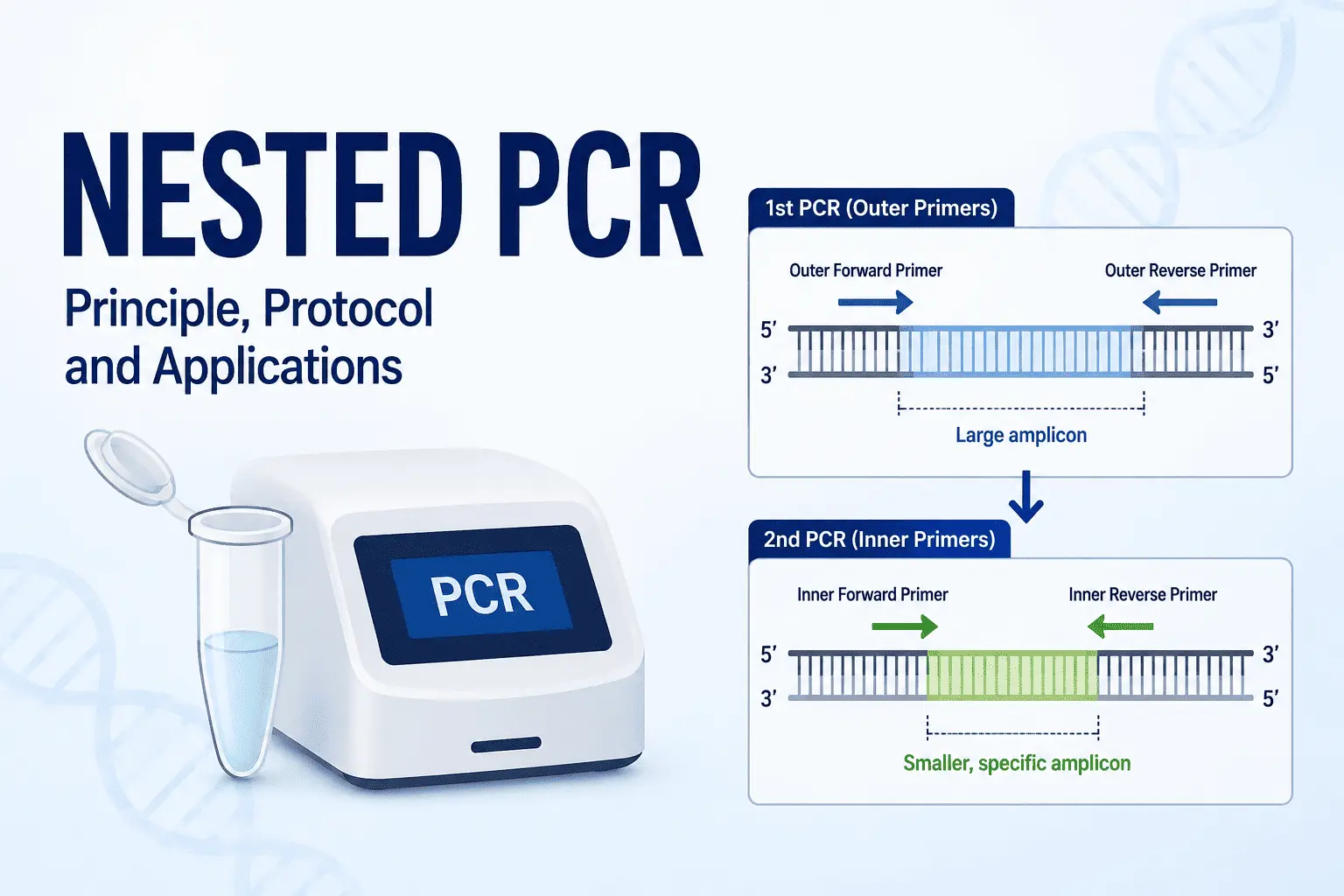
Nested PCR is a modified polymerase chain reaction (PCR) technique designed to improve the specificity and sensitivity of DNA amplification. Unlike conventional PCR, which uses a single pair of primers, nested PCR uses two different primer pairs in two successive rounds of amplification.
In the first round, an outer primer pair amplifies a relatively large region containing the target sequence. A portion of this first PCR product is then used as the template for a second reaction with a second pair of inner primers. These primers bind to sequences located within the first amplicon, producing a smaller and more specific PCR product.
This additional amplification step can be particularly useful when conventional PCR produces nonspecific products or when the target sequence is present at a low abundance. However, the extra manipulation also increases the risk of contamination and makes the technique more labor-intensive.
What Is Nested PCR and How Does It Work?
Definition of Nested PCR
Nested PCR is a two-round PCR strategy that uses two sets of primers targeting different regions of the same DNA sequence.
The first primer pair, known as the outer primers, amplifies a larger DNA fragment. The second primer pair, called the inner or nested primers, targets a sequence located inside the first PCR product.
The principle is straightforward: even if the first PCR produces some nonspecific amplification, it is unlikely that these unwanted products will also contain the correct binding sites for both inner primers. Consequently, the second PCR preferentially amplifies the intended target.
Principle of Nested PCR
Nested PCR can be visualized as amplification occurring in two successive stages:
First PCR:
Outer Forward → [Target region] ← Outer Reverse
The outer primers amplify a relatively large fragment.
Second PCR:
Inner Forward → [Target] ← Inner Reverse
The inner primers bind within the first PCR product and generate a smaller, more specific amplicon.
This provides an additional layer of specificity compared with conventional PCR.
For example, suppose the first PCR generates a 1,000-bp fragment. The second primer pair might bind within that fragment and produce a 400-bp product. Only DNA molecules containing the appropriate internal sequences can efficiently serve as templates for the second amplification.
Nested PCR Workflow
The general workflow consists of several stages:
- DNA or cDNA is prepared from the biological sample.
- The first PCR is performed using the outer primer pair.
- A portion of the first PCR product is transferred into a second PCR reaction.
- The second PCR is performed using the inner primer pair.
- The final product is analyzed, commonly by agarose gel electrophoresis.
- If required, the amplified fragment can be purified and subjected to downstream analysis such as sequencing.
The defining feature is therefore not simply that two PCR reactions are performed, but that the second reaction uses primers targeting a sequence inside the first PCR amplicon.
Nested PCR Primers and Experimental Design
Outer and Inner Primer Design
Primer design is one of the most important factors determining the success of nested PCR.
The outer primers should amplify a region that encompasses the sequence of interest. The resulting product must be large enough to contain suitable binding sites for the inner primers.
The inner primers should bind to sequences located within the first-round amplicon. Their binding sites should be positioned so that the second PCR generates a product of an appropriate size for downstream analysis.
As with conventional PCR, primers should be designed with appropriate:
- Melting temperatures (Tm)
- GC content
- Length
- Specificity
- Distance from repetitive sequences
- Resistance to primer-dimer formation
- Minimal potential for secondary structures
Importantly, the two primer pairs should be designed as a coordinated system rather than independently.
Designing Nested PCR Amplicons
The first-round amplicon generally needs to be sufficiently large to accommodate both inner primer-binding sites.
The second-round product should be clearly distinguishable from potential nonspecific products. Its expected size should also be compatible with the downstream application, such as gel electrophoresis, sequencing, cloning, or mutation analysis.
Primer specificity can be evaluated against the relevant genome or sequence database when appropriate. This is particularly important when working with complex samples containing large amounts of unrelated DNA.
Template and Reaction Considerations
The first-round PCR product serves as the template for the second round. Only a portion of the first reaction is typically transferred rather than using the entire reaction mixture.
The exact amount depends on the experimental system and should be optimized because excessive template can sometimes introduce unwanted components from the first PCR into the second reaction.
Appropriate controls are essential. In particular, because the first PCR generates a highly concentrated DNA product, contamination can produce false-positive results in subsequent reactions.
For this reason, laboratories performing nested PCR should maintain good separation between pre-amplification and post-amplification work areas whenever possible.
Nested PCR Protocol: Step-by-Step Procedure
First-Round PCR
The first PCR is performed using the outer forward and outer reverse primers.
The reaction typically contains:
- DNA or cDNA template
- Forward and reverse outer primers
- DNA polymerase
- dNTPs
- Reaction buffer
- Appropriate magnesium concentration
- Nuclease-free water
The reaction undergoes the standard PCR stages of denaturation, primer annealing, and extension.
The exact cycling conditions depend on the polymerase, primer characteristics, template, and target sequence. Therefore, there is no single set of cycling conditions that is appropriate for every nested PCR assay.
The objective of the first round is to generate an amplicon containing the sequence that will subsequently be amplified by the inner primers.
Second-Round PCR
After the first PCR, an aliquot of the resulting amplification product is used as the template for the second reaction.
The second reaction contains the inner forward and inner reverse primers.
Because these primers recognize sequences located within the first amplicon, the second PCR provides an additional level of target recognition.
The second-round PCR is then performed using cycling conditions appropriate for the inner primer pair and the target sequence.
If successful, the second reaction should produce a distinct amplicon corresponding to the expected internal region.
Detection of the Nested PCR Product
The final PCR product can commonly be analyzed using agarose gel electrophoresis.
A DNA ladder can be used to estimate the size of the amplified fragment. A successful reaction should show a band at approximately the expected size.
For example, if the expected nested PCR product is 400 bp, a prominent band near 400 bp would support successful amplification.
However, gel size alone does not prove that the band represents the correct sequence. When sequence identity is important, the product can be purified and analyzed by DNA sequencing.
Essential Controls
Controls are particularly important in nested PCR because two amplification stages can greatly increase the sensitivity of the assay.
Important controls include:
Positive control:
Contains a known target sequence and demonstrates that the PCR system can amplify the intended target.
No-template control (NTC):
Contains all PCR components except the DNA template. Amplification in this control suggests contamination or nonspecific amplification.
Negative control:
When appropriate, a sample known to lack the target can help assess assay specificity.
Controls should be included in both rounds when the experimental design requires it.
Advantages and Limitations of Nested PCR
Advantages of Nested PCR
The major advantage of nested PCR is its ability to improve amplification specificity.
Using two independent primer pairs provides two levels of sequence recognition. A nonspecific product generated during the first PCR is less likely to contain the correct binding sites for both inner primers.
Other potential advantages include:
- Increased target specificity
- Improved detection of low-abundance targets
- Reduction of nonspecific amplification
- Improved amplification from complex DNA samples
- Generation of a specific product suitable for sequencing
- Ability to recover a target that is difficult to amplify using conventional PCR
These characteristics have made nested PCR useful in a variety of research applications.
Limitations of Nested PCR
The main disadvantage is the additional complexity of the workflow.
Because the first PCR product must be transferred into a second PCR reaction, the technique requires more handling than conventional PCR.
This creates several potential problems:
Higher contamination risk:
The first PCR produces a large quantity of amplified DNA. If this material contaminates other samples or reagents, false-positive results can occur.
Greater time requirement:
Two PCR rounds require more processing time than a single conventional PCR.
More primer design:
Four primers are required rather than two.
More optimization:
Both primer pairs and both PCR reactions may require optimization.
Increased sensitivity to contamination:
The same sensitivity that allows nested PCR to detect low-abundance targets can also make it more susceptible to detecting contaminating DNA.
Nested PCR vs Conventional PCR
| Feature | Conventional PCR | Nested PCR |
|---|---|---|
| PCR rounds | One | Two |
| Primer pairs | One | Two |
| Specificity | Standard | Generally higher |
| Sensitivity | Standard | Can be improved |
| Workflow | Simpler | More complex |
| Contamination risk | Lower | Higher |
| Primer design | Simpler | More demanding |
| Typical use | Routine amplification | Difficult or nonspecific targets |
Nested PCR should therefore not automatically replace conventional PCR. Instead, it is particularly useful when additional specificity or sensitivity is needed.
Applications of Nested PCR in Research and Diagnostics
Detection of Low-Abundance DNA Targets
One important application of nested PCR is the detection of DNA sequences present at low concentrations.
The first amplification increases the amount of target DNA, while the second amplification selectively enriches the internal target sequence.
This can make nested PCR useful when the target is difficult to detect using a single conventional PCR.
Pathogen Detection
Nested PCR has been used in molecular detection of various infectious agents, particularly when the target is present at low levels or when samples contain substantial amounts of background DNA.
The technique has been investigated for detecting bacterial, viral, and parasitic DNA sequences.
However, diagnostic applications require carefully validated assays, appropriate controls, and contamination-prevention procedures because false-positive results can have important consequences.
Cancer and Molecular Biology Research
Nested PCR can also be useful in cancer research and molecular biology.
For example, researchers may use highly specific amplification strategies when analyzing particular DNA regions from complex biological samples.
Potential applications include:
- Amplification of specific genomic regions
- Detection of rare DNA sequences
- Molecular characterization of tumor samples
- Analysis of specific mutations
- Preparation of DNA fragments for sequencing
The technique can be particularly useful when the target represents only a small fraction of the total DNA present in the sample.
Cloning and Sequencing
Nested PCR can help generate a more specific DNA fragment for downstream applications.
After amplification, the desired product can be purified and used for sequencing or, depending on the experimental design, cloning.
For sequencing applications, nested amplification can be helpful when conventional PCR produces multiple products and the researcher needs to selectively amplify the correct target.
Other Research Applications
Nested PCR has also been used in a variety of other molecular biology applications, including:
- Environmental DNA analysis
- Genetic studies
- Detection of rare sequences
- Analysis of complex biological samples
- Identification of specific microbial sequences
Its usefulness is greatest when conventional PCR does not provide sufficient specificity or sensitivity.
Conclusion
Nested PCR is a specialized PCR strategy that uses two successive rounds of amplification and two sets of primers to increase the specificity of target amplification.
The first PCR uses outer primers to amplify a larger region, while the second PCR uses inner primers that bind within the first amplicon. This additional layer of primer recognition can substantially improve target specificity and can be useful for detecting low-abundance sequences.
However, nested PCR also introduces additional handling, primer-design requirements, time, and contamination risk. Careful experimental design and appropriate positive and negative controls are therefore essential.
Overall, Nested PCR remains a useful molecular biology technique when conventional PCR produces nonspecific amplification or fails to detect a target efficiently. Understanding nested PCR primers, the two-round workflow, experimental controls, and contamination prevention is key to obtaining reliable results.


