

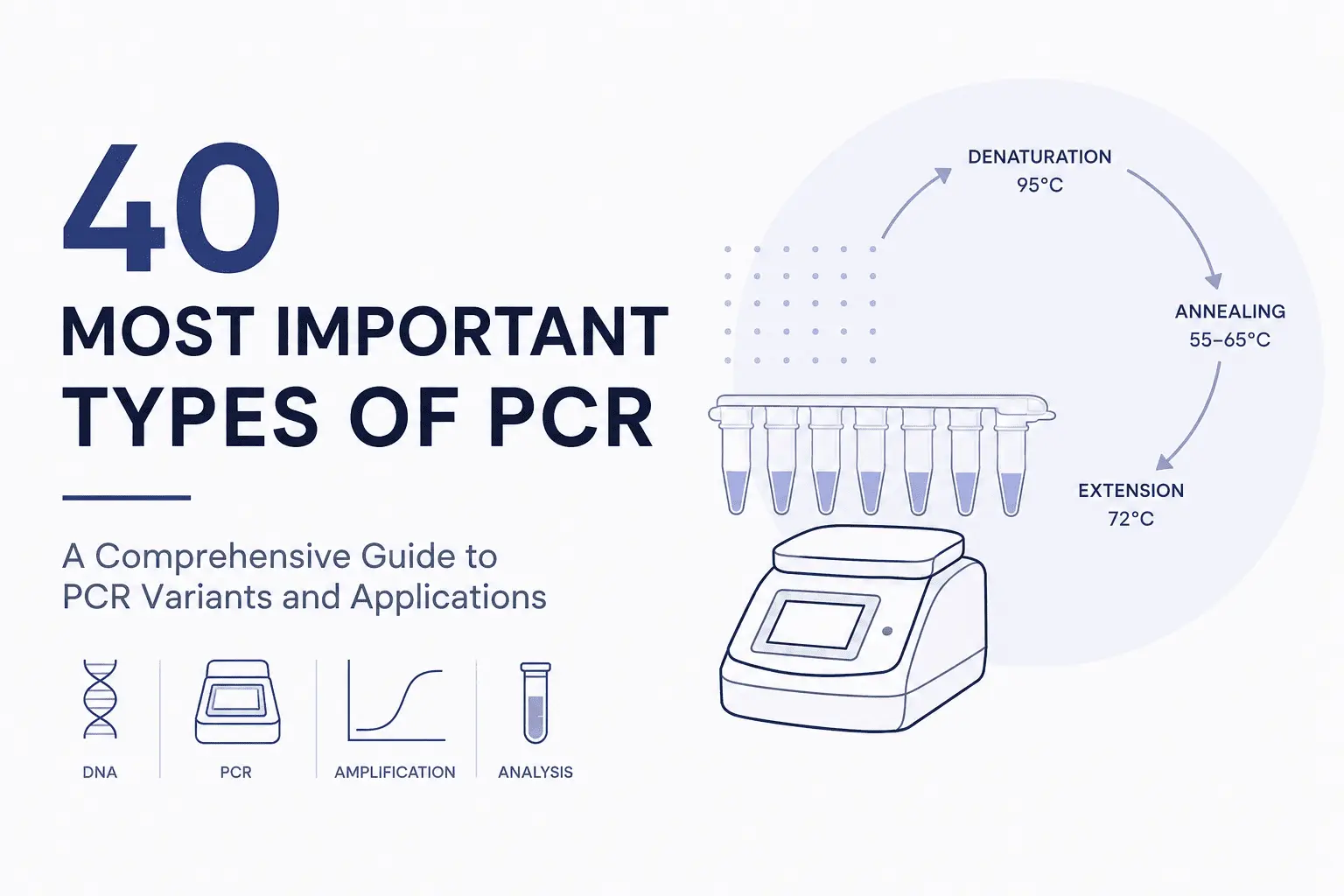
Polymerase chain reaction (PCR) is one of the most important techniques in molecular biology. Since its development, numerous PCR variants have been introduced to improve amplification specificity, sensitivity, speed, quantification, mutation detection, genotyping, cloning, and analysis of RNA or DNA.
Although many specialized PCR methods exist, they can be grouped according to their amplification strategy, detection method, primer design, template type, or intended application. Some variants are closely related and can also be combined—for example, RT-qPCR combines reverse transcription with real-time quantitative PCR, while multiplex qPCR allows several targets to be analyzed simultaneously.
The following are 40 of the most important and widely used PCR variants, covering the major applications of PCR in research, biotechnology, diagnostics, genetics, microbiology, and cancer biology.
1. Conventional PCR
Conventional PCR, also called endpoint PCR, is the basic form of polymerase chain reaction. It amplifies a specific DNA sequence through repeated cycles of denaturation, primer annealing, and extension.
The amplified product is usually analyzed at the end of the reaction using agarose gel electrophoresis. Conventional PCR is widely used for gene amplification, cloning, genotyping, sequencing preparation, and routine molecular biology experiments.
Its main limitation is that amplification is generally evaluated only at the endpoint, making accurate quantitative analysis difficult.
2. Hot-Start PCR
Hot-start PCR is designed to reduce nonspecific amplification and primer-dimer formation. In this approach, DNA polymerase remains inactive at lower temperatures and becomes activated during the initial heating step.
This prevents the polymerase from extending incorrectly paired primers before the actual PCR cycling begins. Hot-start PCR is particularly useful when high specificity is required and is commonly incorporated into commercial PCR master mixes.
3. Touchdown PCR
Touchdown PCR improves specificity by beginning the reaction with an annealing temperature higher than the expected optimal temperature. The annealing temperature is then progressively decreased during the initial cycles.
At higher temperatures, only highly complementary primer-template interactions are favored. As the temperature decreases, amplification becomes more efficient while maintaining improved specificity.
Touchdown PCR is particularly useful when conventional PCR produces nonspecific bands.
4. Gradient PCR
Gradient PCR is primarily used to optimize PCR conditions, especially the annealing temperature. The thermal cycler simultaneously performs reactions at several different temperatures.
The resulting amplification products can be compared to determine the temperature that provides the best combination of specificity and yield.
Gradient PCR is especially useful during the development of new assays or when designing primers for a previously untested target.
5. Long-Range PCR
Long-range PCR is designed to amplify DNA fragments substantially longer than those typically produced by standard PCR.
It generally requires specialized DNA polymerases or polymerase mixtures with improved processivity and proofreading activity. Reaction conditions, template quality, and extension time are particularly important.
Long-range PCR is used for analyzing large genes, genomic regions, structural variants, mitochondrial DNA, and other long DNA fragments.
6. High-Fidelity PCR
High-fidelity PCR uses DNA polymerases with proofreading activity, typically possessing 3′→5′ exonuclease activity.
These enzymes have lower error rates than conventional Taq DNA polymerase, making them particularly valuable when the amplified DNA will subsequently be cloned, sequenced, or used for protein expression.
High-fidelity PCR is therefore widely used in molecular cloning, recombinant DNA technology, and genetic engineering.
7. Multiplex PCR
Multiplex PCR allows multiple DNA targets to be amplified in a single reaction by using several pairs of primers.
This approach saves sample material, reagents, and time while allowing several genes or genomic regions to be analyzed simultaneously.
Multiplex PCR has applications in pathogen detection, genetic testing, forensic analysis, genotyping, and research. Designing compatible primers and optimizing reaction conditions can, however, be more challenging than for single-target PCR.
8. Nested PCR
Nested PCR uses two successive rounds of amplification with two different sets of primers.
The first primer pair amplifies a relatively large region, while the second primer pair amplifies a smaller sequence located within the first amplicon. This additional level of primer specificity can substantially improve detection of low-abundance targets.
Nested PCR is particularly useful when conventional PCR produces weak or nonspecific amplification.
9. Semi-Nested PCR
Semi-nested PCR is similar to nested PCR but uses one primer from the first PCR and one new primer in the second amplification.
It provides increased specificity and sensitivity while requiring fewer new primers than fully nested PCR.
Semi-nested PCR has been used extensively in pathogen detection, transcript analysis, mutation analysis, and amplification of difficult targets.
10. Real-Time PCR (qPCR)
Real-time PCR, commonly called quantitative PCR or qPCR, monitors DNA amplification during the reaction rather than only examining the final product.
Fluorescence increases as amplification occurs, allowing the accumulation of PCR product to be monitored cycle by cycle. The cycle threshold or Cq/Ct value can then be used to estimate the amount of starting nucleic acid.
qPCR is widely used for gene-expression studies, pathogen quantification, genetic analysis, and molecular diagnostics.
11. SYBR Green qPCR
SYBR Green qPCR uses a fluorescent dye that binds to double-stranded DNA. As the amount of amplified DNA increases, fluorescence increases.
The method is relatively simple and cost-effective because it does not require a sequence-specific probe. However, SYBR Green binds to any double-stranded DNA, including nonspecific products and primer dimers.
For this reason, melt-curve analysis is often used to verify the specificity of the amplified product.
12. TaqMan PCR
TaqMan PCR is a probe-based real-time PCR method that uses a sequence-specific fluorescent probe.
During amplification, the probe binds to the target sequence. The DNA polymerase’s 5′→3′ exonuclease activity cleaves the probe, separating the reporter dye from the quencher and generating fluorescence.
TaqMan assays generally provide greater target specificity than nonspecific DNA-binding dyes and are widely used in clinical diagnostics, pathogen detection, genotyping, and gene-expression analysis.
13. Multiplex qPCR
Multiplex qPCR combines the principles of multiplex PCR and real-time PCR.
Several targets can be amplified and quantified simultaneously using different fluorescent probes or distinguishable fluorescent channels.
This is particularly valuable in diagnostic assays where several pathogens, mutations, genes, or internal controls need to be analyzed in a single sample.
14. Reverse Transcription PCR (RT-PCR)
Reverse transcription PCR is used to analyze RNA molecules. Because conventional PCR requires DNA as a template, RNA is first converted into complementary DNA (cDNA) using reverse transcriptase.
The resulting cDNA is then amplified using PCR.
RT-PCR is widely used to study gene expression, RNA viruses, transcript structures, alternative splicing, and RNA biomarkers.
15. One-Step RT-PCR
In one-step RT-PCR, reverse transcription and PCR amplification occur in the same reaction tube.
This reduces the number of handling steps and minimizes the risk of contamination or sample loss.
One-step RT-PCR is particularly convenient for routine RNA detection, especially when many samples need to be processed efficiently.
16. Two-Step RT-PCR
Two-step RT-PCR separates cDNA synthesis from PCR amplification.
First, RNA is converted into cDNA. An aliquot of the resulting cDNA can then be used in one or several PCR reactions targeting different genes.
This approach provides greater flexibility than one-step RT-PCR and is frequently used in gene-expression studies.
17. RT-qPCR
RT-qPCR combines reverse transcription with quantitative real-time PCR.
RNA is first converted to cDNA, and the target sequence is subsequently amplified while fluorescence is monitored in real time.
RT-qPCR is one of the most widely used techniques for measuring gene expression and is commonly used to investigate biomarkers, signaling pathways, cancer-associated genes, viral RNA, and microRNA expression.
18. Digital PCR (dPCR)
Digital PCR is a highly sensitive PCR-based method that partitions a sample into a large number of individual reactions.
Each partition is classified as positive or negative for the target, allowing the original concentration of target molecules to be calculated using statistical principles.
Unlike conventional qPCR, digital PCR can provide absolute quantification without relying on a standard calibration curve.
19. Droplet Digital PCR (ddPCR)
Droplet digital PCR is a form of digital PCR in which the reaction mixture is divided into thousands of microscopic droplets.
Each droplet acts as an independent PCR reaction. After amplification, the number of positive and negative droplets is measured to determine the target concentration.
ddPCR is particularly useful for rare mutation detection, copy-number analysis, low-abundance targets, and precise quantification of nucleic acids.
20. Allele-Specific PCR (AS-PCR)
Allele-specific PCR is designed to distinguish between different alleles based on differences in their DNA sequences.
Primers are designed so that amplification occurs preferentially when the primer perfectly matches a particular allele.
AS-PCR is commonly used for SNP genotyping, mutation detection, inherited disease testing, and cancer mutation analysis.
21. ARMS-PCR
ARMS-PCR stands for Amplification Refractory Mutation System PCR. It is a specialized form of allele-specific PCR designed to detect known mutations or polymorphisms.
Allele-specific primers are designed so that amplification occurs only when the target allele is present.
ARMS-PCR is widely used for detecting clinically important genetic variants and somatic mutations.
22. PCR-RFLP
PCR-RFLP combines PCR amplification with restriction fragment length polymorphism analysis.
A target DNA region is first amplified and then digested with a restriction enzyme. Sequence differences can create or eliminate restriction sites, resulting in different fragment patterns.
The products are usually separated by gel electrophoresis. PCR-RFLP has historically been widely used for genotyping and mutation analysis.
23. Methylation-Specific PCR (MSP)
Methylation-specific PCR is used to analyze DNA methylation.
DNA is first treated with bisulfite, which changes unmethylated cytosines while leaving methylated cytosines largely unchanged. Primers are then designed to distinguish methylated and unmethylated sequences.
MSP is particularly important in epigenetics and cancer research, where abnormal DNA methylation can contribute to gene silencing and tumor development.
24. Quantitative Methylation-Specific PCR (qMSP)
qMSP extends methylation-specific PCR by incorporating real-time fluorescence detection.
It allows researchers to estimate the level of methylation in specific genomic regions rather than simply determining whether methylation is present.
qMSP has been investigated extensively for cancer biomarkers, tumor suppressor gene methylation, and liquid-biopsy applications.
25. Bisulfite PCR
Bisulfite PCR involves amplification of DNA following bisulfite conversion.
Because bisulfite treatment changes the sequence of DNA according to its methylation status, subsequent PCR and sequencing can be used to determine methylation patterns at specific cytosine positions.
Bisulfite PCR is therefore an important component of many DNA methylation studies.
26. Inverse PCR
Inverse PCR is designed to amplify DNA sequences flanking a known DNA region.
Instead of amplifying toward each other from outside the target, primers are designed within a known region and point outward. The DNA is often circularized before amplification.
Inverse PCR is useful for studying unknown sequences adjacent to known regions, insertion sites, genomic rearrangements, and transposable-element integration sites.
27. RACE-PCR
RACE stands for Rapid Amplification of cDNA Ends.
RACE-PCR is used to identify unknown regions at the 5′ or 3′ ends of RNA transcripts. It is particularly useful when researchers know part of a transcript but do not know its complete sequence.
The technique can therefore help determine transcript boundaries, untranslated regions, and alternative transcript structures.
28. 5′ RACE
5′ RACE specifically identifies the 5′ end of an RNA transcript.
It is useful for determining transcription start regions and identifying previously unknown upstream sequences.
5′ RACE can be particularly valuable when characterizing newly discovered genes or transcripts.
29. 3′ RACE
3′ RACE is used to determine the 3′ end of an RNA transcript.
It commonly takes advantage of the poly(A) tail found on many eukaryotic mRNAs.
The technique can help identify transcript termination sites, 3′ untranslated regions, and alternative polyadenylation patterns.
30. Colony PCR
Colony PCR is a rapid method for screening bacterial colonies after molecular cloning.
Instead of extracting and purifying plasmid DNA from every colony, a small amount of bacterial material is used directly as the PCR template.
Primers targeting the vector or insert can determine whether a colony contains the expected recombinant construct. Colony PCR can therefore greatly accelerate cloning workflows.
31. Overlap Extension PCR
Overlap extension PCR, also known as splicing by overlap extension (SOE-PCR), is used to join DNA fragments together.
Primers are designed so that different PCR products contain complementary overlapping sequences. The overlapping fragments can then anneal and be extended to generate a fused DNA molecule.
This method is useful for constructing fusion genes, introducing mutations, and engineering recombinant DNA sequences.
32. Site-Directed Mutagenesis PCR
Site-directed mutagenesis PCR is used to introduce a specific nucleotide change into a DNA molecule.
Primers containing the desired mutation are used to amplify the target DNA, after which the resulting product is recovered and propagated using an appropriate cloning strategy.
It is widely used to investigate protein function, enzyme activity, regulatory elements, and the biological effects of specific mutations.
33. RAPD-PCR
RAPD stands for Random Amplified Polymorphic DNA.
It uses short arbitrary primers to amplify multiple regions of genomic DNA. Differences in the resulting banding patterns can be used to compare genetic variation between samples.
RAPD-PCR has been used in genetic diversity studies, organism identification, and molecular ecology, although its reproducibility can be lower than that of sequence-specific methods.
34. AFLP-PCR
AFLP stands for Amplified Fragment Length Polymorphism.
The method combines restriction enzyme digestion of genomic DNA with adaptor ligation and selective PCR amplification.
AFLP can generate numerous DNA markers across the genome and has been used for genetic diversity analysis, population genetics, mapping, and genotyping.
35. ISSR-PCR
ISSR stands for Inter-Simple Sequence Repeat PCR.
The method uses primers based on microsatellite repeat sequences to amplify DNA regions located between microsatellites.
ISSR-PCR is commonly used to investigate genetic diversity, population structure, cultivar identification, and evolutionary relationships.
36. PCR-SSCP
PCR-SSCP stands for Polymerase Chain Reaction–Single-Strand Conformation Polymorphism.
Following PCR amplification, DNA strands are separated and allowed to adopt sequence-dependent three-dimensional conformations. Even a single nucleotide difference can sometimes alter the conformation and therefore the electrophoretic mobility of the DNA.
PCR-SSCP has been used to screen for mutations and genetic polymorphisms.
37. High-Resolution Melting PCR (HRM-PCR)
HRM-PCR is a post-amplification analysis method commonly performed following real-time PCR.
DNA is gradually heated while fluorescence is monitored. Small sequence differences can produce changes in the DNA melting profile.
HRM is particularly useful for SNP genotyping, mutation screening, methylation analysis, and rapid variant detection without requiring sequencing of every sample.
38. ChIP-PCR
ChIP-PCR stands for Chromatin Immunoprecipitation PCR.
In this approach, chromatin is immunoprecipitated using an antibody against a specific DNA-associated protein, such as a transcription factor or histone modification. PCR is then used to determine whether particular genomic regions are enriched in the immunoprecipitated material.
ChIP-PCR is widely used to investigate gene regulation, transcription-factor binding, and epigenetic modifications.
39. Emulsion PCR (emPCR)
Emulsion PCR is a specialized amplification method in which DNA molecules and PCR reagents are compartmentalized into tiny droplets within an emulsion.
Ideally, individual DNA templates are amplified clonally within separate compartments.
emPCR has been used in several sequencing technologies and is particularly important for generating large numbers of clonal DNA copies from individual templates.
40. LATE-PCR
LATE-PCR stands for Linear-After-The-Exponential PCR.
It is a specialized form of asymmetric PCR designed to generate a large amount of single-stranded DNA after an initial exponential amplification phase.
The production of single-stranded DNA makes LATE-PCR useful for applications involving probe hybridization, sequencing, and detection of specific variants.
How to Choose the Appropriate PCR Type
The most appropriate PCR method depends largely on the type of sample, target molecule, required sensitivity, and purpose of the experiment.
For simple amplification of a DNA fragment, conventional PCR is usually sufficient. If the target is RNA, reverse transcription PCR is required to convert RNA into cDNA before amplification.
When quantitative information is needed, qPCR or RT-qPCR is generally preferred. For extremely sensitive detection or absolute quantification, digital PCR or ddPCR may be more appropriate.
For detecting a known mutation, allele-specific PCR, ARMS-PCR, or another mutation-specific approach can be useful. When the objective is to analyze DNA methylation, methylation-specific PCR or bisulfite-based PCR methods are appropriate.
For cloning, colony PCR, high-fidelity PCR, overlap-extension PCR, and site-directed mutagenesis PCR are particularly important. When the sequence surrounding a known region is unknown, inverse PCR, RACE-PCR, or genome-walking approaches can be considered.
PCR Variants at a Glance
| PCR variant | Main purpose |
|---|---|
| Conventional PCR | General DNA amplification |
| Hot-start PCR | Improve specificity |
| Touchdown PCR | Reduce nonspecific amplification |
| Gradient PCR | Optimize PCR conditions |
| Long-range PCR | Amplify long DNA fragments |
| High-fidelity PCR | Minimize amplification errors |
| Multiplex PCR | Amplify multiple targets |
| Nested PCR | Increase specificity and sensitivity |
| Semi-nested PCR | Increase specificity |
| qPCR | Quantify DNA during amplification |
| SYBR Green qPCR | Fluorescent DNA quantification |
| TaqMan PCR | Probe-based quantitative detection |
| Multiplex qPCR | Quantify multiple targets |
| RT-PCR | Amplify RNA-derived cDNA |
| One-step RT-PCR | Reverse transcription + PCR in one tube |
| Two-step RT-PCR | Separate cDNA synthesis and PCR |
| RT-qPCR | Quantify RNA expression |
| Digital PCR | Absolute nucleic-acid quantification |
| ddPCR | Highly sensitive digital quantification |
| AS-PCR | Allele discrimination |
| ARMS-PCR | Known mutation detection |
| PCR-RFLP | Genotyping using restriction digestion |
| MSP | DNA methylation detection |
| qMSP | Quantitative methylation analysis |
| Bisulfite PCR | DNA methylation analysis |
| Inverse PCR | Amplify unknown flanking sequences |
| RACE-PCR | Identify transcript ends |
| 5′ RACE | Identify 5′ transcript ends |
| 3′ RACE | Identify 3′ transcript ends |
| Colony PCR | Screen recombinant colonies |
| Overlap-extension PCR | Join DNA fragments |
| Site-directed mutagenesis PCR | Introduce specific mutations |
| RAPD-PCR | Genetic fingerprinting |
| AFLP-PCR | Genetic polymorphism analysis |
| ISSR-PCR | Genetic diversity analysis |
| PCR-SSCP | Mutation and polymorphism screening |
| HRM-PCR | Variant and mutation detection |
| ChIP-PCR | Study DNA–protein interactions |
| emPCR | Clonal amplification in compartments |
| LATE-PCR | Generate single-stranded DNA |
Conclusion
PCR has evolved from a relatively simple DNA amplification technique into a broad family of molecular biology methods. Different PCR variants have been developed to address specific challenges, including low template abundance, nonspecific amplification, long DNA targets, RNA analysis, quantitative measurement, mutation detection, methylation analysis, genotyping, cloning, and high-throughput sequencing.
Among the most important methods, conventional PCR remains fundamental for routine DNA amplification, while qPCR and RT-qPCR are essential for quantitative nucleic-acid analysis. Digital PCR provides highly sensitive absolute quantification, whereas multiplex PCR enables several targets to be analyzed simultaneously. Specialized approaches such as nested PCR, allele-specific PCR, RACE-PCR, inverse PCR, methylation-specific PCR, and high-fidelity PCR further expand the applications of the technology.
Importantly, these methods are not always mutually exclusive. Many can be combined to create specialized workflows—for example, multiplex RT-qPCR, nested RT-PCR, digital PCR for mutation detection, or high-fidelity PCR for molecular cloning.
Together, these variants make PCR one of the most versatile and widely used technologies in modern molecular biology, genetics, microbiology, biotechnology, and cancer research.


