

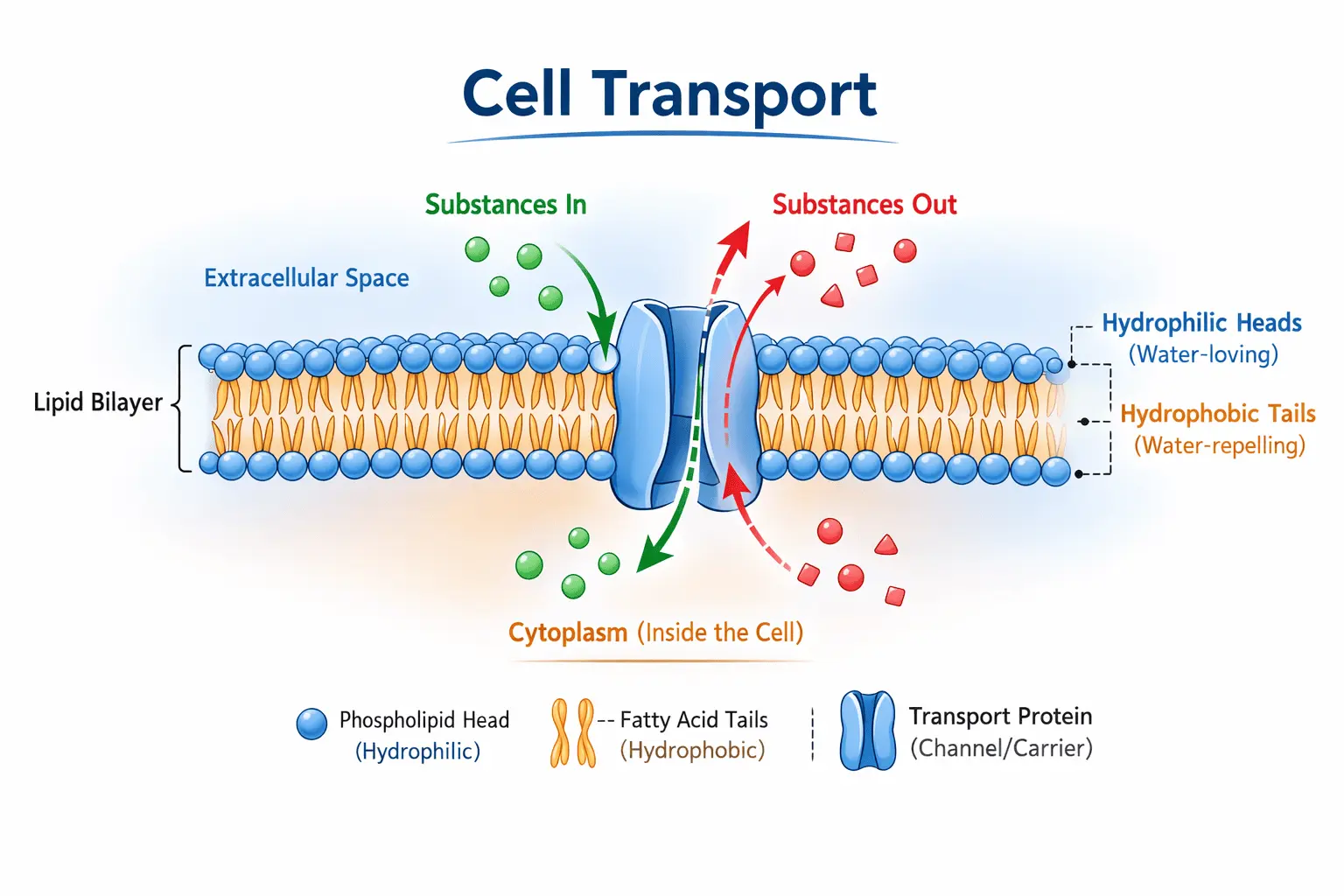
Cell transport is the biological process by which substances move across the plasma membrane and within cells to maintain cellular function. To survive, cells must continuously exchange nutrients, gases, ions, and waste products with their environment while maintaining a stable internal balance. This exchange is possible because the plasma membrane is selectively permeable, allowing certain molecules to pass while restricting others.
Through specialized transport mechanisms, cells regulate the movement of molecules such as glucose, ions, and oxygen. These processes are essential for maintaining cellular homeostasis, generating energy, controlling osmotic balance, and enabling communication with the surrounding environment.
In this guide, we will explore the major mechanisms of membrane transport, including passive transport, active transport, electrochemical gradients, vesicular transport (endocytosis and exocytosis), and intracellular trafficking.
II. The Plasma Membrane and Selective Permeability
A. Structure of the Plasma Membrane
The ability of cells to regulate cell transport depends primarily on the structural organization of the plasma membrane. According to the fluid mosaic model, first proposed by Singer and Nicolson, the membrane is a dynamic and flexible structure composed of a phospholipid bilayer with embedded proteins.
1. Phospholipid Bilayer
Phospholipids are amphipathic molecules containing:
- A hydrophilic (water-attracting) phosphate head
- Two hydrophobic (water-repelling) fatty acid tails
In aqueous environments, phospholipids spontaneously arrange into a bilayer, with hydrophobic tails facing inward and hydrophilic heads facing outward. This arrangement creates a semi-permeable barrier that:
- Allows small nonpolar molecules (e.g., O₂, CO₂) to diffuse freely
- Restricts large, polar, or charged molecules
The hydrophobic core of the membrane is the main reason why many substances require specialized transport proteins to cross it.
2. Membrane Proteins
Membrane proteins are essential for selective permeability and transport. They are classified into:
- Integral (transmembrane) proteins – span the bilayer and often function as channels, carriers, or pumps.
- Peripheral proteins – loosely attached to the membrane surface and often involved in signaling or structural support.
Transport proteins embedded in the membrane enable the controlled passage of ions, sugars, amino acids, and other essential molecules.
3. Cholesterol and Membrane Fluidity
Cholesterol molecules are interspersed between phospholipids in animal cell membranes. They regulate membrane fluidity by:
- Preventing excessive rigidity at low temperatures
- Limiting excessive fluidity at high temperatures
This balance ensures that transport proteins maintain proper structure and function.
B. Selective Permeability and Transport Determinants
The plasma membrane is described as selectively permeable because it permits some substances to pass more easily than others. The movement of molecules across the membrane depends on several factors:
1. Molecular Size
Small molecules diffuse more easily than large macromolecules.
2. Polarity
Nonpolar molecules cross readily through the lipid bilayer, while polar molecules require transport proteins.
3. Charge
Ions cannot cross the hydrophobic core without specialized channels or carriers.
4. Concentration Gradient
Molecules naturally move from areas of high concentration to low concentration (down their gradient).
5. Electrochemical Gradient
For charged particles, both concentration difference and electrical potential influence movement.
III. Passive Transport (No Energy Required)
Passive transport is a fundamental category of cell transport in which substances move across the plasma membrane without the direct expenditure of cellular energy (ATP). Instead, movement occurs down a concentration gradient or electrochemical gradient, meaning molecules travel from regions of higher concentration to lower concentration until equilibrium is reached.
Passive transport is essential for gas exchange, nutrient distribution, and maintaining osmotic balance.
A. Simple Diffusion
Simple diffusion is the direct movement of molecules through the phospholipid bilayer without the assistance of transport proteins.
Key Characteristics:
- Occurs down the concentration gradient
- Requires no ATP
- Does not involve membrane proteins
- Continues until equilibrium is reached
Molecules That Use Simple Diffusion:
- Small nonpolar gases (O₂, CO₂)
- Lipid-soluble molecules
- Small hydrophobic substances
Because the membrane’s hydrophobic core favors nonpolar molecules, these substances can pass freely. The rate of diffusion depends on:
- Concentration gradient magnitude
- Temperature
- Membrane surface area
- Lipid solubility of the molecule
However, polar molecules and charged ions cannot efficiently cross the membrane via simple diffusion due to the hydrophobic interior.
B. Facilitated Diffusion
Facilitated diffusion is a passive process that requires membrane transport proteins to move substances across the membrane. Although proteins are involved, no ATP is consumed because movement still occurs down the concentration gradient.
There are two major types of facilitated diffusion:
1. Channel Proteins
Channel proteins form hydrophilic pores that allow specific ions or water molecules to cross the membrane rapidly.
Types of Channels:
- Voltage-gated channels – open in response to changes in membrane potential
- Ligand-gated channels – open when a specific molecule binds
- Mechanically gated channels – respond to physical deformation
- Aquaporins – specialized channels for water transport
Channels are typically highly selective and allow rapid transport of ions such as Na⁺, K⁺, Ca²⁺, and Cl⁻.
2. Carrier Proteins
Carrier proteins bind specific molecules and undergo conformational changes to shuttle them across the membrane.
Characteristics:
- Specific to particular substrates
- Slower than channel proteins
- Exhibit saturation kinetics (transport maximum)
An important example is the glucose transporter (GLUT), which enables glucose to enter cells via facilitated diffusion.
C. Osmosis
Osmosis is the passive movement of water across a selectively permeable membrane from a region of lower solute concentration to a region of higher solute concentration.
Water movement aims to equalize solute concentrations on both sides of the membrane.
Tonicity Conditions:
- Hypotonic solution – lower solute concentration outside the cell → water enters
- Isotonic solution – equal solute concentration → no net water movement
- Hypertonic solution – higher solute concentration outside the cell → water exits
Osmosis is critical for maintaining cell volume and structural integrity. Specialized water channels called aquaporins significantly increase the rate of water transport across membranes.
Passive transport provides the foundation for cellular homeostasis and sets the stage for more complex energy-dependent mechanisms, which we will examine next in active transport.
IV. Active Transport (Energy-Dependent Mechanisms)
While passive transport allows substances to move down their gradients, many essential cellular processes require movement against a concentration or electrochemical gradient. This uphill movement is known as active transport, and it requires cellular energy.
Active transport is crucial for maintaining ion gradients, regulating cell volume, controlling intracellular pH, and enabling nutrient uptake even when extracellular concentrations are low. Unlike passive mechanisms, active transport does not move toward equilibrium—it actively establishes and maintains gradients.
Active transport can be divided into primary active transport and secondary active transport.
A. Primary Active Transport
Primary active transport directly uses energy derived from ATP hydrolysis to move substances across the membrane.
Mechanism Overview:
- A specific ion or molecule binds to the pump.
- ATP is hydrolyzed.
- The pump undergoes a conformational change.
- The substance is transported against its gradient.
- The pump resets to its original configuration.
Key Features:
- Direct ATP consumption
- High substrate specificity
- Essential for maintaining electrochemical gradients
Major Examples:
1. Sodium–Potassium Pump (Na⁺/K⁺-ATPase)
- Pumps 3 Na⁺ ions out of the cell
- Pumps 2 K⁺ ions into the cell
- Maintains resting membrane potential
- Essential for nerve and muscle function
2. Calcium Pumps (Ca²⁺-ATPases)
- Transport Ca²⁺ out of the cytosol
- Maintain low intracellular calcium levels
3. Proton Pumps (H⁺-ATPases)
- Transport hydrogen ions across membranes
- Contribute to pH regulation and organelle acidification
Primary active transport establishes the ion gradients that many other transport processes depend on.
B. Secondary Active Transport
Secondary active transport does not use ATP directly. Instead, it relies on the energy stored in ion gradients created by primary active transport.
This mechanism couples the downhill movement of one molecule to the uphill movement of another.
Core Principle:
The electrochemical gradient of one ion (commonly Na⁺ or H⁺) drives the transport of another molecule against its gradient.
Secondary active transport occurs through cotransporters, which can function as:
1. Symport (Cotransport)
- Both molecules move in the same direction across the membrane.
- Example: Sodium–glucose cotransporter (SGLT).
- Na⁺ moves down its gradient into the cell.
- Glucose is transported into the cell against its gradient.
2. Antiport (Countertransport)
- Molecules move in opposite directions.
- Example: Na⁺/Ca²⁺ exchanger.
- Na⁺ enters the cell.
- Ca²⁺ exits the cell.
C. Importance of Active Transport
Active transport is essential for:
- Establishing membrane potential
- Driving nutrient uptake
- Regulating intracellular ion concentrations
- Maintaining osmotic balance
- Supporting electrical signaling in excitable cells
These gradients not only sustain cellular homeostasis but also form the foundation for membrane potential and electrical signaling, which we will examine in the next section.
V. Membrane Potential and Electrochemical Gradients
A central consequence of active and passive cell transport is the generation of electrochemical gradients across the plasma membrane. Because ions carry electrical charge, their unequal distribution between the inside and outside of the cell creates both a concentration difference and an electrical difference. Together, these form the electrochemical gradient, which is a major driving force in membrane transport.
A. Establishment of Ion Gradients
Ion gradients arise primarily from:
- Selective membrane permeability
- Activity of ion pumps (such as the Na⁺/K⁺-ATPase)
- Differential distribution of ions across the membrane
For example:
- Sodium (Na⁺) concentration is higher outside the cell.
- Potassium (K⁺) concentration is higher inside the cell.
Primary active transport establishes these gradients, while selective ion channels allow controlled passive movement.
Because ions cannot freely cross the hydrophobic membrane core, transport proteins regulate their distribution, preventing equilibrium and maintaining functional gradients.
B. The Membrane Potential
The membrane potential is the electrical voltage difference across the plasma membrane. It results from:
- Unequal ion distribution
- Selective permeability to certain ions (especially K⁺)
- The electrogenic nature of ion pumps
In most animal cells, the resting membrane potential is negative inside relative to the outside. This negative charge primarily arises because:
- More K⁺ leaks out of the cell than Na⁺ leaks in
- The Na⁺/K⁺ pump exports more positive charges than it imports
The membrane potential is measured in millivolts (mV) and plays a critical role in cellular function.
C. Electrochemical Gradients
An electrochemical gradient has two components:
- Chemical gradient – difference in solute concentration
- Electrical gradient – difference in charge across the membrane
For ions, both forces influence movement. For example:
- A positive ion is attracted to a negatively charged interior.
- A concentration gradient may oppose or reinforce the electrical gradient.
The net movement of an ion depends on the combined effect of these two forces.
Electrochemical gradients provide stored potential energy that drives:
- Secondary active transport
- Rapid ion flux through channels
- Electrical signaling in specialized cells
D. Functional Significance
Membrane potential and electrochemical gradients are essential for:
- Nutrient uptake via cotransporters
- Regulation of cell volume
- Maintenance of intracellular pH
- Electrical activity in neurons and muscle cells
- Rapid signal transmission
Rather than being static conditions, these gradients are dynamic and tightly regulated. They represent a critical integration point between passive transport, active transport, and cellular signaling.
VI. Bulk (Vesicular) Transport
Not all forms of cell transport involve individual ions or small molecules crossing the membrane through channels or pumps. Large particles, macromolecules, and even portions of extracellular fluid are transported via vesicular (bulk) transport.
This mechanism requires energy and involves the formation or fusion of membrane-bound vesicles. Unlike passive or active transport of small solutes, bulk transport moves materials without directly crossing the lipid bilayer.
Bulk transport occurs in two major directions:
- Endocytosis → material enters the cell
- Exocytosis → material exits the cell like exosomes release
A. Endocytosis
Endocytosis is the process by which the plasma membrane invaginates to enclose extracellular material, forming a vesicle that brings the material into the cell.
This process requires ATP and cytoskeletal participation.
There are three main types:
1. Phagocytosis (“Cell Eating”)
- Phagocytosis: Engulfs large particles (e.g., debris, microorganisms)
- Forms large vesicles called phagosomes
- Common in specialized cells such as macrophages
The membrane extends around the particle, internalizes it, and later fuses with lysosomes for degradation.
2. Pinocytosis (“Cell Drinking”)
- Non-specific uptake of extracellular fluid
- Forms small vesicles
- Occurs continuously in many cell types
Pinocytosis allows cells to sample and regulate extracellular fluid composition.
3. Receptor-Mediated Endocytosis
- Highly specific
- Involves ligand–receptor binding
- Uses clathrin-coated pits
In this mechanism:
- A ligand binds to its membrane receptor.
- The membrane region invaginates.
- A clathrin-coated vesicle forms.
- The vesicle internalizes the bound molecules.
This pathway enables efficient uptake of specific molecules even when present in low concentrations.
B. Exocytosis
Exocytosis is the process by which intracellular vesicles fuse with the plasma membrane to release their contents outside the cell.
It serves several essential functions:
- Secretion of proteins and hormones
- Neurotransmitter release
- Delivery of membrane proteins
- Membrane renewal
There are two primary forms:
1. Constitutive Exocytosis
- Occurs continuously
- Delivers membrane proteins and lipids
- Maintains plasma membrane composition
All cells perform constitutive secretion.
2. Regulated Exocytosis
- Occurs in response to specific signals
- Vesicles are stored until triggered
- Common in secretory cells
For example, secretory vesicles may fuse with the membrane only after a rise in intracellular Ca²⁺ concentration.
C. Significance of Vesicular Transport
Bulk transport allows cells to:
- Internalize large molecules
- Remove waste
- Secrete signaling molecules
- Remodel the plasma membrane
- Maintain communication with their environment
Unlike channel- or pump-mediated transport, vesicular mechanisms preserve membrane integrity while moving substantial quantities of material.
Vesicular transport connects directly to intracellular trafficking pathways within the endomembrane system, which we will examine next as we explore how vesicles are directed to specific destinations inside the cell.
VII. Intracellular Transport and Vesicular Trafficking
Once materials enter or are synthesized within the cell, they must be accurately delivered to specific destinations. This highly organized movement of vesicles and cargo within the cell is known as intracellular transport or vesicular trafficking.
Intracellular trafficking ensures that proteins, lipids, and other molecules reach the correct organelle, membrane domain, or extracellular location.
A. The Endomembrane System
The endomembrane system is a network of interconnected organelles that coordinate vesicular transport. It includes:
- Endoplasmic reticulum (ER)
- Golgi apparatus
- Transport vesicles
- Lysosomes
- Plasma membrane
1. The Secretory Pathway
Proteins synthesized in the rough ER enter the ER lumen and are packaged into vesicles that:
- Bud from the ER
- Fuse with the Golgi apparatus
- Undergo modification and sorting
- Are directed to their final destination
Destinations may include:
- The plasma membrane
- Lysosomes
- Extracellular space (via exocytosis)
2. The Endocytic Pathway
Material internalized by endocytosis follows a trafficking route through:
- Early endosomes
- Late endosomes
- Lysosomes
This pathway enables recycling of receptors and degradation of internalized material.
B. Vesicle Formation and Targeting
Transport vesicles must form correctly and fuse with the appropriate target membrane. This requires molecular specificity.
1. Coat Proteins
Different coat proteins regulate vesicle budding:
- Clathrin → involved in endocytosis and Golgi trafficking
- COPII → transports vesicles from ER to Golgi
- COPI → mediates retrograde transport (Golgi to ER)
Coat proteins help shape the vesicle and select cargo molecules.
2. Vesicle Targeting and Fusion
Accurate delivery depends on:
- Rab GTPases → guide vesicles to the correct target
- SNARE proteins → mediate membrane fusion
When compatible SNARE proteins on the vesicle and target membrane interact, membranes fuse, releasing cargo to its proper location.
This ensures directional flow and prevents mistargeting.
C. Cytoskeleton-Based Transport
Vesicles do not randomly diffuse through the cytoplasm. Instead, they are transported along cytoskeleton tracks using motor proteins.
1. Microtubule-Based Transport
Motor proteins move vesicles along microtubules:
- Kinesin → generally moves cargo toward the cell periphery
- Dynein → typically moves cargo toward the cell center
These motors use ATP to “walk” along microtubules.
2. Actin-Based Transport
- Myosin motor proteins move cargo along actin filaments
- Important for short-distance transport near the plasma membrane
D. Functional Importance
Intracellular transport and vesicular trafficking allow cells to:
- Maintain organelle identity
- Sort and deliver proteins accurately
- Regulate membrane composition
- Coordinate secretion and uptake
- Support cell polarity and spatial organization
Conclusion
Cell transport is a highly coordinated and essential process that enables cells to maintain internal stability while continuously interacting with their environment. From passive diffusion and ATP-driven pumps to vesicular trafficking and cytoskeleton-based delivery systems, each transport mechanism plays a distinct yet interconnected role in sustaining cellular function.
By integrating membrane structure, electrochemical gradients, and intracellular trafficking pathways, cells achieve precise control over nutrient uptake, ion balance, secretion, and waste removal. Understanding these mechanisms not only clarifies how cells maintain homeostasis but also provides a foundational framework for studying more advanced topics in cell biology, including signaling, metabolism, and cellular organization.
References
Textbooks
- Alberts, B., Johnson, A., Lewis, J., Morgan, D., Raff, M., Roberts, K., & Walter, P. (2022). Molecular biology of the cell (7th ed.). W. W. Norton & Company.
- Cooper, G. M., & Hausman, R. E. (2019). The cell: A molecular approach (8th ed.). Sinauer Associates.
- Karp, G. (2021). Cell and molecular biology: Concepts and experiments (9th ed.). Wiley.
- Lodish, H., Berk, A., Kaiser, C. A., Krieger, M., Scott, M. P., Bretscher, A., Ploegh, H., & Amon, A. (2021). Molecular cell biology (9th ed.). W. H. Freeman.
- Nelson, D. L., & Cox, M. M. (2021). Lehninger principles of biochemistry (8th ed.). W. H. Freeman.
Review Articles
- Singer, S. J., & Nicolson, G. L. (1972). The fluid mosaic model of the structure of cell membranes. Science, 175(4023), 720–731.
https://www.science.org/doi/10.1126/science.175.4023.720 - Rothman, J. E. (1994). Mechanisms of intracellular protein transport. Nature, 372(6501), 55–63.
https://www.nature.com/articles/372055a0 - Skou, J. C. (1998). Nobel lecture: The identification of the sodium–potassium pump. Bioscience Reports, 18(4), 155–169.
https://portlandpress.com/bioscirep/article/18/4/155/53721 - Südhof, T. C., & Rothman, J. E. (2009). Membrane fusion: Grappling with SNARE and SM proteins. Science, 323(5913), 474–477.
https://www.science.org/doi/10.1126/science.1161748
Cell transport refers to the movement of substances across the cell membrane or within the cell. It allows cells to import nutrients, remove waste products, and maintain internal balance.
Materials inside the cell are transported through intracellular trafficking, which involves vesicles, the cytoskeleton, and motor proteins that move molecules between organelles.
Proteins are transported within cells mainly through vesicular transport between organelles such as the endoplasmic reticulum and the Golgi apparatus, and through transport vesicles that deliver them to their final destinations.
Facilitated diffusion and some forms of active transport use carrier proteins to move specific molecules across the plasma membrane. These proteins bind to the molecule and change shape to transport it across the membrane.


