

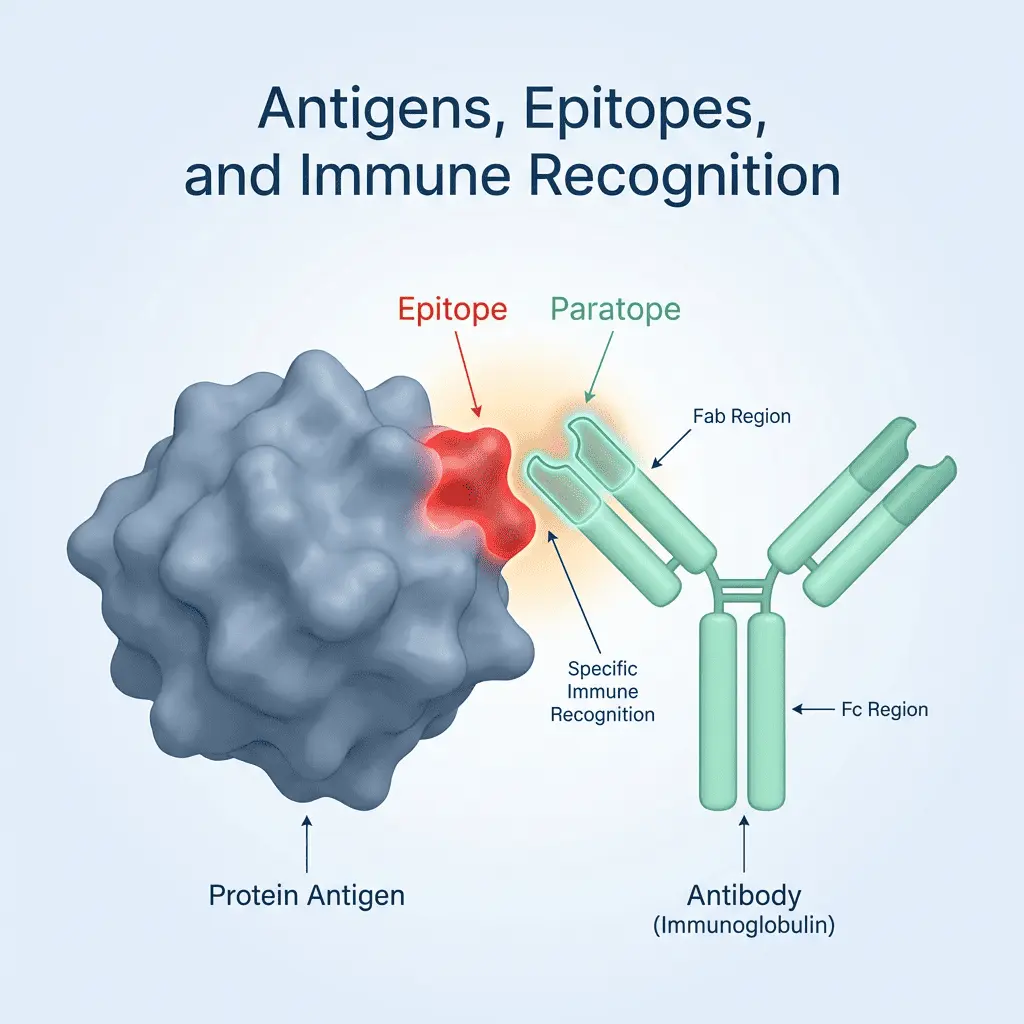
The ability of the immune system to recognize and respond to foreign molecules is central to immune protection. This process depends on antigens, which initiate immune responses, and epitopes, the specific regions of antigens recognized by immune receptors. Precise immune recognition ensures effective defense against pathogens while maintaining tolerance to self.
This article introduces the core concepts of antigens, epitopes, and immune recognition, and explains how these interactions shape immune responses in health and disease.
What Are Antigens? Fundamental Concepts in Immunology
Definition and General Characteristics of Antigens
An antigen is any molecule capable of being recognized by the immune system and inducing a specific immune response. Antigens are typically foreign to the host and can be derived from pathogens such as bacteria, viruses, fungi, or parasites, but they may also originate from altered self-cells, such as tumor cells. Most antigens are proteins or polysaccharides, although lipids and nucleic acids can also be antigenic when associated with carrier molecules.
Types of Antigens
Antigens can be classified based on their origin and biological context:
- Exogenous antigens: Enter the body from the external environment (e.g. microbial proteins, toxins).
- Endogenous antigens: Generated within cells, often from viral infections or intracellular pathogens.
- Autoantigens: Self-molecules that are normally tolerated but can trigger immune responses in autoimmune diseases.
- Tumor antigens: Abnormally expressed or mutated proteins found on cancer cells.
- Alloantigens: Antigens from other individuals of the same species, important in transplantation.
Factors Influencing Antigenicity
Not all molecules are equally capable of inducing immune responses. Antigenicity depends on several factors:
- Molecular size: Larger molecules are generally more immunogenic.
- Chemical complexity: Structurally complex molecules are better recognized.
- Degree of foreignness: Greater difference from self increases immune recognition.
- Route and dose of exposure: These influence how antigens are processed and presented.
Epitopes – The Specific Targets of Immune Recognition
Definition of Epitopes
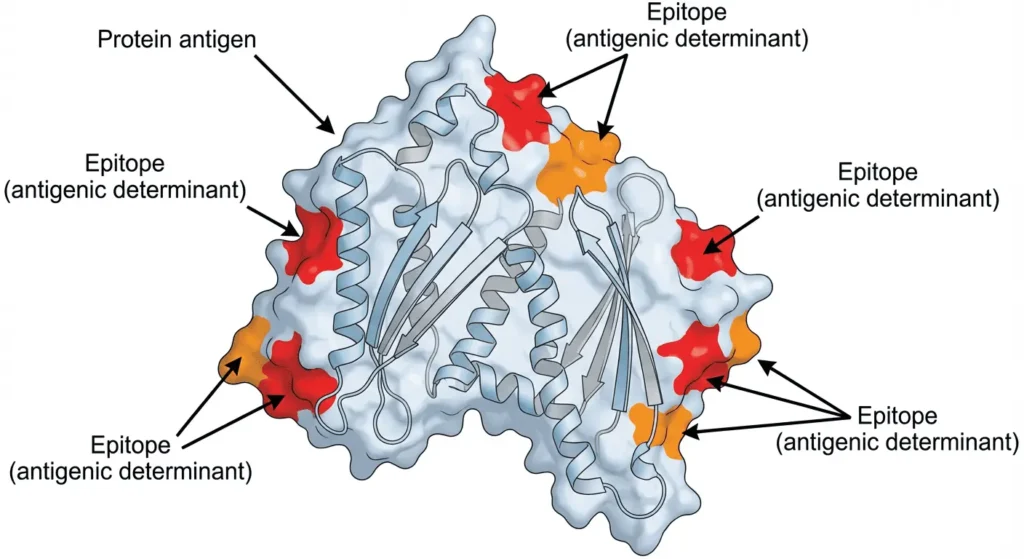
An epitope, also known as an antigenic determinant, is the specific region of an antigen that is directly recognized by components of the immune system. While an antigen may be a large and complex molecule, immune receptors do not interact with the entire structure. Instead, antibodies, B-cell receptors (BCRs), and T-cell receptors (TCRs) bind to discrete epitopes, making them the true functional units of immune recognition.
Types of Epitopes
Epitopes can be classified based on their structural organization within the antigen:
- Linear (sequential) epitopes
These consist of a continuous sequence of amino acids. They are often preserved after antigen processing and are commonly recognized by T cells. - Conformational (discontinuous) epitopes
These are formed by amino acids that are distant in the primary sequence but brought together by protein folding. They are typically recognized by antibodies and BCRs and depend on the native three-dimensional structure of the antigen.
B-Cell vs T-Cell Epitopes
The nature of epitope recognition differs between B cells and T cells:
- B-cell epitopes are usually exposed on the surface of native antigens and can be linear or conformational. Recognition occurs without antigen processing.
- T-cell epitopes are short peptide fragments generated through antigen processing and presented on major histocompatibility complex (MHC) molecules. T cells recognize the epitope only in the context of peptide–MHC complexes.
Mechanisms of Immune Recognition
Antigen Recognition by B Cells
B cells recognize antigens in their native, unprocessed form through membrane-bound immunoglobulins known as B-cell receptors (BCRs). Binding occurs when a BCR specifically interacts with an epitope exposed on the antigen surface. This interaction can lead to B-cell activation, internalization of the antigen, and differentiation into antibody-secreting plasma cells or memory B cells. The high specificity of BCR–epitope binding ensures targeted humoral immune responses.
Antigen Processing and Presentation
T cells cannot recognize free antigens and require antigen processing and presentation by antigen-presenting cells (APCs) such as dendritic cells, macrophages, and B cells. Antigens are enzymatically degraded into peptides, which are then loaded onto major histocompatibility complex (MHC) molecules:
- MHC class I pathway presents endogenous peptides to CD8⁺ cytotoxic T cells.
- MHC class II pathway presents exogenous peptides to CD4⁺ helper T cells.
This system allows continuous immune surveillance of both intracellular and extracellular antigens.
T Cell Recognition and Activation
T-cell activation occurs when the T-cell receptor (TCR) specifically recognizes a peptide–MHC complex on the surface of an APC. Effective activation requires additional co-stimulatory signals provided by APCs. Once activated, T cells proliferate and differentiate into effector cells that coordinate immune responses or directly eliminate infected or abnormal cells.
Biological and Clinical Significance of Antigen Recognition
Role in Protective Immunity
Accurate antigen recognition is essential for effective immune defense. By specifically identifying pathogenic antigens, the immune system can eliminate infectious agents while minimizing damage to host tissues. This specificity also enables the formation of immunological memory, allowing faster and stronger responses upon re-exposure to the same antigen.
Implications in Vaccination
Modern vaccines are designed to exploit antigen recognition mechanisms by introducing selected antigens or epitopes that elicit protective immunity without causing disease. Understanding which epitopes efficiently activate B and T cells is critical for vaccine development, particularly for subunit, peptide, and recombinant vaccines. Precise antigen selection improves vaccine efficacy and safety.
Dysregulation of Immune Recognition
Failures in antigen recognition or tolerance can lead to disease. Recognition of self-antigens may result in autoimmune disorders, while exaggerated responses to harmless antigens cause allergies and hypersensitivity reactions. In cancer, tumor cells may evade immune recognition by altering antigen expression or antigen presentation pathways, enabling disease progression.
Conclusion
Antigens and epitopes form the molecular basis of immune recognition, guiding how the immune system detects, interprets, and responds to foreign and altered self-molecules. Through highly specific interactions involving immune receptors and antigen presentation pathways, these mechanisms ensure effective protection while maintaining immune tolerance. A clear understanding of antigen recognition is fundamental to immunology and underpins advances in vaccination, autoimmunity research, and cancer immunotherapy.


[…] Histocompatibility Complex (MHC) class II molecules, which are essential for displaying processed antigens to CD4+ helper T cells. Some APCs also present antigens via MHC class I molecules to CD8+ cytotoxic […]