

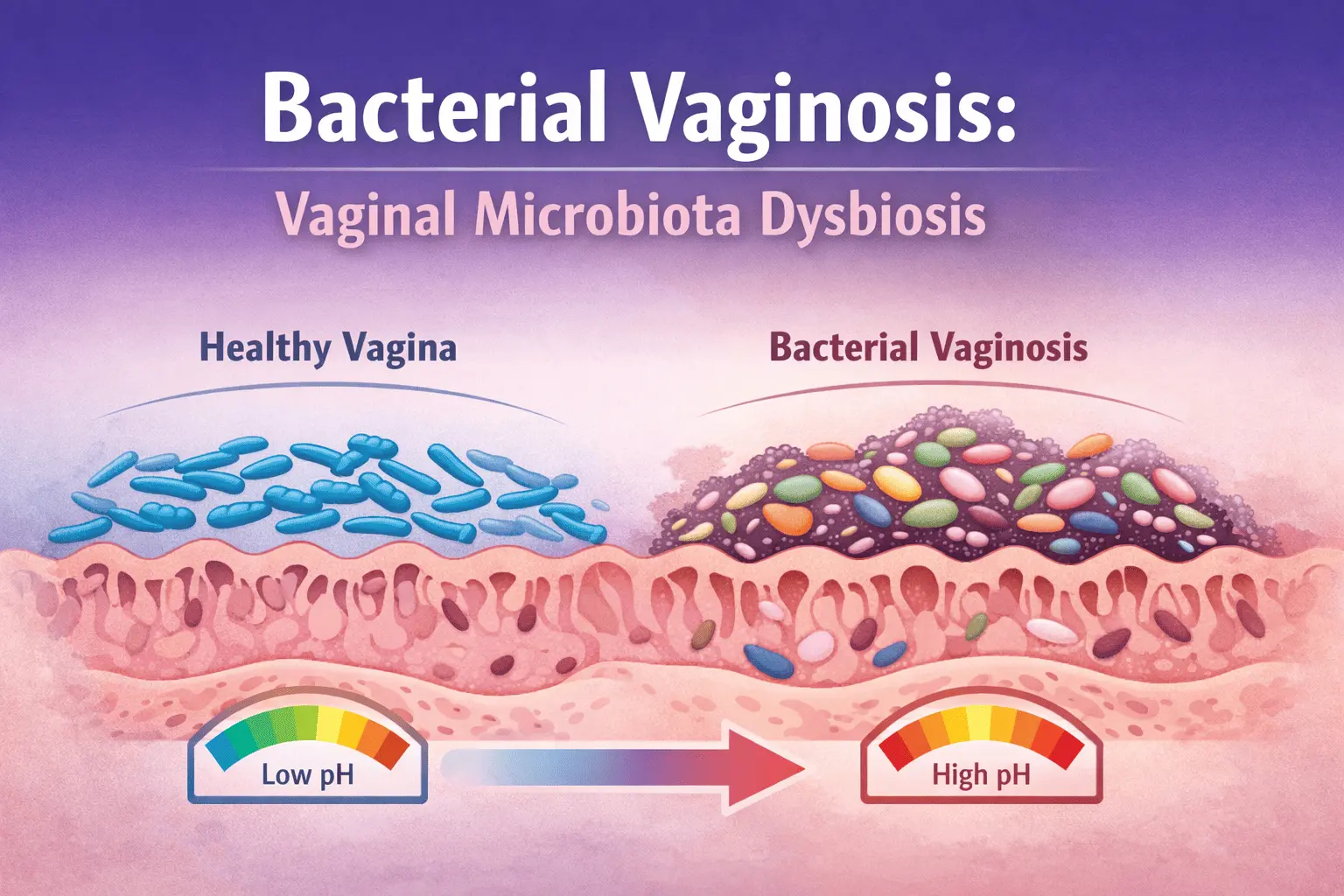
Bacterial vaginosis (BV) is not a classical infection caused by a single pathogen, but a microbiota imbalance characterized by the disruption of the normal vaginal microbial ecosystem. It is a common condition in women of reproductive age and is associated with important reproductive and infectious health outcomes.
From a microbiological perspective, BV represents a shift from a Lactobacillus-dominated, low-diversity microbiome to a polymicrobial, anaerobe-rich community with altered metabolic and immune interactions. Understanding BV as an ecological disorder provides the foundation for exploring its pathogenesis, diagnosis, and emerging microbiome-based treatments in the following sections.
This article examines bacterial vaginosis through a microbiological lens, focusing on changes in vaginal microbiota composition, microbial interactions, and biofilm formation. It also discusses current diagnostic approaches and emerging strategies aimed at restoring a healthy vaginal ecosystem.
Vaginal Microbiota: Normal vs. Dysbiotic State
The vaginal microbiota is a dynamic microbial ecosystem whose composition plays a central role in maintaining vaginal health. Clear differences exist between the eubiotic (healthy) state and the dysbiotic state observed in bacterial vaginosis.
Composition of a Healthy Vaginal Microbiome
In healthy reproductive-age women, the vaginal microbiota is typically dominated by Lactobacillus species such as L. crispatus, L. gasseri, L. jensenii, and L. iners. These bacteria provide protection through several key mechanisms:
- Lactic acid production, which maintains a low vaginal pH (≈3.5–4.5) unfavorable to many pathogens
- Secretion of antimicrobial substances, including hydrogen peroxide and bacteriocins
- Competitive exclusion of opportunistic and pathogenic microorganisms
- Reinforcement of epithelial barrier integrity
This low-diversity, Lactobacillus-rich environment is considered a hallmark of vaginal microbial stability and resilience.
Microbial Shift in Bacterial Vaginosis
Bacterial vaginosis is characterized by a marked loss of Lactobacillus dominance and a transition toward a diverse, anaerobe-rich microbial community. Key features of this dysbiotic shift include:
- Expansion of strict and facultative anaerobic bacteria
- Increase in vaginal pH, often above 4.5
- Reduced production of lactic acid and other antimicrobial factors
- Greater microbial diversity and ecological instability
These changes weaken natural defenses and create conditions that favor persistence and recurrence of BV.
Key Bacterial Species Associated with BV
BV is a polymicrobial condition, commonly associated with the enrichment of several anaerobic taxa, including:
- Gardnerella vaginalis, often considered a central ecological driver
- Atopobium vaginae, frequently detected within BV-associated biofilms
- Curved and motile bacteria such as Mobiluncus spp.
- Other anaerobes including Prevotella and Bacteroides species
Rather than acting independently, these microorganisms form cooperative networks that contribute to biofilm formation, altered metabolism, and disease persistence—topics explored in the next section.
Microbiological Mechanisms and Pathogenesis of BV
Bacterial vaginosis develops through complex microbiological mechanisms involving microbial cooperation, metabolic shifts, and altered host–microbe interactions, rather than invasion by a single pathogen.
Biofilm Formation and Microbial Cooperation
A defining feature of BV is the formation of polymicrobial biofilms that adhere tightly to the vaginal epithelium. These structured communities:
- Are initiated primarily by Gardnerella vaginalis, which acts as a biofilm scaffold
- Facilitate the attachment and persistence of other BV-associated anaerobes, including Atopobium vaginae
- Protect bacteria from host immune defenses and antimicrobial treatments
Biofilm organization enhances microbial survival, promotes interspecies metabolic cooperation, and contributes significantly to treatment failure and recurrence.
Metabolic Byproducts and Clinical Manifestations
The dysbiotic BV microbiota exhibits altered metabolic activity, particularly the degradation of amino acids and peptides. This leads to the production of:
- Biogenic amines (e.g., putrescine, cadaverine, trimethylamine)
- Volatile organic compounds responsible for the characteristic fishy odor
These metabolic byproducts correlate with increased vaginal pH and the typical discharge observed in BV, linking microbial metabolism directly to clinical symptoms.
Host–Microbe Interactions
BV-associated microbial communities also influence the vaginal epithelium and local immune environment:
- Disruption of epithelial barrier function
- Modulation of innate immune responses with altered cytokine production
- Low-grade inflammation that may increase susceptibility to sexually transmitted infections
Together, these microbiological and host-related processes explain why BV behaves as a chronic, recurrent condition rather than an acute infection.
Diagnosis of Bacterial Vaginosis: Microbiological Approaches
Accurate diagnosis of bacterial vaginosis relies on identifying microbiota alterations rather than a single causative organism. Both classical microscopy and modern molecular tools are used to capture these microbial changes.
Microscopic Diagnosis (Gram Stain and Nugent Score)
The Gram-stained vaginal smear remains the microbiological gold standard for BV diagnosis. Evaluation focuses on:
- Relative abundance of Lactobacillus morphotypes (large Gram-positive rods)
- Presence of Gardnerella/anaerobic morphotypes (small Gram-variable rods)
- Curved rods consistent with Mobiluncus spp.
These features are quantified using the Nugent scoring system, which assigns a score from 0 to 10:
- 0–3: normal microbiota
- 4–6: intermediate state
- 7–10: bacterial vaginosis
This method directly reflects the ecological shift from eubiosis to dysbiosis.
Clinical Criteria vs. Laboratory Diagnosis
Clinical diagnosis often relies on Amsel criteria, which include vaginal pH elevation, characteristic discharge, odor on potassium hydroxide testing, and presence of clue cells. While useful in clinical settings, these criteria:
- Are subjective and examiner-dependent
- Do not provide detailed information on microbial composition
- Are less sensitive for intermediate or asymptomatic cases
From a microbiological standpoint, laboratory-based methods offer greater reproducibility and mechanistic insight.
Molecular and Culture-Independent Methods
Advances in molecular microbiology have transformed BV diagnosis and research:
- PCR-based assays enable sensitive detection of BV-associated bacteria
- 16S rRNA gene sequencing allows comprehensive profiling of the vaginal microbiome
- Identification of distinct community state types (CSTs) improves understanding of disease heterogeneity
These culture-independent approaches highlight BV as a spectrum of dysbiotic states and are increasingly informing personalized diagnostic and therapeutic strategies.
Treatment, Recurrence, and Microbiome Restoration
Current management of bacterial vaginosis focuses on reducing anaerobic overgrowth, but long-term success is limited by microbiome disruption and biofilm persistence.
Antimicrobial Therapy and Microbial Resistance
Standard treatment relies on metronidazole or clindamycin, administered orally or intravaginally. These antibiotics are effective at reducing BV-associated anaerobes but:
- Also affect beneficial Lactobacillus populations
- Do not fully eradicate structured biofilms
- May select for tolerant or resistant microbial communities
As a result, antimicrobial therapy often restores symptoms without fully reestablishing a stable, protective microbiota.
Recurrence and Biofilm Persistence
Recurrence is a hallmark of BV, with many women experiencing relapse within months of treatment. Key contributing factors include:
- Incomplete disruption of polymicrobial biofilms attached to the vaginal epithelium
- Rapid recolonization by BV-associated anaerobes
- Failure of Lactobacillus species to reestablish dominance
These features reinforce the concept of BV as a chronic ecological disorder rather than a transient infection.
Probiotics and Microbiota-Targeted Strategies
Microbiome-focused approaches aim to restore vaginal eubiosis rather than simply eliminate bacteria:
- Lactobacillus-based probiotics seek to reestablish acidification and colonization resistance
- Adjunctive therapies target biofilm disruption and microbial interactions
- Emerging strategies include live biotherapeutic products and personalized microbiome modulation
Such approaches reflect a shift toward ecosystem restoration, offering promising avenues for reducing recurrence and improving long-term outcomes.
Conclusion
Bacterial vaginosis is best viewed as a disorder of the vaginal microbial ecosystem rather than a disease caused by a single pathogen. Its development and persistence are driven by microbial interactions, metabolic changes, and biofilm formation that disrupt normal host–microbe balance.
A deeper understanding of these microbiological mechanisms is essential for improving diagnosis and moving toward microbiome-focused therapies that restore vaginal eubiosis and reduce recurrence, shaping the future of BV management.


