

What Is Urine Specific Gravity?
Definition
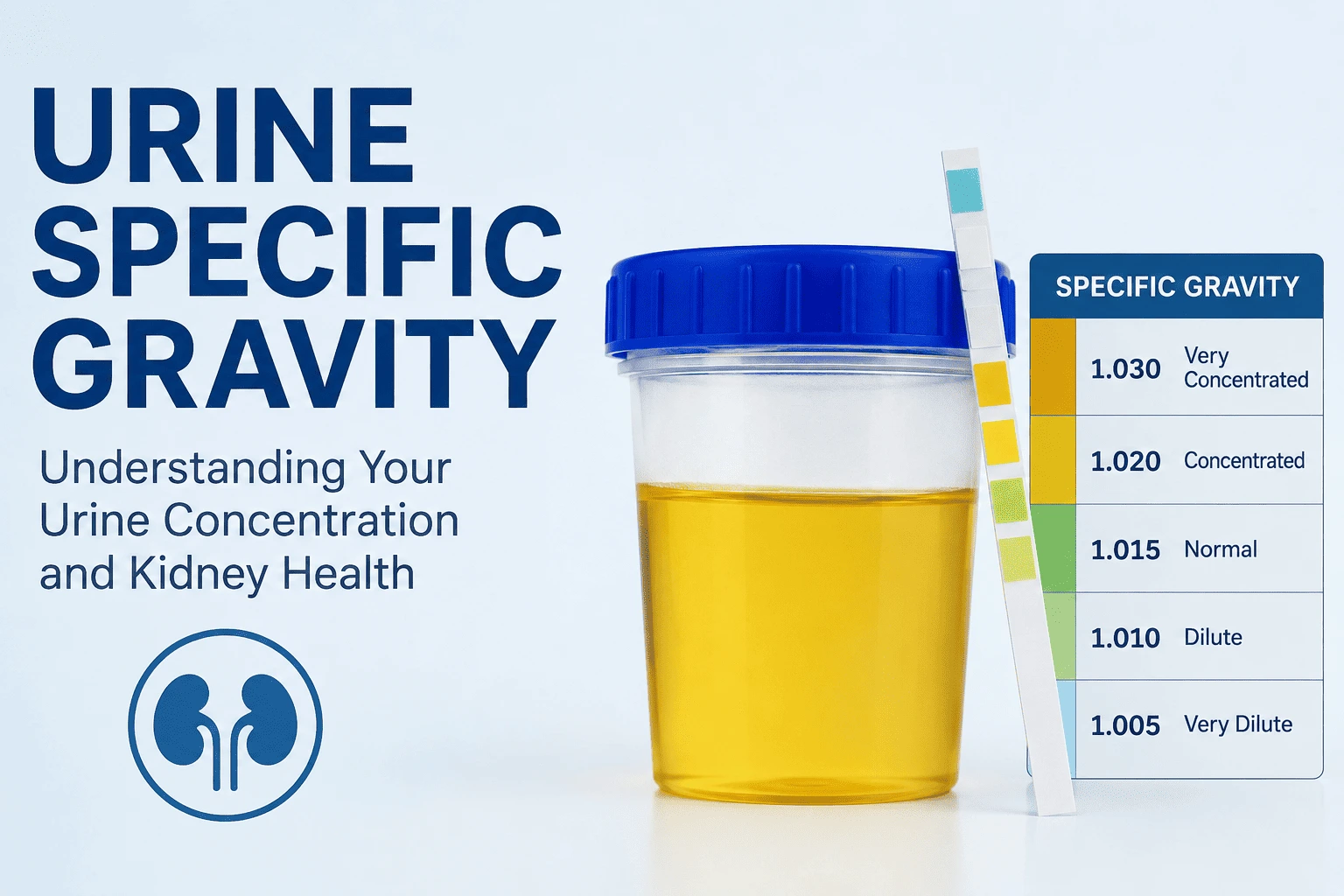
Urine specific gravity (USG) is a laboratory measurement that reflects the concentration of dissolved substances in urine. It compares the density of urine to the density of water.
- Water has a specific gravity of 1.000
- Urine specific gravity is usually higher because it contains dissolved substances such as salts, urea, and other waste products
- The more concentrated the urine, the higher the specific gravity
This simple measurement provides valuable insight into how well the kidneys are functioning.
What Does Urine Specific Gravity Measure?
Urine specific gravity gives an overall indication of how concentrated or diluted the urine is.
- High specific gravity means urine is concentrated
- Low specific gravity means urine is diluted
- It reflects the balance between fluid intake and fluid loss
- It also indicates how effectively the kidneys are regulating water and solute balance
Rather than measuring a single substance, it evaluates the total concentration of all dissolved particles in the urine.
Role of the Kidneys in Urine Concentration
The kidneys play a central role in controlling urine concentration through filtration and reabsorption processes.
- Blood is filtered in the glomeruli to form primary urine
- Useful substances and water are reabsorbed in the renal tubules
- Waste products and excess substances remain in the urine
- Hormones such as antidiuretic hormone (ADH) regulate water reabsorption
When the kidneys function properly, they adjust urine concentration based on the body’s hydration status.
Normal Range of Urine Specific Gravity
Typical Reference Range
Urine specific gravity normally falls within a relatively narrow range in healthy individuals.
- The typical range is 1.005 to 1.030
- Values closer to 1.005 indicate more diluted urine
- Values closer to 1.030 indicate more concentrated urine
- Small variations within this range are considered normal
This range may vary slightly depending on the laboratory and measurement method used.
Factors That Influence Normal Values
Urine specific gravity is not a fixed value and can change throughout the day based on several physiological factors.
- Fluid intake: drinking large amounts of water lowers specific gravity
- Dehydration: increases urine concentration and raises specific gravity
- Diet: high protein or salt intake can increase values
- Physical activity: sweating can lead to more concentrated urine
- Environmental conditions: hot weather may increase concentration due to fluid loss
These variations are normal and reflect the body’s ability to maintain fluid balance.
First Morning Urine vs. Random Samples
The timing of urine collection can significantly affect specific gravity results.
- First morning urine is usually more concentrated
- It often has a higher specific gravity due to overnight water conservation
- Random urine samples may be more diluted depending on recent fluid intake
- Comparing results requires consideration of the collection time
For this reason, clinicians sometimes prefer first morning samples for more consistent evaluation.
When Is a Value Considered Abnormal?
Values outside the normal range may suggest an underlying issue, but they must be interpreted in context.
- Values below 1.005 may indicate excessive hydration or impaired kidney concentration ability
- Values above 1.030 may suggest dehydration or the presence of substances like glucose or protein
- A single abnormal result is not always diagnostic
- Additional tests are often needed to confirm any suspected condition
Understanding the normal range is essential for identifying meaningful deviations and guiding further clinical evaluation.
Causes of High Urine Specific Gravity
What Does High Urine Specific Gravity Mean?
High urine specific gravity indicates that the urine is more concentrated than normal.
- It reflects a higher amount of dissolved substances relative to water
- Commonly associated with reduced fluid volume in the body
- May also result from the presence of abnormal substances in urine
- Often seen in conditions affecting hydration or kidney function
This finding should always be interpreted alongside clinical symptoms and other laboratory results.
Dehydration
Dehydration is the most common cause of elevated urine specific gravity.
- Occurs when fluid intake is insufficient or fluid loss is excessive
- Leads to reduced urine volume and increased concentration
- Causes include vomiting, diarrhea, excessive sweating, or inadequate water intake
- The kidneys conserve water, resulting in concentrated urine
In this context, high specific gravity is usually reversible with proper hydration.
Presence of Glucose in Urine
Glucose in urine can significantly increase urine specific gravity.
- Commonly seen in uncontrolled diabetes mellitus
- Excess glucose is excreted in urine (glycosuria)
- Glucose draws water into the urine, increasing its density
- Often accompanied by symptoms such as frequent urination and thirst
This is an important diagnostic clue in metabolic disorders.
Protein in Urine
Proteinuria can also raise urine specific gravity.
- Indicates abnormal leakage of protein from the bloodstream into urine
- Often associated with kidney disorders such as glomerular disease
- Increased protein content contributes to higher urine density
- May require further evaluation with additional kidney function tests
Persistent proteinuria is a significant clinical finding.
Syndrome of Inappropriate Antidiuretic Hormone (SIADH)
SIADH is a condition characterized by excessive release of antidiuretic hormone.
- Leads to increased water reabsorption in the kidneys
- Results in reduced urine volume and highly concentrated urine
- Causes persistently elevated urine specific gravity
- May be associated with neurological disorders, lung disease, or certain medications
This condition requires careful medical evaluation and management.
Other Contributing Factors
Several additional factors can contribute to high urine specific gravity.
- Use of certain medications such as diuretics
- Reduced kidney perfusion due to conditions like heart failure
- Acute illnesses causing fluid imbalance
- Administration of contrast agents during imaging studies
Identifying the underlying cause is essential for accurate diagnosis and appropriate treatment.
Causes of Low Urine Specific Gravity
What Does Low Urine Specific Gravity Mean?
Low urine specific gravity indicates that the urine is more diluted than normal.
- It reflects a lower concentration of dissolved substances
- Suggests excess water relative to solutes in the urine
- Often linked to high fluid intake or impaired kidney concentrating ability
- May be temporary or associated with underlying medical conditions
This finding should be interpreted in the context of hydration status and clinical symptoms.
Overhydration
Excessive fluid intake is a common and usually harmless cause of low urine specific gravity.
- Occurs when large amounts of water are consumed in a short period
- Leads to dilution of urine and reduced solute concentration
- The kidneys excrete excess water to maintain fluid balance
- Often seen in individuals who intentionally increase water intake
In most cases, values return to normal once fluid intake is balanced.
Diabetes Insipidus
Diabetes insipidus is a key pathological cause of persistently low urine specific gravity.
- Characterized by a deficiency or resistance to antidiuretic hormone (ADH)
- Results in reduced water reabsorption in the kidneys
- Leads to the production of large volumes of very dilute urine
- Common symptoms include excessive thirst and frequent urination
This condition requires medical evaluation and specific diagnostic testing.
Chronic Kidney Disease
Chronic kidney disease can impair the kidneys’ ability to concentrate urine.
- Damage to nephrons reduces responsiveness to regulatory hormones
- Leads to an inability to properly reabsorb water
- Results in persistently low or fixed urine specific gravity
- Often associated with other abnormal kidney function tests
This is an important indicator of reduced renal function.
Acute Tubular Necrosis
Acute tubular necrosis affects the renal tubules responsible for urine concentration.
- Caused by ischemia or exposure to toxic substances
- Leads to damage of tubular cells and impaired reabsorption
- Results in dilute urine with low specific gravity
- May occur in hospitalized or critically ill patients
Recovery depends on the severity and underlying cause of the injury.
Impaired Renal Concentrating Ability
Some conditions specifically affect the kidneys’ ability to concentrate urine without complete kidney failure.
- Can occur in early stages of kidney disease
- May be seen in electrolyte imbalances such as low sodium levels
- Results in urine that remains consistently diluted
- Sometimes referred to as hyposthenuria
Persistent findings may require further investigation to identify the underlying cause.
How Urine Specific Gravity Is Measured and Interpreted
Methods Used to Measure Urine Specific Gravity
Urine specific gravity can be measured using different laboratory techniques, each with its own level of accuracy.
- Dipstick test
- Commonly used in routine urinalysis
- Provides a quick estimate of urine concentration
- Less precise compared to other methods
- Refractometer
- Measures how light bends as it passes through urine
- More accurate and widely used in laboratories
- Can detect small changes in urine concentration
- Urinometer
- An older method based on urine density
- Less commonly used today due to lower accuracy
The choice of method depends on the clinical setting and the level of precision required.
Role in Routine Urinalysis
Urine specific gravity is a standard component of urinalysis and provides important diagnostic information.
- Helps assess hydration status
- Provides insight into kidney function
- Often interpreted alongside parameters such as pH, protein, glucose, and ketones
- Serves as an initial screening tool for various medical conditions
Because it is simple and quick, it is routinely included in general health evaluations.
Factors Affecting Measurement Accuracy
Several factors can influence urine specific gravity results and should be considered during interpretation.
- Presence of glucose or protein can artificially increase values
- Radiographic contrast agents may elevate specific gravity
- Temperature variations can affect measurement accuracy
- Highly alkaline urine may interfere with dipstick readings
- Improper sample handling or delayed analysis can alter results
Understanding these factors helps avoid misinterpretation of test outcomes.
How Results Are Interpreted
Interpreting urine specific gravity requires considering both the value and the clinical context.
- High values suggest concentrated urine and possible dehydration or excess solutes
- Low values indicate diluted urine or impaired kidney concentrating ability
- Persistently fixed values may point to chronic kidney disease
- Results should always be correlated with symptoms and other laboratory findings
A single measurement provides useful information, but repeated testing may be needed for accurate diagnosis.
FAQs
The normal range is typically between 1.005 and 1.030
Values within this range usually indicate normal kidney function and hydration status
It means the urine is more concentrated than normal
Common causes include dehydration, glucose in urine, or protein in urine
It indicates diluted urine
It may be due to excessive fluid intake or conditions like diabetes insipidus
Yes, it can vary depending on fluid intake, diet, and physical activity
First morning urine is usually more concentrated than later samples
No, it is not diagnostic on its own
It must be interpreted along with symptoms and other laboratory test results
Medical Disclaimer: This content is for informational and educational purposes only and does not constitute medical advice. It is not intended to replace professional medical consultation, diagnosis, or treatment. Always seek the advice of a qualified healthcare provider with any questions regarding a medical condition.


