

Gas chromatography (GC) is an analytical separation technique widely used to separate, identify, and quantify volatile and semi-volatile chemical compounds in complex mixtures. It is an important technique in analytical chemistry, biochemistry, pharmaceutical research, environmental science, food safety, and medical laboratory analysis.
The technique works by vaporizing a sample and transporting it through a chromatographic column using an inert carrier gas. Inside the column, the different compounds interact with a stationary phase to varying degrees, resulting in different retention times and allowing their separation.
Gas chromatography is particularly useful for analyzing compounds that can be vaporized without undergoing significant thermal decomposition. When coupled with mass spectrometry (GC-MS), it also provides powerful capabilities for identifying unknown substances.
This article explains the principle of gas chromatography, its main components, the analytical procedure, chromatogram interpretation, and its major applications in biological and analytical laboratories.
1. What Is Gas Chromatography and How Does It Work?
Gas chromatography is a chromatographic technique that separates the components of a mixture based on their distribution between a gaseous mobile phase and a stationary phase contained inside a column.
Unlike liquid chromatography, which uses a liquid mobile phase, gas chromatography uses a carrier gas to transport vaporized compounds through the column.
Principle of Gas Chromatography
The principle of gas chromatography is based on the differences in volatility and interactions of chemical compounds with the stationary phase.
During analysis, the sample is introduced into a heated injection port, where it is vaporized. The carrier gas then transports the vaporized sample through the chromatographic column.
As the compounds travel through the column, they repeatedly interact with the stationary phase. Compounds that interact strongly with the stationary phase spend more time inside the column and move more slowly. In contrast, compounds with weaker interactions spend more time in the mobile phase and travel faster.
Consequently, the different compounds leave the column at different times, known as retention times.
The separation process can be summarized as follows:
- Sample injection into the heated injection port.
- Vaporization of the sample.
- Transport of vaporized compounds by the carrier gas.
- Separation of compounds inside the chromatographic column.
- Detection of separated compounds.
- Recording and interpretation of the chromatogram.
Main Phases Involved in Gas Chromatography
1. Mobile phase
The mobile phase is a gaseous carrier that transports the sample through the chromatographic column. Common carrier gases include:
- Helium: An inert gas widely used in GC analysis.
- Hydrogen: Provides high efficiency and rapid analysis but requires appropriate safety precautions.
- Nitrogen: Used in specific applications, depending on the detector and analytical conditions.
The carrier gas should be chemically inert under the analytical conditions and sufficiently pure to avoid contamination and interference.
2. Stationary phase
The stationary phase is the material responsible for retaining and separating the compounds inside the chromatographic column.
It is usually a non-volatile liquid polymer coated onto the internal surface of a capillary column or supported on a solid material in packed columns.
The chemical properties of the stationary phase influence the separation selectivity. For example, nonpolar stationary phases are commonly used for separating nonpolar compounds, while polar phases are useful for compounds with polar interactions.
Difference Between Gas Chromatography and Liquid Chromatography
| Feature | Gas Chromatography (GC) | Liquid Chromatography (LC) |
|---|---|---|
| Mobile phase | Gas | Liquid |
| Sample state | Vaporized | Usually dissolved in liquid |
| Main requirement | Volatility and thermal stability | Solubility in mobile phase |
| Separation column | GC column | LC column |
| Common applications | Volatile compounds | Non-volatile and thermally sensitive compounds |
2. Gas Chromatography Instrumentation and Main Components
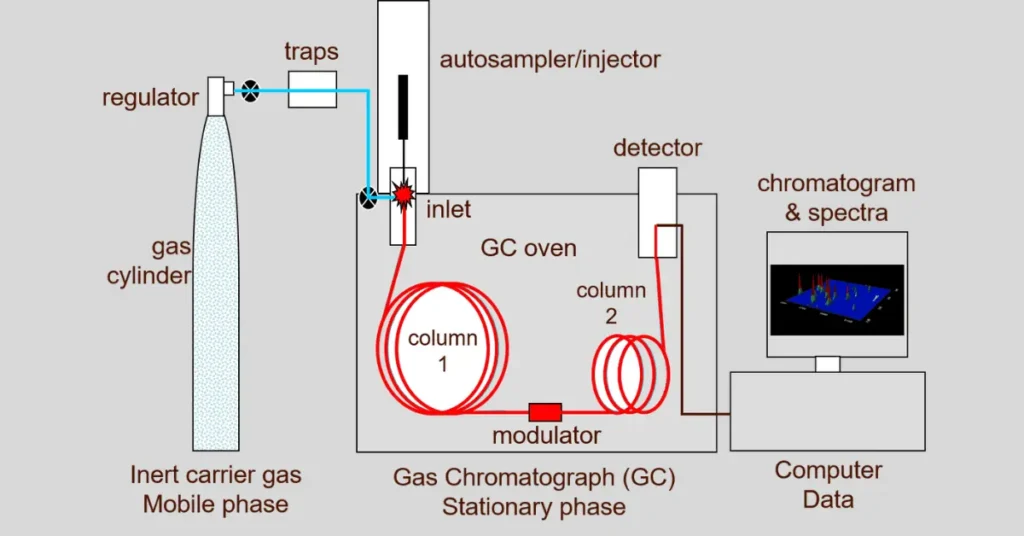
A gas chromatograph is an analytical instrument composed of several interconnected components. Each component plays a specific role in transporting, separating, and detecting the compounds present in a sample.
The main components include the carrier gas supply, injection system, chromatographic column, column oven, detector, and data acquisition system.
Carrier Gas Supply
The carrier gas supply provides the mobile phase required to transport the vaporized sample through the chromatographic column.
Helium, hydrogen, and nitrogen are commonly used gases. The gas passes through pressure regulators, purification filters, and flow-control systems before entering the instrument.
Maintaining a stable carrier gas flow rate is essential for obtaining reproducible retention times and efficient separation.
Sample Injection System
The injection system introduces a small quantity of the sample into the gas chromatograph.
The injection port is heated to a temperature sufficient to vaporize the sample rapidly without causing significant degradation.
Two common injection modes are:
- Split injection: Only a fraction of the vaporized sample enters the column, while the remaining portion is vented. It is suitable for relatively concentrated samples.
- Splitless injection: Most of the vaporized sample is transferred into the column. It is particularly useful for trace-level analysis and samples containing low concentrations of analytes.
The injection technique depends on the sample concentration and the sensitivity required.
Chromatographic Column
The chromatographic column is the central component responsible for separating the different compounds in the sample.
Two main types of columns are used:
1. Packed columns
Packed columns contain a solid support material coated with a stationary phase. They generally have a larger internal diameter and lower separation efficiency than modern capillary columns.
2. Capillary columns
Capillary columns are narrow tubes, commonly made of fused silica, with a thin stationary-phase coating on their internal surface.
They provide high separation efficiency and are widely used in modern gas chromatography.
The choice of column depends on the nature of the compounds being analyzed, their polarity, and the required separation efficiency.
Column Oven
The column is placed inside a temperature-controlled oven.
Temperature plays an important role in controlling the volatility of compounds and their interactions with the stationary phase.
Two operating modes are commonly used:
- Isothermal operation: The column temperature remains constant throughout the analysis.
- Temperature-programmed operation: The temperature increases gradually during the analysis to facilitate the separation of compounds with different boiling points.
Temperature programming is particularly useful when analyzing complex mixtures containing compounds with a wide range of volatilities.
Detectors Used in Gas Chromatography
After separation, the compounds leave the column and enter a detector, which converts their presence into an electrical signal.
Several detector types are available depending on the chemical properties of the analytes.
1. Flame Ionization Detector (FID)
The flame ionization detector is one of the most widely used GC detectors.
It works by burning the organic compounds in a hydrogen-air flame. The combustion process generates ions, producing an electrical current proportional to the amount of detectable organic material.
Main characteristics:
- High sensitivity for many organic compounds.
- Wide linear dynamic range.
- Particularly useful for hydrocarbons.
- Limited response to compounds without carbon-hydrogen bonds.
- Destructive detection method.
2. Thermal Conductivity Detector (TCD)
The thermal conductivity detector measures changes in the thermal conductivity of the gas leaving the chromatographic column.
When a compound enters the detector, it changes the thermal conductivity of the gas mixture, producing a measurable electrical signal.
Its main characteristics include:
- Broad applicability to different compounds.
- Non-destructive detection.
- Lower sensitivity than FID for many organic analytes.
- Useful for detecting permanent gases and inorganic compounds.
3. Electron Capture Detector (ECD)
The electron capture detector is highly sensitive to compounds capable of capturing electrons.
It is particularly useful for detecting halogenated compounds, including certain pesticides and environmental pollutants.
4. Mass Spectrometry Detector (MS)
Mass spectrometry can be coupled with gas chromatography to form gas chromatography-mass spectrometry (GC-MS).
In this system, compounds separated by the GC column enter the mass spectrometer, where they are ionized and fragmented into charged particles.
These ions are separated according to their mass-to-charge ratio (m/z), producing a mass spectrum that can be used to identify compounds.
GC-MS is particularly valuable for complex biological, pharmaceutical, toxicological, and environmental samples.
3. Gas Chromatography Procedure: From Sample Preparation to Analysis
Gas chromatography analysis involves several steps, beginning with sample preparation and ending with the interpretation of analytical results.
Sample Preparation
Sample preparation is an important step because impurities, non-volatile substances, and interfering compounds can affect chromatographic separation and instrument performance.
Depending on the sample type, preparation may involve:
- Extraction of target compounds from biological or environmental samples.
- Filtration to remove suspended particles.
- Dilution to obtain an appropriate analyte concentration.
- Centrifugation to separate particulate material.
- Chemical derivatization when necessary.
Derivatization is particularly useful when compounds have low volatility or poor thermal stability. Chemical modification can improve their volatility and chromatographic behavior.
For example, certain fatty acids and amino acids may require derivatization before GC analysis.
Sample Injection and Vaporization
A small volume of the prepared sample is introduced into the heated injection port using an appropriate syringe or automated autosampler.
The sample is rapidly vaporized and mixed with the carrier gas.
Depending on the injection mode, the vaporized sample enters the column through split or splitless injection.
Separation Inside the Chromatographic Column
The carrier gas transports the vaporized compounds through the column.
During this process, the analytes repeatedly distribute between the mobile and stationary phases.
Their different interactions with the stationary phase and differences in volatility produce different migration rates.
As a result, the compounds become separated and leave the column at different retention times.
Detection and Signal Processing
When each compound exits the column, it reaches the detector.
The detector generates an electrical signal corresponding to the presence and quantity of the compound.
The data acquisition system records these signals and converts them into a chromatogram.
Each detectable compound generally produces a peak, provided that the analytical conditions allow adequate separation and detection.
Qualitative and Quantitative Analysis
Gas chromatography can be used for both qualitative and quantitative analysis.
Qualitative analysis
Qualitative analysis aims to identify the compounds present in a sample.
One common approach is to compare the retention time of an unknown compound with that of an authentic reference standard analyzed under identical conditions.
When GC is coupled with mass spectrometry, identification can be further supported by comparing the mass spectrum with reference spectral libraries.
Quantitative analysis
Quantitative analysis determines the concentration or amount of a specific compound in a sample.
It is commonly performed by measuring the peak area or peak height and comparing the results with calibration standards of known concentrations.
Two common quantification approaches are:
- External standard calibration: The analyte response is compared with a calibration curve prepared using known concentrations.
- Internal standard calibration: A known quantity of another compound is added to samples and standards to compensate for variations during sample preparation and analysis.
4. How to Interpret a Gas Chromatography Chromatogram
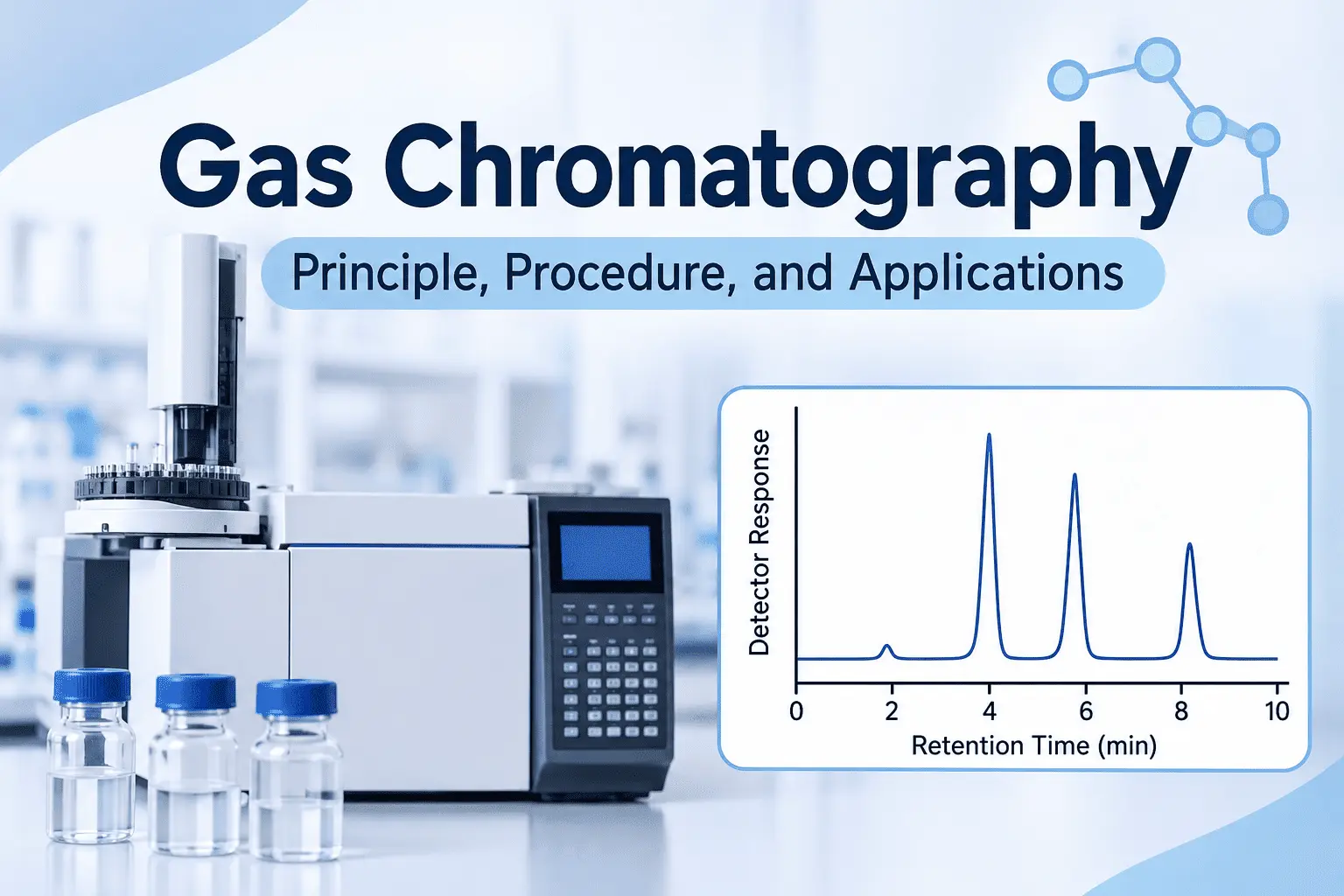
A chromatogram is the graphical representation of the detector response as a function of time.
It provides information about the number of detected components, their retention times, and their relative or calculated quantities.
Main Features of a Chromatogram
A typical gas chromatography chromatogram contains several important elements:
- X-axis: Represents retention time, usually expressed in minutes.
- Y-axis: Represents detector response, often expressed in signal units or electrical current.
- Peaks: Correspond to detected compounds.
- Baseline: Represents the detector signal when no significant analyte is being detected.
Each peak represents a compound or a group of compounds that were not fully separated.
The position and size of the peaks provide important analytical information.
Important Chromatographic Parameters
1. Retention time (tR)
Retention time is the time required for a compound to travel from the injection point to the detector.
It is commonly used for the identification of compounds by comparison with reference standards under identical analytical conditions.
2. Retention factor (k)
The retention factor describes how strongly a compound is retained by the stationary phase relative to its movement through the mobile phase.
It is calculated using the adjusted retention time divided by the dead time of the column.
3. Resolution (Rs)
Resolution measures the degree of separation between two adjacent chromatographic peaks.
Higher resolution indicates better separation. A resolution of approximately 1.5 or greater is commonly considered sufficient for baseline separation of two peaks under typical conditions.
4. Peak area and peak height
Peak area corresponds to the integrated detector response over the duration of a peak.
Peak height represents the maximum detector response reached by that peak.
Peak area is generally preferred for quantitative analysis because it is less sensitive to moderate variations in peak width.
5. Theoretical plates and column efficiency
Theoretical plates are a measure of chromatographic column efficiency.
A higher number of theoretical plates generally indicates narrower peaks and better separation efficiency under comparable conditions.
Factors Affecting Gas Chromatography Separation
Several experimental parameters can influence chromatographic performance:
- Column temperature: Increasing temperature generally reduces retention times but may decrease separation between some compounds.
- Carrier gas flow rate: Changes in flow rate affect analysis time and column efficiency.
- Column dimensions: Column length, internal diameter, and stationary-phase film thickness influence separation.
- Stationary-phase properties: The polarity and chemical characteristics of the stationary phase determine analyte interactions.
- Sample concentration: Excessive sample loading can cause peak broadening and distorted peak shapes.
- Injection conditions: Injection temperature and technique influence sample vaporization and transfer into the column.
Optimizing these parameters is essential for obtaining accurate, reproducible, and reliable analytical results.
5. Applications, Advantages, and Limitations of Gas Chromatography
Gas chromatography is widely used in research laboratories, industrial quality control, clinical toxicology, and environmental monitoring because of its high separation efficiency and analytical versatility.
Applications of Gas Chromatography
1. Medical and Clinical Laboratory Analysis
Gas chromatography can be used to analyze volatile compounds and metabolites in biological samples, including blood, urine, and breath.
Examples include the analysis of volatile organic compounds, alcohols, organic acids, and certain metabolic products.
2. Toxicology and Drug Screening
GC is an important analytical technique in forensic and clinical toxicology.
It can be used to detect and quantify alcohols, volatile toxic substances, and various drugs or their metabolites, depending on their chemical properties and sample preparation requirements.
GC-MS is particularly valuable for identifying unknown toxicological compounds.
3. Pharmaceutical Analysis
In pharmaceutical laboratories, gas chromatography is used for:
- Analysis of residual solvents in pharmaceutical products.
- Detection of volatile impurities.
- Quality control of raw materials.
- Assessment of certain active pharmaceutical ingredients.
4. Food Safety and Quality Control
Gas chromatography is used to analyze volatile compounds responsible for food aroma and flavor.
It can also be used to determine fatty acid profiles, detect certain pesticide residues, and monitor chemical contaminants in food products.
5. Environmental Analysis
Environmental laboratories use GC to detect and quantify volatile organic compounds (VOCs), petroleum hydrocarbons, pesticides, and other environmental contaminants in water, soil, and air samples.
6. Biochemical and Biological Research
Gas chromatography contributes to biological research through the analysis of:
- Fatty acid methyl esters.
- Volatile metabolites.
- Lipid composition.
- Organic acids.
- Volatile organic compounds produced by microorganisms.
These applications make GC a useful analytical tool in biochemistry, microbiology, and metabolomics research.
Advantages of Gas Chromatography
Gas chromatography offers several important advantages:
- High separation efficiency: Capillary columns can provide excellent separation of complex mixtures.
- High sensitivity: Appropriate detectors can detect low concentrations of specific compounds.
- Good reproducibility: Well-controlled analytical conditions allow reliable and repeatable measurements.
- Rapid analysis: Many samples can be analyzed within relatively short periods.
- Versatility: Different detectors and columns can be selected depending on the analytical objective.
- Quantitative capabilities: GC supports accurate quantification when appropriate calibration and quality-control procedures are applied.
Limitations of Gas Chromatography
Despite its advantages, gas chromatography has some limitations:
- Volatility requirement: Compounds must be sufficiently volatile or capable of being converted into volatile derivatives.
- Thermal stability: Thermally unstable compounds may decompose during vaporization or separation.
- Sample preparation: Some biological samples require complex extraction and derivatization procedures.
- Equipment cost: GC instruments, particularly GC-MS systems, can require substantial investment.
- Specialized expertise: Appropriate method development, maintenance, and chromatogram interpretation require trained personnel.
For these reasons, liquid chromatography is often preferred for analyzing large, non-volatile, or thermally sensitive biological molecules such as proteins, peptides, and many complex pharmaceuticals.
Conclusion
Gas chromatography is an important analytical separation technique used to separate, identify, and quantify volatile and semi-volatile compounds. Its principle relies on the distribution of analytes between a gaseous mobile phase and a stationary phase inside a chromatographic column.
The technique involves several essential components, including the carrier gas supply, injection system, chromatographic column, temperature-controlled oven, and detector. Understanding their functions is necessary for performing reliable analyses and interpreting chromatographic results.
With applications in clinical toxicology, pharmaceutical quality control, food safety, environmental monitoring, and biochemical research, gas chromatography remains an essential tool in modern analytical laboratories.
When coupled with mass spectrometry, it provides even greater analytical capabilities by combining chromatographic separation with structural information for compound identification.


