

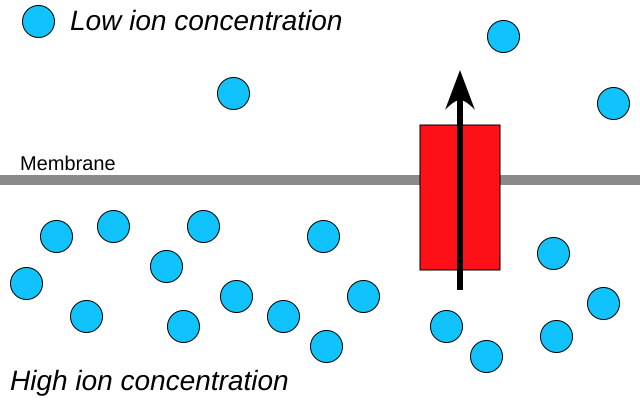
Chemiosmosis is a fundamental biological process through which cells convert energy stored in electrochemical gradients into chemical energy in the form of adenosine triphosphate (ATP). The concept was first introduced by Peter Mitchell in the 1960s, who proposed the chemiosmotic theory — a groundbreaking explanation of how ATP is synthesized in both mitochondria and chloroplasts.
In essence, chemiosmosis involves the movement of protons (H⁺ ions) across a semipermeable membrane, creating a proton gradient that stores potential energy. This energy drives the enzyme ATP synthase to phosphorylate adenosine diphosphate (ADP) into ATP, providing the main energy currency for cellular activities.
This process occurs in two major biological contexts:
- Oxidative phosphorylation within the inner mitochondrial membrane during cellular respiration, and
- Photophosphorylation within the thylakoid membrane during photosynthesis.
2. The Principle of Chemiosmosis
The principle of chemiosmosis is based on the creation and utilization of an electrochemical gradient across a biological membrane. This gradient, known as the proton motive force (PMF), is generated by the movement of protons (H⁺ ions) from one side of the membrane to the other, creating both a pH difference and an electrical potential.
During energy conversion processes such as cellular respiration or photosynthesis, high-energy electrons are passed along a series of protein complexes within the electron transport chain (ETC). As these electrons flow through the complexes, energy is released and used to pump protons across the membrane — from the mitochondrial matrix to the intermembrane space, or from the stroma into the thylakoid lumen, depending on the organelle.
This proton accumulation establishes a gradient where one side of the membrane becomes rich in protons (acidic and positively charged) while the opposite side becomes relatively alkaline and negatively charged. The resulting proton motive force acts like stored energy, similar to water behind a dam.
When protons flow back across the membrane through ATP synthase, their potential energy is converted into mechanical rotational energy, which the enzyme uses to catalyze the formation of ATP from ADP and inorganic phosphate (Pi).
Thus, chemiosmosis elegantly links electron transport and ATP synthesis, providing the key mechanism by which cells harness and store biochemical energy.
3. Chemiosmosis in Cellular Respiration
Chemiosmosis plays a central role in cellular respiration, specifically during the oxidative phosphorylation stage in the mitochondria. It is the process that converts the energy carried by NADH and FADH₂ — produced in glycolysis and the Krebs cycle — into ATP, the main energy molecule of the cell.
3.1 The Site: Inner Mitochondrial Membrane
Chemiosmosis occurs across the inner mitochondrial membrane, which houses the electron transport chain (ETC) and the enzyme ATP synthase. This membrane separates the mitochondrial matrix (where the Krebs cycle takes place) from the intermembrane space, allowing the creation of a controlled proton gradient.
3.2 Formation of the Proton Gradient
The process begins when high-energy electrons from NADH and FADH₂ are transferred to the ETC complexes (I to IV). As electrons move through these complexes, the released energy drives proton pumps that actively transport H⁺ ions from the matrix to the intermembrane space.
This pumping action results in:
- A higher concentration of protons in the intermembrane space
- A negative charge and higher pH in the matrix
Together, these differences generate the proton motive force (PMF) — an electrochemical gradient that stores potential energy.
3.3 ATP Synthesis via ATP Synthase
Protons then flow back into the matrix through ATP synthase (Complex V). This flow, called proton flux, provides the energy for ATP synthase to rotate and catalyze the phosphorylation of ADP + Pi → ATP.
For every full turn of the enzyme, approximately three ATP molecules are produced.
3.4 Electron Acceptance by Oxygen
At the end of the electron transport chain, oxygen (O₂) acts as the final electron acceptor, combining with electrons and protons to form water (H₂O). This step ensures the continuation of electron flow and prevents a backup in the ETC.
3.5 Energy Yield
Through chemiosmosis, each NADH molecule generates about 3 ATP, and each FADH₂ yields around 2 ATP, making this stage the most energy-efficient part of cellular respiration.
4. Chemiosmosis in Photosynthesis
Chemiosmosis is not limited to cellular respiration; it also plays a vital role in photosynthesis, where it drives ATP synthesis during the light-dependent reactions. In this context, chemiosmosis occurs within the chloroplasts, specifically across the thylakoid membrane, converting light energy into chemical energy usable by the cell.
4.1 The Site: Thylakoid Membrane of the Chloroplast
Inside the chloroplast, the thylakoid membrane separates the thylakoid lumen (interior space) from the stroma (fluid surrounding the thylakoids). Embedded within this membrane are the photosystems (I and II), the electron transport chain (ETC), and ATP synthase — all essential components of the chemiosmotic process.
4.2 Formation of the Proton Gradient
When light energy excites electrons in Photosystem II (PSII), these high-energy electrons travel through the ETC toward Photosystem I (PSI).
As electrons move through the chain, their energy is used to pump protons (H⁺ ions) from the stroma into the thylakoid lumen. Additionally, the splitting of water molecules (photolysis) by PSII releases:
- Electrons (to replace those lost by PSII),
- Protons (H⁺) (which contribute to the proton gradient), and
- Oxygen (O₂) as a byproduct.
This dual mechanism — proton pumping and water splitting — leads to a high proton concentration inside the thylakoid lumen compared to the stroma.
4.3 ATP Synthesis by ATP Synthase
As the proton gradient builds up, protons flow back into the stroma through the ATP synthase complex. The movement of these protons (the proton motive force) provides the energy needed to convert ADP and inorganic phosphate (Pi) into ATP.
4.4 Integration with the Calvin Cycle
The ATP generated through chemiosmosis, along with NADPH (produced by Photosystem I), is then used in the Calvin cycle to fix carbon dioxide into organic molecules such as glucose.
4.5 Key Difference from Mitochondrial Chemiosmosis
While both mitochondria and chloroplasts use proton gradients and ATP synthase, their energy sources differ:
- In mitochondria, electrons come from the oxidation of nutrients.
- In chloroplasts, electrons are energized by light.
5. ATP Synthase – The Molecular Motor
At the heart of chemiosmosis lies ATP synthase, an extraordinary enzyme complex that functions as a molecular motor. It is responsible for converting the potential energy stored in the proton gradient into chemical energy in the form of ATP — the universal energy currency of the cell.
5.1 Structure of ATP Synthase
ATP synthase is a large multi-subunit enzyme embedded in the inner mitochondrial membrane and the thylakoid membrane of chloroplasts. It consists of two main parts:
- F₀ region: located within the membrane, forming a proton channel that allows H⁺ ions to flow through.
- F₁ region: projects into the mitochondrial matrix or stroma, containing catalytic sites for ATP synthesis.
These two regions are connected by a central rotational stalk, enabling the enzyme to physically rotate as protons pass through.
5.2 Mechanism of ATP Formation
When protons move down their electrochemical gradient through the F₀ channel, they cause the rotor portion of the enzyme to spin. This mechanical motion induces conformational changes in the F₁ catalytic domain, driving the reaction: ADP+Pi→ATP
Each full rotation of ATP synthase results in the production of approximately three ATP molecules. This process demonstrates a remarkable example of mechanochemical energy conversion — transforming ion flow into molecular motion and, ultimately, into chemical bonds.
5.3 Universality of ATP Synthase
ATP synthase is one of the most conserved enzymes in all of biology. It operates in:
- Mitochondria, during oxidative phosphorylation
- Chloroplasts, during photophosphorylation
- Prokaryotic cells, across their plasma membrane
This universality highlights its evolutionary importance as an ancient and efficient energy-converting machine.
5.4 Efficiency and Biological Significance
ATP synthase is extraordinarily efficient — nearly 100% of the energy from the proton motive force is converted into ATP. Without it, cells would be unable to sustain the energy demands of metabolism, transport, and biosynthesis.
Thus, ATP synthase serves as the final step of chemiosmosis, coupling the movement of protons with ATP production to power virtually all cellular processes.
6. Chemiosmosis vs. Substrate-Level Phosphorylation
Cells generate ATP through two main mechanisms: chemiosmosis and substrate-level phosphorylation. Although both processes result in ATP formation, they differ fundamentally in mechanism, location, and energy source.
6.1 Mechanism of ATP Formation
- Chemiosmosis:
In chemiosmosis, ATP is synthesized indirectly through the energy stored in a proton gradient across a membrane. The flow of protons through ATP synthase drives the phosphorylation of ADP to ATP. This process couples electron transport with ATP synthesis, as seen in oxidative phosphorylation (mitochondria) and photophosphorylation (chloroplasts). - Substrate-Level Phosphorylation:
Here, ATP is produced directly by transferring a phosphate group from a high-energy intermediate substrate to ADP. This process does not require membranes, proton gradients, or ATP synthase. It occurs during glycolysis and the Krebs cycle, where enzymes such as phosphoglycerate kinase or succinate-CoA synthetase catalyze ATP formation.
6.2 Energy Source
- Chemiosmosis: Uses the electrochemical energy of a proton motive force, established by the electron transport chain.
- Substrate-Level Phosphorylation: Relies on chemical energy directly stored in substrate molecules (e.g., 1,3-bisphosphoglycerate, phosphoenolpyruvate).
6.3 Cellular Location
- Chemiosmosis: Occurs in the inner mitochondrial membrane (during respiration) and the thylakoid membrane (during photosynthesis).
- Substrate-Level Phosphorylation: Takes place in the cytoplasm (glycolysis) and mitochondrial matrix (Krebs cycle).
6.4 ATP Yield and Efficiency
- Chemiosmosis: Produces the majority of ATP in aerobic organisms (around 32–34 ATP molecules per glucose).
- Substrate-Level Phosphorylation: Generates a small fraction of total ATP (only 2–4 ATP per glucose).
6.5 Comparative Summary
| Feature | Chemiosmosis | Substrate-Level Phosphorylation |
|---|---|---|
| Type of Process | Indirect (via proton gradient) | Direct (via enzyme-catalyzed transfer) |
| Membrane Required | Yes | No |
| Enzyme Involved | ATP synthase | Kinases or synthetases |
| Occurs In | Mitochondria, chloroplasts | Cytoplasm, mitochondrial matrix |
| Energy Source | Proton motive force | High-energy substrate |
| ATP Yield | High | Low |
Conclusion
Chemiosmosis is a central process in bioenergetics, linking electron transport to ATP synthesis through the creation and utilization of proton gradients. It occurs in both mitochondria and chloroplasts, powering cellular respiration and photosynthesis. By driving ATP production via ATP synthase, chemiosmosis provides the energy necessary for virtually all cellular functions. Understanding this process highlights the elegant efficiency of life’s energy conversion systems and its critical role in sustaining biological activity.
References:
- Berg, J. M., Tymoczko, J. L., & Gatto, G. J. (2019). Biochemistry (9th ed.). W.H. Freeman.
- Nelson, D. L., Cox, M. M. (2021). Lehninger Principles of Biochemistry (8th ed.). W.H. Freeman.
- Mitchell, P. (1961). Coupling of phosphorylation to electron and hydrogen transfer by a chemi-osmotic type of mechanism. Nature, 191(4784), 144–148. https://doi.org/10.1038/191144a0
- Taiz, L., Zeiger, E., Møller, I. M., & Murphy, A. (2015). Plant Physiology and Development (6th ed.). Sinauer Associates.
- Alberts, B., Johnson, A., Lewis, J., Morgan, D., Raff, M., Roberts, K., & Walter, P. (2022). Molecular Biology of the Cell (7th ed.). Garland Science.
- Campbell, M. K., & Farrell, S. O. (2015). Biochemistry (8th ed.). Cengage Learning.
- Voet, D., Voet, J. G., & Pratt, C. W. (2016). Fundamentals of Biochemistry: Life at the Molecular Level (5th ed.). Wiley.
- lackstone NW. Chemiosmosis, Evolutionary Conflict, and Eukaryotic Symbiosis. Results Probl Cell Differ. 2020;69:237-251. doi: 10.1007/978-3-030-51849-3_9.
- Macdonald JE, Ashby PD. The molecular mechanism of ATP synthase constrains the evolutionary landscape of chemiosmosis. Biophys J. 2025 Jul 1;124(13):2103-2119. doi: 10.1016/j.bpj.2025.05.017.


