

All living cells require energy to perform essential biological processes such as growth, repair, and maintenance. This energy is supplied in the form of adenosine triphosphate (ATP), which is primarily generated through cellular respiration. Among the different types of respiration, aerobic respiration is the most efficient mechanism used by eukaryotic organisms to produce ATP.
Aerobic respiration is a biochemical process that involves the complete oxidation of glucose (or other organic molecules) in the presence of oxygen (O₂). This reaction results in the release of carbon dioxide (CO₂), water (H₂O), and a large amount of ATP. The process occurs mainly in the mitochondria, often referred to as the “powerhouses” of the cell, due to their critical role in energy metabolism.
The Overall Chemical Equation of Aerobic Respiration
The process of aerobic respiration can be summarized by a single balanced chemical equation that represents the complete oxidation of one molecule of glucose in the presence of oxygen: C₆H₁₂O₆ + 6O₂ → 6CO₂ + 6H₂O + Energy (≈36–38 ATP)
In this equation, glucose (C₆H₁₂O₆) acts as the primary substrate, while oxygen (O₂) functions as the final electron acceptor. During the reaction, glucose molecules are broken down through a series of metabolic pathways, leading to the production of carbon dioxide (CO₂), water (H₂O), and adenosine triphosphate (ATP) — the main energy currency of the cell.
This reaction is a form of oxidation-reduction (redox) process, where glucose is oxidized (loses electrons) and oxygen is reduced (gains electrons) to form water. The controlled transfer of electrons through cellular pathways prevents energy loss as heat and allows for the efficient synthesis of ATP.
The overall equation highlights the interdependence between respiration and photosynthesis: while plants use light energy to convert carbon dioxide and water into glucose and oxygen, animals and most microorganisms reverse this process to release stored energy.
Stages of Aerobic Respiration
Aerobic respiration is a multistep metabolic process that takes place within the cytoplasm and mitochondria of eukaryotic cells. It involves a series of enzymatic reactions that gradually extract energy from glucose and store it in the form of ATP.
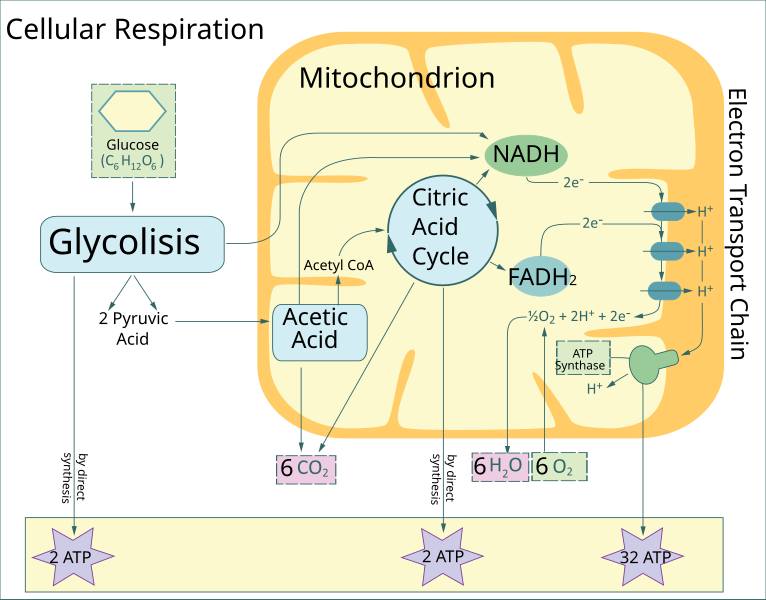
This process occurs in four main stages: Glycolysis, Pyruvate Oxidation, Krebs Cycle, and the Electron Transport Chain (ETC). Each stage plays a distinct role in the conversion of chemical energy into a usable cellular form.
1. Glycolysis — The First Step of Glucose Breakdown
Location: Cytoplasm
Main Function: Conversion of glucose to pyruvate
Glycolysis is the initial stage of aerobic respiration and occurs in the cytoplasm of the cell. In this ten-step process, one molecule of glucose (C₆H₁₂O₆) is enzymatically broken down into two molecules of pyruvate (C₃H₄O₃). This process does not require oxygen and can occur under both aerobic and anaerobic conditions.
During glycolysis:
- 2 ATP molecules are consumed in the early steps (investment phase).
- 4 ATP molecules are produced later (payoff phase), resulting in a net gain of 2 ATP.
- 2 NAD⁺ molecules are reduced to 2 NADH, which carry high-energy electrons to later stages.
Overall, glycolysis provides a modest amount of energy but produces critical intermediates needed for subsequent steps of aerobic respiration.
Glucose + 2NAD⁺ + 2ADP + 2Pᵢ → 2Pyruvate + 2NADH + 2ATP + 2H₂O
2. Pyruvate Oxidation — The Link Reaction
Location: Mitochondrial matrix
Main Function: Conversion of pyruvate into acetyl-CoA
The pyruvate molecules produced in glycolysis are transported into the mitochondrial matrix, where each is oxidized into acetyl-CoA by the enzyme pyruvate dehydrogenase complex (PDC).
During this process:
- One molecule of CO₂ is released per pyruvate (decarboxylation).
- NAD⁺ is reduced to NADH, transferring high-energy electrons to the electron carriers.
This reaction forms a vital link between glycolysis and the Krebs cycle, as acetyl-CoA serves as the entry molecule for the next stage of aerobic respiration.
2Pyruvate + 2NAD⁺ + 2CoA → 2Acetyl-CoA + 2NADH + 2CO₂
3. Krebs Cycle (Citric Acid Cycle)
Location: Mitochondrial matrix
Main Function: Oxidation of acetyl-CoA and generation of electron carriers
The Krebs cycle, also known as the citric acid cycle or tricarboxylic acid (TCA) cycle, is a cyclic series of reactions that further oxidize acetyl-CoA into carbon dioxide (CO₂). This stage generates NADH, FADH₂, and a small amount of ATP through substrate-level phosphorylation.
For each molecule of glucose (two turns of the cycle):
- 6 NADH, 2 FADH₂, and 2 ATP (or GTP) are produced.
- 4 CO₂ molecules are released as waste.
These electron carriers (NADH and FADH₂) are essential for powering the final stage of aerobic respiration, where the majority of ATP is synthesized.
4. Electron Transport Chain and Oxidative Phosphorylation
Location: Inner mitochondrial membrane
Main Function: Production of ATP using electrons from NADH and FADH₂
The electron transport chain (ETC) is the final and most energy-productive stage of aerobic respiration. It involves a series of protein complexes (I–IV) embedded in the inner mitochondrial membrane.
During this process:
- Electrons from NADH and FADH₂ pass through the chain, releasing energy.
- This energy is used to pump protons (H⁺) into the intermembrane space, creating a proton gradient.
- The return flow of protons through ATP synthase drives oxidative phosphorylation, producing ~34 ATP molecules.
- Finally, oxygen (O₂) acts as the terminal electron acceptor, combining with protons and electrons to form water (H₂O).
O₂ + 4e⁻ + 4H⁺ → 2H₂O
This step highlights the crucial role of oxygen in sustaining life — without it, the entire chain halts, and ATP production ceases.
Summary of Energy Yield
| Stage | Location | ATP Produced | Main Products |
|---|---|---|---|
| Glycolysis | Cytoplasm | 2 ATP | 2 Pyruvate, 2 NADH |
| Pyruvate Oxidation | Mitochondrial Matrix | 0 ATP | 2 Acetyl-CoA, 2 NADH |
| Krebs Cycle | Mitochondrial Matrix | 2 ATP | 6 NADH, 2 FADH₂, 4 CO₂ |
| Electron Transport Chain | Inner Membrane | 32–34 ATP | H₂O, ATP |
Total ATP Yield: ≈ 36–38 ATP per glucose molecule
Energy Yield in Aerobic Respiration
The efficiency of aerobic respiration lies in its remarkable ability to extract a high amount of energy from glucose molecules. Through the coordinated actions of glycolysis, the Krebs cycle, and the electron transport chain, the process generates approximately 36 to 38 molecules of ATP per molecule of glucose under optimal conditions.
This high energy yield is largely attributed to the electron transport chain and oxidative phosphorylation, where most of the ATP is synthesized. The controlled transfer of electrons through mitochondrial complexes ensures minimal energy loss as heat and maximizes ATP production.
In contrast, anaerobic respiration or fermentation produces only 2 ATP per glucose, as it lacks the oxidative steps that require oxygen. This comparison illustrates the superior metabolic efficiency of aerobic pathways in supporting sustained cellular activities such as active transport, biosynthesis, and cell division.
However, the total number of ATP molecules generated may vary slightly depending on:
- Cell type and metabolic conditions
- Shuttle systems used to transfer cytoplasmic NADH into mitochondria (malate-aspartate or glycerol phosphate shuttle)
- Mitochondrial membrane integrity and oxygen availability
Ultimately, aerobic respiration provides the primary energy supply for most eukaryotic organisms, making it essential for maintaining cellular homeostasis and organismal survival.
Cellular Location and Organelle Involvement
The process of aerobic respiration is compartmentalized within the cell to ensure maximum efficiency in energy conversion. Each stage occurs in a specific cellular location that provides the appropriate enzymes, cofactors, and microenvironment necessary for optimal metabolic activity.
In eukaryotic cells, aerobic respiration primarily takes place in the mitochondria. The structural organization of the mitochondrion plays a central role in facilitating the different biochemical reactions involved.
- Outer Membrane: Serves as a permeable boundary allowing small molecules and ions to enter the intermembrane space.
- Inner Membrane: Contains the electron transport chain and ATP synthase complexes. Its extensive folding into cristae increases surface area, enhancing ATP production efficiency.
- Matrix: The site of the Krebs cycle and pyruvate oxidation, containing necessary enzymes, substrates, and mitochondrial DNA.
The cytoplasm also participates in aerobic respiration, as it hosts the initial step — glycolysis, where glucose is split into pyruvate before entering the mitochondria.
In prokaryotic cells, which lack membrane-bound organelles, aerobic respiration still occurs but is adapted differently. The cytoplasm carries out reactions equivalent to glycolysis and the Krebs cycle, while the plasma membrane functions analogously to the mitochondrial inner membrane, hosting the electron transport chain and ATP synthase.
This compartmentalization, whether in mitochondria or at the plasma membrane, ensures a controlled flow of electrons, proton gradient formation, and efficient ATP synthesis, all of which are essential for sustaining cellular metabolism.
Aerobic vs Anaerobic Respiration
Cells can generate energy through two main metabolic routes: aerobic and anaerobic respiration. While both processes begin with glycolysis, they diverge significantly in their dependence on oxygen, ATP yield, and end products.
Aerobic respiration requires oxygen as the final electron acceptor, allowing for the complete oxidation of glucose into carbon dioxide (CO₂) and water (H₂O). This pathway enables the production of approximately 36–38 molecules of ATP per molecule of glucose, making it highly efficient and suitable for sustaining long-term energy demands in multicellular organisms.
In contrast, anaerobic respiration occurs in the absence of oxygen. Cells rely solely on glycolysis for ATP generation, resulting in the production of only 2 ATP molecules per glucose. The pyruvate formed during glycolysis is converted into other products such as lactic acid (in animal cells) or ethanol and carbon dioxide (in yeast and some bacteria) to regenerate NAD⁺, allowing glycolysis to continue.
Key Differences Between Aerobic and Anaerobic Respiration
| Feature | Aerobic Respiration | Anaerobic Respiration |
|---|---|---|
| Oxygen Requirement | Requires oxygen | Occurs without oxygen |
| Location | Cytoplasm and mitochondria | Cytoplasm only |
| End Products | CO₂ and H₂O | Lactic acid / Ethanol + CO₂ |
| ATP Yield | 36–38 ATP per glucose | 2 ATP per glucose |
| Organisms | Most eukaryotes (animals, plants) | Some bacteria, yeast, and muscle cells under hypoxia |
| Efficiency | High | Low |
Although anaerobic pathways are less efficient, they are crucial under hypoxic conditions, such as during intense muscular activity or in microorganisms that inhabit oxygen-poor environments. In contrast, aerobic respiration supports complex multicellular life by providing a continuous and efficient energy supply.
Conclusion
Aerobic respiration is a fundamental biological process that enables cells to efficiently convert glucose and oxygen into ATP, the universal energy currency of life. Through a coordinated sequence of reactions—glycolysis, pyruvate oxidation, the Krebs cycle, and the electron transport chain—cells extract maximal energy to sustain vital functions such as growth, repair, and homeostasis.
Its reliance on oxygen and the compartmentalized structure of mitochondria make aerobic respiration remarkably efficient compared to anaerobic pathways. Understanding this process provides essential insights into cellular metabolism, energy regulation, and the physiological mechanisms that support life in both simple and complex organisms.


