

Key Takeaway
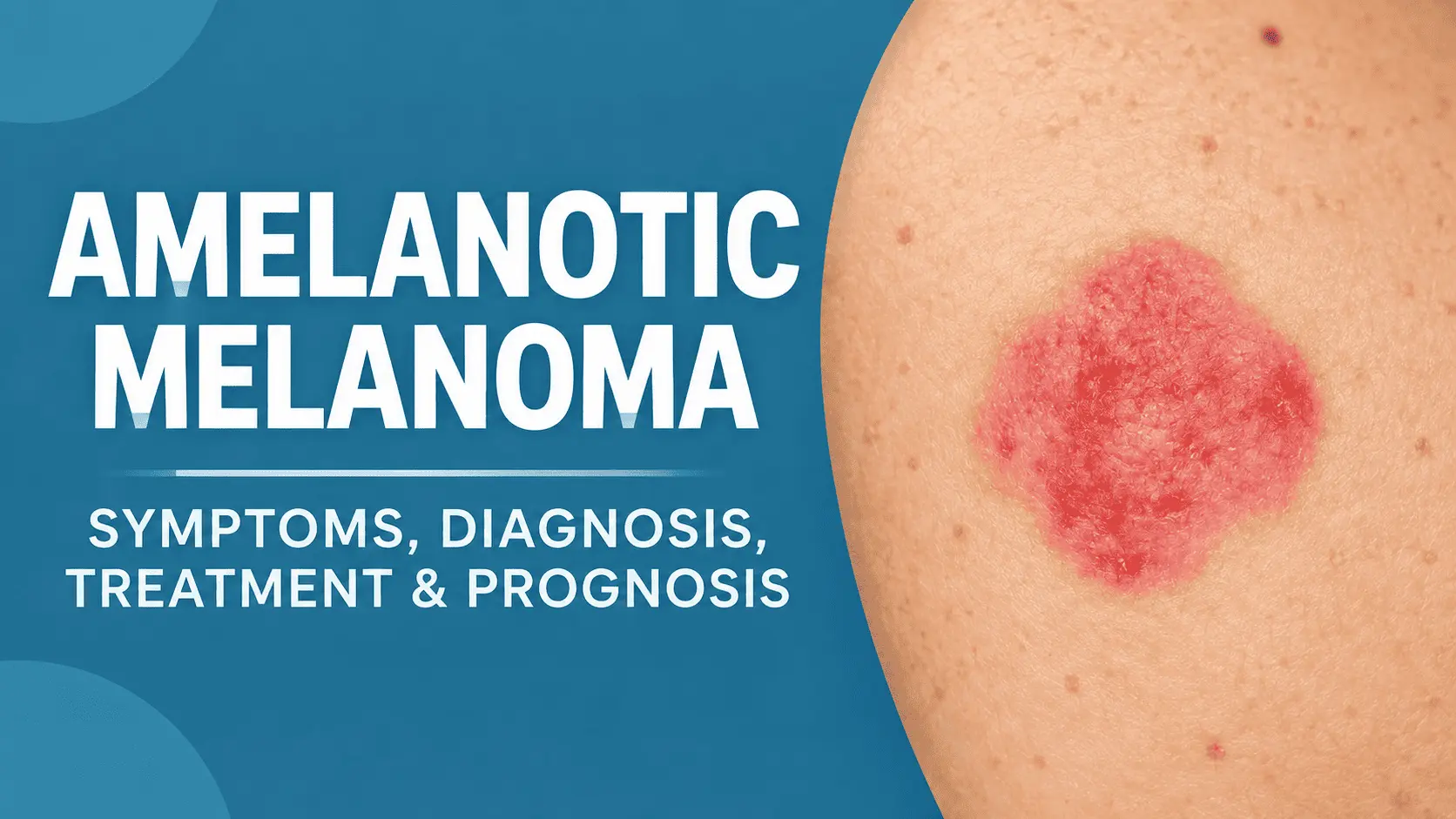
- Amelanotic melanoma is a rare form of melanoma that produces little or no melanin, so it may appear pink, red, or skin-colored rather than dark brown or black.
- It can be difficult to recognize because it may resemble benign skin conditions or other skin cancers.
- Warning signs can include an asymmetric or irregular lesion, changes in size or appearance, rapid growth, bleeding, crusting, or ulceration.
- Diagnosis may require dermoscopy and a skin biopsy, with additional laboratory or imaging tests used when appropriate.
- Treatment depends on the stage and characteristics of the melanoma and may include surgery, immunotherapy, targeted therapy, or other treatments.
- Because its appearance can make early detection challenging, any new, changing, persistent, or unusual skin lesion should be evaluated by a healthcare professional.
In this article, we will explore the key aspects of amelanotic melanoma, including its clinical presentation, risk factors, diagnostic challenges, treatment strategies, and prognosis.
What is Amelanotic Melanoma?
Amelanotic melanoma is a subtype of melanoma characterized by the absence or very low levels of melanin, the pigment that gives skin lesions their typical dark brown or black color. Because of this, the lesions often appear pink, red, or flesh-colored, making them blend in with other benign skin conditions. This lack of pigmentation is the primary reason why amelanotic melanoma is more difficult to detect compared to conventional melanomas.
Although it accounts for only 2–8% of all melanoma cases, amelanotic melanoma tends to be more aggressive and is frequently diagnosed at later stages, when the cancer has already spread deeper into the skin or metastasized.
Key Characteristics
- Appears as a pink, red, or skin-colored lesion rather than dark.
- Can mimic benign growths like eczema, psoriasis, or basal cell carcinoma.
- Often has irregular borders and may change in size or texture.
- Found on sun-exposed areas but may also develop in unusual sites like mucous membranes or under the nails.
Because of its subtle appearance, both patients and healthcare providers may fail to recognize amelanotic melanoma early, making awareness and clinical vigilance crucial.
Amelanotic Melanoma Symptoms and Clinical Presentation
Unlike classic melanomas, which are usually dark brown or black, amelanotic melanoma presents without obvious pigmentation. This makes early recognition challenging, as the lesions often resemble harmless skin conditions. Patients may mistake them for insect bites, rashes, scars, or benign growths.
Common Symptoms and Signs
- Color: pink, red, skin-toned, or sometimes slightly white.
- Shape: irregular or asymmetric growth, often with poorly defined borders.
- Surface changes: ulceration, crusting, or bleeding may occur.
- Growth pattern: rapid enlargement over weeks or months.
- Texture: firm or raised nodules, though some remain flat.
How It Differs from Typical Melanoma
- Traditional melanoma is usually dark and pigmented, while amelanotic melanoma is non-pigmented.
- Patients and clinicians are more likely to overlook amelanotic melanoma due to its resemblance to benign lesions.
- Dermoscopy and biopsy are often required to distinguish it from basal cell carcinoma, squamous cell carcinoma, eczema, or psoriasis.
Clinical Clues
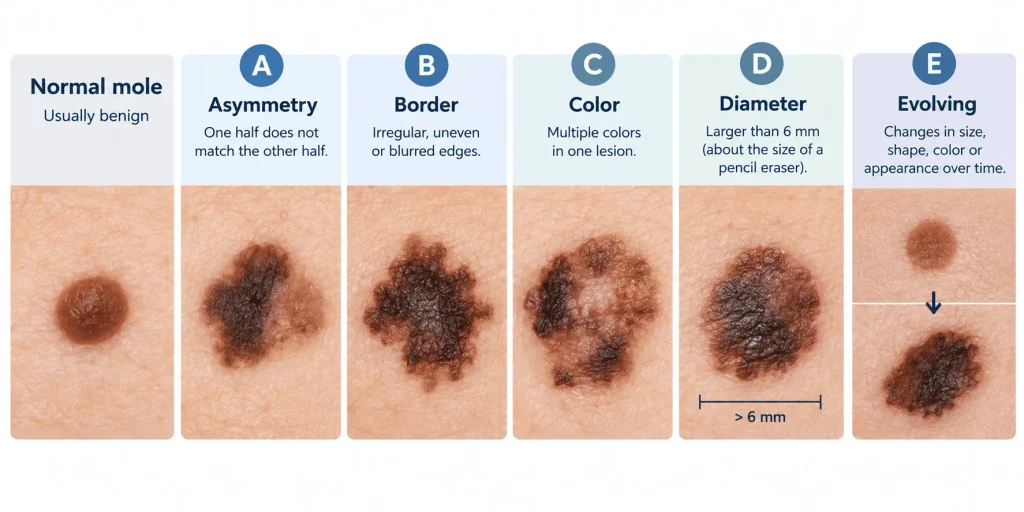
Dermatologists sometimes use the modified ABCDE rule to identify amelanotic melanoma:
- A – Asymmetry
- B – Border irregularity
- C – Color (lack of dark pigment; pink or red instead)
- D – Diameter > 6 mm
- E – Evolution (any change over time)
Recognizing these subtle differences is critical, as delayed diagnosis significantly worsens prognosis.
Causes and Risk Factors
The exact causes of amelanotic melanoma are similar to those of conventional melanoma, but its unique lack of pigmentation is linked to specific biological and genetic factors. Like all melanomas, it arises from malignant transformation of melanocytes, but in this subtype, the tumor cells produce little or no melanin.
Genetic Factors
Research has shown that amelanotic melanomas often carry mutations in genes involved in cell growth and survival, including:
- BRAF mutations – found in a significant proportion of melanomas and associated with uncontrolled cell proliferation.
- NRAS mutations – linked to more aggressive tumor behavior.
- KIT mutations – particularly common in acral and mucosal melanomas.
These genetic changes not only drive tumor development but also influence how the cancer responds to targeted therapies.
Environmental and Lifestyle Risk Factors
- Ultraviolet (UV) radiation exposure: chronic sun exposure and tanning beds increase the risk.
- Fair skin and light hair: individuals with less natural pigment are more susceptible.
- Family history of melanoma: genetic predisposition increases lifetime risk.
- Multiple or atypical moles (nevi): higher chance of malignant transformation.
- Weakened immune system: transplant recipients, patients with HIV, or those on long-term immunosuppressive therapy are more vulnerable.
Why Amelanotic Melanoma is Riskier
Because amelanotic melanoma does not display the typical dark pigmentation, patients often overlook early warning signs. This means the cancer is frequently diagnosed at later stages, when the tumor is thicker or has already spread, contributing to poorer outcomes compared to pigmented melanoma.
Diagnosis of Amelanotic Melanoma
Diagnosing amelanotic melanoma is often challenging because the lesions lack the typical dark pigmentation of melanoma. Instead, they may mimic benign or less aggressive conditions, which frequently leads to delayed or incorrect diagnosis.
Why Misdiagnosis is Common
- Resembles benign skin disorders such as eczema, psoriasis, or dermatitis.
- Can be confused with other skin cancers, including basal cell carcinoma and squamous cell carcinoma.
- May present as a nonspecific pink or red bump, often mistaken for an infection or insect bite.
Diagnostic Tools and Methods
- Clinical Examination
- Dermatologists look for suspicious changes using the ABCDE rule (Asymmetry, Border, Color, Diameter, Evolution).
- In amelanotic melanoma, the “C” (Color) may not apply, making the “E” (Evolution—change over time) especially important.
- Dermoscopy
- A non-invasive imaging technique that allows closer examination of skin structures.
- In amelanotic melanoma, dermoscopy often reveals atypical vascular patterns, irregular blood vessels, and subtle structural changes rather than pigmentation.
- Biopsy (Gold Standard)
- Excisional biopsy is the most accurate diagnostic method.
- Pathologists analyze tissue under a microscope to confirm melanoma.
- Histopathology shows malignant melanocytes with little or no melanin.
- Immunohistochemistry
- Used when pigmentation is absent and diagnosis is uncertain.
- Common markers:
- S100 protein
- HMB-45
- Melan-A (MART-1)
- These markers confirm the melanocytic origin of the tumor.
- Imaging Studies
- In advanced cases, imaging such as CT, MRI, or PET scans may be performed to evaluate for metastasis.
Importance of Early and Accurate Diagnosis
Early detection dramatically improves outcomes. Because amelanotic melanoma is often diagnosed at a more advanced stage, regular skin checks, dermoscopic evaluation, and prompt biopsy of atypical lesions are crucial for timely management.
Staging and Prognosis
Like other types of melanoma, amelanotic melanoma is staged based on the American Joint Committee on Cancer (AJCC) TNM classification, which considers Tumor thickness and ulceration (T), lymph Node involvement (N), and Metastasis (M). Proper staging is essential to determine treatment options and predict outcomes.
Staging System
- Stage 0 (Melanoma in situ) – confined to the epidermis, excellent prognosis.
- Stage I–II (Localized melanoma) – thicker tumors but no spread to lymph nodes; prognosis depends on Breslow thickness and ulceration.
- Stage III (Regional spread) – cancer has reached nearby lymph nodes or adjacent skin.
- Stage IV (Distant metastasis) – spread to distant organs such as the lungs, liver, or brain; poor prognosis.
Prognostic Challenges in Amelanotic Melanoma
- Delayed diagnosis: lesions are often detected at more advanced stages because they lack pigmentation.
- Thicker tumors at diagnosis: higher Breslow depth at presentation compared to pigmented melanomas.
- Higher metastatic potential: amelanotic melanoma has an increased risk of spreading earlier.
Survival Rate
- The 5-year survival rate for melanoma varies widely depending on stage:
- Early-stage (localized): ~90–95%
- Regional spread: ~60%
- Distant metastasis: <25%
- Amelanotic melanoma generally has a worse prognosis than pigmented melanoma due to late detection and aggressive progression.
Factors Influencing Prognosis
- Tumor thickness (Breslow depth)
- Ulceration
- Mitotic rate
- Presence of lymph node involvement
- Response to therapy (immunotherapy and targeted therapy can improve outcomes in advanced cases).
Treatment Options for Amelanotic Melanoma
Management of amelanotic melanoma follows similar principles to other melanoma types but is often more challenging due to late-stage detection. Treatment strategies depend on the stage of the disease, tumor thickness, and whether metastasis is present.
1. Surgical Excision (Primary Treatment)
- The first-line treatment for localized amelanotic melanoma.
- Involves removing the tumor with a margin of healthy tissue to reduce recurrence risk.
- For thicker tumors, a sentinel lymph node biopsy is often performed to check for spread.
2. Immunotherapy
- A major breakthrough in melanoma treatment, particularly for advanced disease.
- Immune checkpoint inhibitors enhance the body’s immune system to attack cancer cells:
- PD-1 inhibitors: nivolumab, pembrolizumab
- CTLA-4 inhibitors: ipilimumab
- Often used in metastatic or recurrent melanoma and have significantly improved survival rates.
3. Targeted Therapy
- For tumors with specific genetic mutations (commonly BRAF V600E).
- Drugs used in combination:
- BRAF inhibitors: vemurafenib, dabrafenib
- MEK inhibitors: trametinib, cobimetinib
- Effective in shrinking tumors and delaying progression, but resistance may develop.
4. Radiation Therapy
- Used in certain cases for local control or palliation, especially when surgery is not feasible.
- May be applied to brain or bone metastases to relieve symptoms.
5. Chemotherapy (Less Common)
- Once the standard for advanced melanoma, but now less frequently used due to the effectiveness of immunotherapy and targeted therapy.
- Agents like dacarbazine or temozolomide may still be used in specific scenarios.
Multidisciplinary Approach
Because amelanotic melanoma is aggressive, management often requires a team of dermatologists, oncologists, pathologists, and surgeons to optimize treatment and improve survival outcomes.
Amelanotic Melanoma vs. Other Skin Lesions
One of the greatest challenges with amelanotic melanoma is that it can closely resemble other common skin conditions. This similarity often leads to misdiagnosis and delayed treatment. Recognizing the differences is critical for accurate and timely management.
Common Conditions It Mimics
- Basal Cell Carcinoma (BCC)
- Usually appears as a shiny, pearly nodule or a pinkish growth.
- May ulcerate or bleed, much like amelanotic melanoma.
- Unlike melanoma, BCC rarely metastasizes.
- Squamous Cell Carcinoma (SCC)
- Presents as a scaly, red patch or nodule.
- Can ulcerate and become tender.
- Generally less aggressive than melanoma but still potentially invasive.
- Benign Lesions (Eczema, Psoriasis, Dermatitis)
- Red, inflamed patches that may itch or scale.
- Typically respond to topical treatments, unlike melanoma.
- Infections or Insect Bites
- Localized redness, swelling, or small nodules.
- Usually resolve spontaneously, but persistent lesions should raise suspicion.
Key Differences
- Pigmentation: Unlike typical melanoma, amelanotic melanoma lacks dark pigment, appearing pink or skin-colored.
- Borders: Often irregular and poorly defined compared to benign conditions.
- Evolution: Continuous growth, ulceration, or bleeding is a red flag.
- Dermoscopy: Reveals atypical vascular patterns in melanoma, unlike benign skin lesions.
References and Further Reading
- Gong HZ, Zheng HY, Li J. Amelanotic melanoma. Melanoma Res. 2019 Jun;29(3):221-230. doi: 10.1097/CMR.0000000000000571.
- Misiąg P, Molik K, Kisielewska M, Typek P, Skowron I, Karwowska A, Kuźnicki J, Wojno A, Ekiert M, Choromańska A. Amelanotic Melanoma-Biochemical and Molecular Induction Pathways. Int J Mol Sci. 2024 Oct 26;25(21):11502. doi: 10.3390/ijms252111502.
- Jiang C, Jain NP, Stewart CL. Amelanotic melanoma: Clinical presentation, diagnosis, and management. Clin Dermatol. 2025 Jan-Feb;43(1):10-15. doi: 10.1016/j.clindermatol.2025.01.009.
- American Academy of Dermatology (AAD).What to Look For: ABCDEs of Melanoma.
American Academy of Dermatology – ABCDEs of Melanoma - American Academy of Dermatology (AAD).Melanoma: Signs and Symptoms.
American Academy of Dermatology – Melanoma Signs and Symptoms - American Cancer Society (ACS).Signs and Symptoms of Melanoma Skin Cancer.
American Cancer Society – Signs and Symptoms of Melanoma - National Cancer Institute (NCI).Melanoma Treatment (PDQ®) – Patient Version.
National Cancer Institute – Melanoma Treatment - National Cancer Institute (NCI).What Does Melanoma Look Like?
This is particularly useful for supporting the section discussing the visual appearance and ABCDE characteristics of melanoma.
National Cancer Institute – What Does Melanoma Look Like? - Centers for Disease Control and Prevention (CDC).Skin Cancer Risk Factors.
Useful for the section discussing UV exposure, sunburn, skin characteristics, moles, and family history.
CDC – Skin Cancer Risk Factors - Centers for Disease Control and Prevention (CDC).Reducing Risk for Skin Cancer.
Supports the recommendations about sun protection and avoiding indoor tanning.
CDC – Reducing Risk for Skin Cancer - European Society for Medical Oncology (ESMO).Cutaneous melanoma: ESMO Clinical Practice Guideline for diagnosis, treatment and follow-up.
A useful clinical reference for diagnosis, staging, treatment, and follow-up.
ESMO Clinical Practice Guideline – Cutaneous Melanoma - Gershenwald JE, Scolyer RA, Hess KR, et al. Melanoma staging: Evidence-based changes in the American Joint Committee on Cancer eighth edition cancer staging manual. CA: A Cancer Journal for Clinicians. 2017;67(6):472–492.
PubMed – AJCC 8th Edition Melanoma Staging - Gershenwald JE, Scolyer RA. Melanoma Staging: American Joint Committee on Cancer (AJCC) 8th Edition and Beyond. Annals of Surgical Oncology. 2018;25:2105–2110.
PubMed – Melanoma Staging: AJCC 8th Edition and Beyond


