

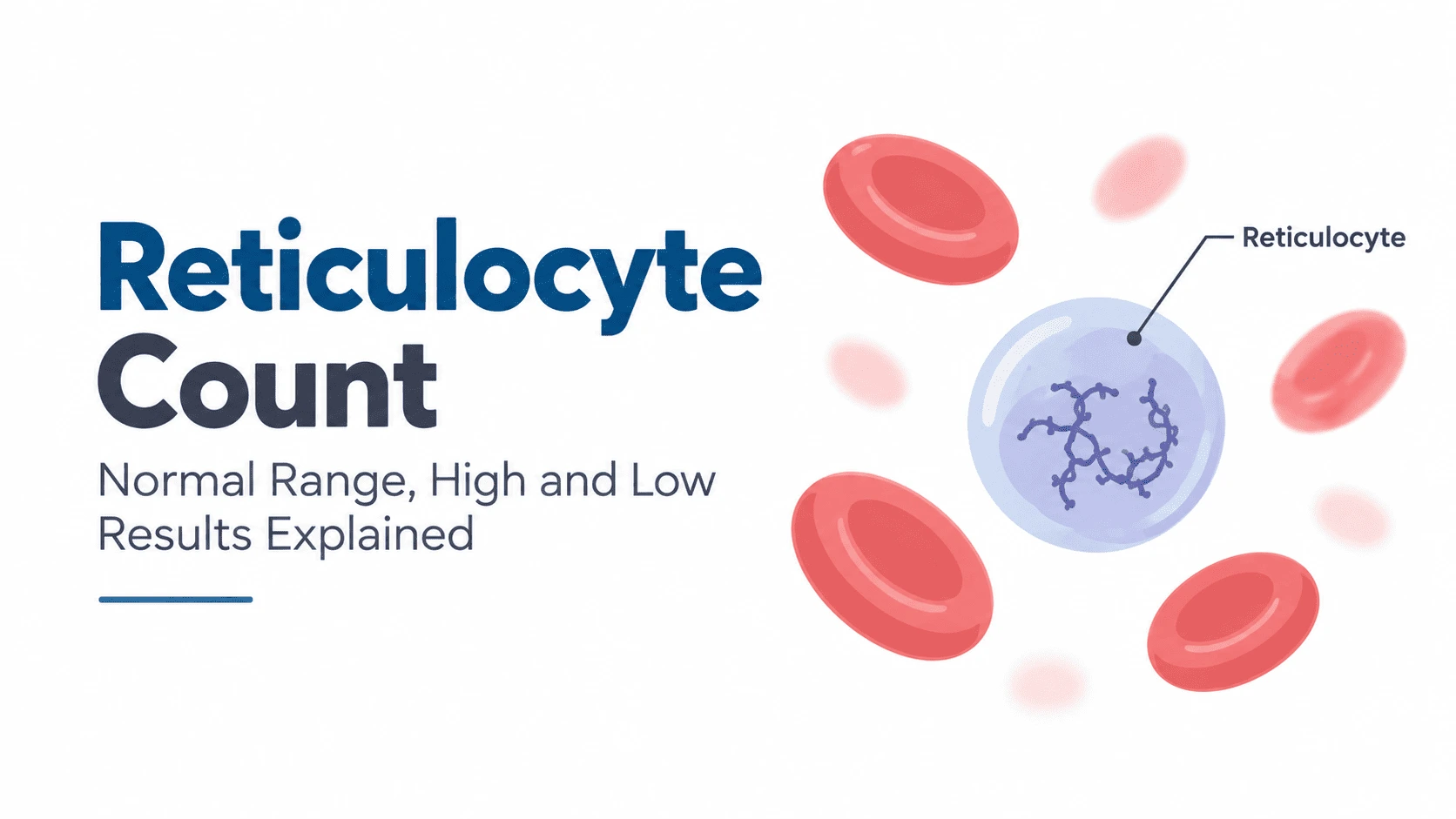
A reticulocyte count is a blood test that provides information about how actively the bone marrow is producing new red blood cells. Reticulocytes are immature red blood cells that have recently been released from the bone marrow into the bloodstream. Because they mature into fully developed red blood cells within a short period, their number can provide a useful indication of recent red blood cell production.
The test is particularly important when evaluating anemia, because it helps determine whether the bone marrow is responding appropriately to a reduced red blood cell mass. A high reticulocyte count can indicate increased red blood cell production, whereas a low count may suggest that the bone marrow is not producing enough new cells.
However, the result should not be interpreted in isolation. Hemoglobin, hematocrit, red blood cell indices, and other laboratory findings are often needed to determine the underlying cause of an abnormal result.
1. What Is a Reticulocyte Count?
Reticulocytes are young red blood cells produced in the bone marrow. They develop from erythroid precursor cells through a process called erythropoiesis, which ultimately produces mature erythrocytes responsible for transporting oxygen throughout the body.
Unlike mature red blood cells, reticulocytes still contain remnants of ribosomal RNA. This residual RNA gives them their characteristic appearance when identified using special laboratory stains. As reticulocytes circulate in the blood, they continue to mature and eventually become fully developed erythrocytes.
A reticulocyte count measures the number or proportion of these immature red blood cells in peripheral blood.
What does the reticulocyte count tell us?
The result provides an indirect assessment of recent bone marrow activity. In simple terms, it helps answer an important question:
Is the bone marrow producing an appropriate number of new red blood cells?
This information becomes especially useful when a person has anemia.
For example, if red blood cells are being lost rapidly through bleeding or destroyed prematurely through hemolysis, the bone marrow should normally increase red blood cell production. This increased production can lead to a higher number of circulating reticulocytes.
In contrast, anemia caused by insufficient red blood cell production may be associated with a normal or low reticulocyte response.
Reticulocyte count and anemia
Anemia can develop through several broad mechanisms:
- Blood loss
- Increased destruction of red blood cells
- Reduced red blood cell production
The reticulocyte count helps distinguish between these mechanisms by showing whether the bone marrow is responding to the reduction in circulating red blood cells.
For this reason, the test is often ordered alongside a complete blood count (CBC) and other investigations when anemia is identified.
The reticulocyte count can therefore provide information that the hemoglobin concentration alone cannot provide. Hemoglobin tells us about the current red blood cell-related oxygen-carrying capacity, while reticulocytes provide information about ongoing red blood cell production.
2. Reticulocyte Count Normal Range
The normal reticulocyte count is commonly reported as a percentage of circulating red blood cells. In many laboratories, the adult reference range is approximately 0.5% to 2.5%, although the exact interval varies according to the laboratory, analytical method, age, and population.
Because reference intervals differ, the range printed on the laboratory report should be used when interpreting an individual result.
A reticulocyte count can also be reported as an absolute reticulocyte count, which expresses the actual number of reticulocytes in a given volume of blood.
Reticulocyte percentage
The reticulocyte percentage represents the proportion of circulating red blood cells that are reticulocytes.
For example, a result of 1.5% means that approximately 1.5 out of every 100 circulating red blood cells are reticulocytes.
This measurement is useful, but it has an important limitation in patients with anemia.
When the total number of mature red blood cells decreases, the percentage of reticulocytes can appear relatively high even when the bone marrow response is not particularly strong.
For this reason, additional calculations such as the corrected reticulocyte count or reticulocyte production index (RPI) may provide a more meaningful assessment in anemic patients.
Absolute reticulocyte count
The absolute reticulocyte count estimates the actual number of reticulocytes circulating in the blood.
It is often expressed as cells per microliter (cells/µL), although reporting units can vary between laboratories.
Unlike the reticulocyte percentage, the absolute count is less affected by changes in the total red blood cell population. This can make it useful when assessing bone marrow activity in people with anemia.
Do reticulocyte ranges vary with age?
Yes. Reticulocyte values can differ according to age, and newborns can have higher reticulocyte counts than older children and adults.
The appropriate reference interval should therefore be selected according to the patient’s age and the laboratory’s established reference range.
It is also important to remember that laboratory reference intervals are not universal. Differences in instruments, analytical methods, populations, and laboratory procedures can result in different reported ranges.
Therefore, a result should always be interpreted using the reference interval provided with the laboratory report rather than comparing it with an isolated value from another source.
3. High Reticulocyte Count: Causes and Meaning
A high reticulocyte count, also called reticulocytosis, generally indicates that the bone marrow is increasing red blood cell production.
This increase can occur when the body needs to replace red blood cells that have been lost or destroyed.
The important question is not simply whether the reticulocyte count is high, but why it is high and whether the increase is appropriate for the patient’s clinical situation.
Blood loss
Acute or ongoing blood loss can stimulate increased red blood cell production.
When red blood cells are lost, the body responds by increasing erythropoiesis in the bone marrow. After a delay, more newly produced reticulocytes enter the circulation.
Therefore, an increased reticulocyte count can occur following significant blood loss.
The reticulocyte response may not appear immediately after bleeding because the bone marrow requires time to increase production and release additional immature cells into the bloodstream.
Hemolytic anemia
Reticulocytosis is also common in hemolytic anemia, a group of conditions in which red blood cells are destroyed faster than they are normally removed.
If the bone marrow remains capable of producing red blood cells, it attempts to compensate for this increased destruction by accelerating erythropoiesis.
Depending on the severity of hemolysis and the capacity of the bone marrow, the resulting increase in reticulocytes can be substantial.
Other laboratory findings can help establish whether hemolysis is occurring. These may include bilirubin, lactate dehydrogenase (LDH), haptoglobin, and blood smear findings.
Response to treatment
An increased reticulocyte count can also occur during recovery from certain nutritional deficiencies or conditions that previously suppressed red blood cell production.
For example, after effective treatment of iron deficiency, vitamin B12 deficiency, or folate deficiency, erythropoiesis may increase as the bone marrow recovers.
This temporary rise in reticulocytes can therefore be evidence that treatment is producing a hematologic response.
Recovery of bone marrow activity
Reticulocytes can increase when bone marrow activity recovers after temporary suppression.
Possible situations include recovery after certain infections, treatments, or other conditions that have temporarily reduced blood cell production.
The interpretation depends on the clinical context and other blood count results.
When is a high reticulocyte count an appropriate response?
A high reticulocyte count is generally considered an appropriate response when the body is attempting to compensate for red blood cell loss or destruction and the bone marrow is capable of increasing production.
For example:
Anemia → increased red blood cell loss → bone marrow stimulation → increased reticulocyte production
This pattern differs from anemia caused primarily by inadequate production, where the reticulocyte response may be insufficient.
Importantly, a high reticulocyte count does not automatically identify the underlying disease. It indicates increased erythropoietic activity, and additional investigations may be necessary to determine the cause.
4. Low Reticulocyte Count: Causes and Meaning
A low reticulocyte count generally indicates that the bone marrow is not producing enough new red blood cells relative to the body’s needs.
This finding can be particularly significant when anemia is present.
If a person has substantial anemia but the reticulocyte response remains low, the bone marrow may not be adequately compensating for the reduced red blood cell mass.
Nutritional deficiencies
Deficiencies of nutrients required for erythropoiesis can reduce effective red blood cell production.
Iron deficiency can limit hemoglobin synthesis and impair the production of normal red blood cells.
Vitamin B12 and folate deficiencies can interfere with DNA synthesis in developing erythroid cells, resulting in ineffective erythropoiesis.
Depending on the severity and stage of the deficiency, the reticulocyte response may be reduced.
Other laboratory findings, including red blood cell indices and measurements of iron, vitamin B12, and folate status, can help identify these conditions.
Bone marrow disorders
The bone marrow is the primary site of red blood cell production. Disorders that directly affect hematopoietic tissue can therefore result in reduced reticulocyte production.
Examples include:
- Aplastic anemia
- Myelodysplastic syndromes
- Bone marrow infiltration
- Certain hematologic malignancies
- Other disorders affecting hematopoietic stem or progenitor cells
In these situations, other blood cell lineages may also be affected, potentially resulting in abnormalities involving white blood cells or platelets.
Chronic kidney disease
The kidneys produce erythropoietin (EPO), a hormone that stimulates red blood cell production in the bone marrow.
In chronic kidney disease, reduced erythropoietin production can contribute to decreased erythropoiesis and anemia.
Consequently, patients with kidney disease may have an inadequate reticulocyte response relative to the degree of anemia.
Chemotherapy and other causes of marrow suppression
Some medications and medical treatments can suppress bone marrow activity.
Chemotherapy, for example, can reduce the production of blood cells, including red blood cells. Other drugs and systemic conditions can also affect erythropoiesis.
The reticulocyte count can therefore provide useful information when evaluating anemia associated with reduced marrow production.
Why a low reticulocyte count matters in anemia
Consider two patients with the same hemoglobin concentration.
If one has a high reticulocyte response and the other has a low response, the underlying mechanisms may be very different.
The first patient may have anemia associated with blood loss or red blood cell destruction, while the second may have impaired red blood cell production.
Thus, the reticulocyte count adds an important functional dimension to the interpretation of anemia.
5. How to Interpret a Reticulocyte Count
The reticulocyte count should be interpreted together with the hemoglobin concentration, hematocrit, red blood cell count, mean corpuscular volume (MCV), and clinical context.
A reticulocyte percentage alone can sometimes be misleading, particularly in patients with significant anemia.
Corrected reticulocyte count
The corrected reticulocyte count adjusts the observed reticulocyte percentage according to the patient’s hematocrit.
A commonly used calculation is:
Corrected reticulocyte count (%) = Reticulocyte % × (Patient hematocrit / Normal hematocrit)
For example, if a patient has a reticulocyte percentage of 6% but a substantially reduced hematocrit, the corrected value will be lower than the original percentage.
This illustrates why the reported reticulocyte percentage should not automatically be interpreted as evidence of a strong marrow response.
Reticulocyte production index
The reticulocyte production index (RPI) provides another way to assess whether the bone marrow response is appropriate for the severity of anemia.
The calculation incorporates both the corrected reticulocyte percentage and the maturation time of reticulocytes.
A simplified representation is:
RPI = Corrected reticulocyte count ÷ maturation correction factor
The maturation factor increases as the hematocrit becomes lower because reticulocytes are released earlier from the bone marrow and remain in circulation longer before reaching full maturity.
An RPI that is relatively low in a patient with anemia suggests inadequate red blood cell production, whereas a higher RPI indicates a stronger marrow response.
Exact interpretation depends on the clinical setting and calculation method used.
Example of reticulocyte interpretation
Suppose a patient has anemia and a reticulocyte percentage of 5%.
At first glance, 5% may appear clearly elevated compared with a typical adult reference interval.
However, if the patient’s red blood cell mass is substantially reduced, the percentage alone may overestimate the adequacy of the bone marrow response.
After correction for the degree of anemia, the reticulocyte response may prove to be less robust than the initial percentage suggests.
This is why clinicians may use the absolute reticulocyte count or RPI rather than relying exclusively on the uncorrected percentage.
Reticulocyte count in the evaluation of anemia
A useful conceptual approach is to divide anemic patients according to their marrow response.
Increased reticulocyte response:
Suggests that the bone marrow is actively responding, as can occur with blood loss or hemolysis.
Inadequate reticulocyte response:
Suggests impaired or insufficient red blood cell production, which can occur with nutritional deficiencies, kidney disease, bone marrow disorders, or marrow suppression.
This distinction can help guide subsequent laboratory testing.
For example, depending on the initial findings, additional investigations may include:
- Peripheral blood smear
- Iron studies
- Ferritin
- Vitamin B12 and folate
- Bilirubin
- LDH
- Haptoglobin
- Kidney function tests
- Additional hematologic investigations when indicated
Reticulocyte count is not interpreted alone
An abnormal reticulocyte count does not by itself establish a diagnosis.
The result must be considered alongside the patient’s symptoms, medical history, CBC findings, peripheral blood smear, and other laboratory investigations.
The same reticulocyte value can have different clinical significance depending on whether a patient has anemia, recent bleeding, hemolysis, chronic kidney disease, nutritional deficiency, or another underlying condition.
Medical Disclaimer: This content is for informational and educational purposes only and does not constitute medical advice. It is not intended to replace professional medical consultation, diagnosis, or treatment. Always seek the advice of a qualified healthcare provider with any questions regarding a medical condition.


