

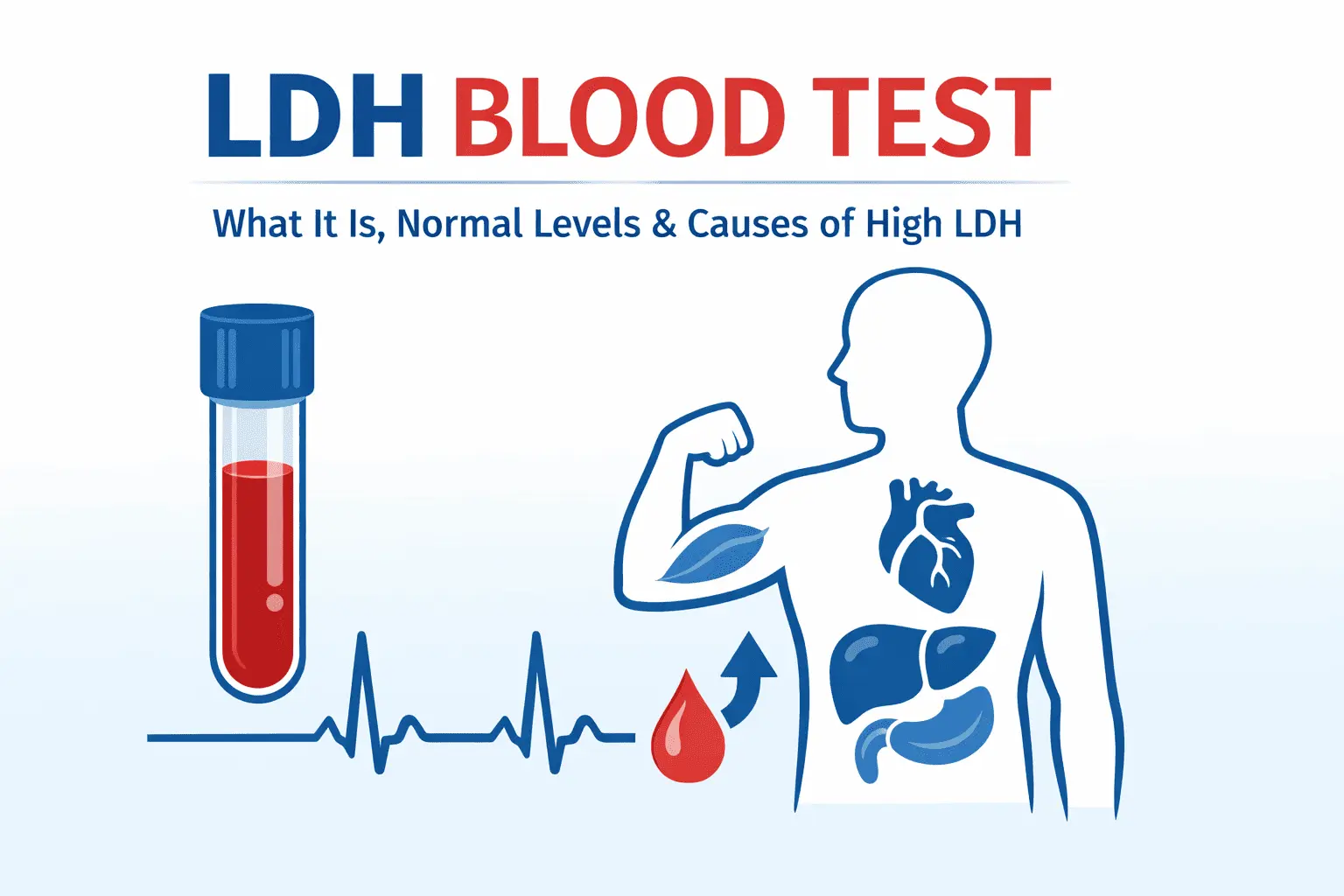
The LDH blood test is a simple yet powerful diagnostic tool used to detect tissue damage and monitor a wide range of health conditions. It measures levels of Lactate Dehydrogenase (LDH), an enzyme found throughout the body that is released into the bloodstream when cells are damaged.
In this article, you’ll learn what LDH is, how the LDH test works, what normal and high LDH levels mean, and when this test is used in clinical practice.
Key Takeaway
- The LDH blood test measures levels of Lactate Dehydrogenase to help detect tissue damage in the body
- Elevated LDH levels can be linked to various conditions, including infections, organ damage, and cancer
- The test is non-specific, meaning it cannot diagnose a condition on its own
- Results must be interpreted alongside other lab tests and clinical findings
- LDH is especially useful for monitoring disease progression and treatment response
What is LDH?
Lactate Dehydrogenase (LDH) is an enzyme that plays a central role in the body’s energy production. It is present in almost all tissues, which is why it is considered a non-specific but useful biomarker of cellular damage.
Definition and Function
LDH catalyzes a key step in cellular metabolism:
- It converts lactate into pyruvate and vice versa
- This reaction is essential in the process of glycolysis
- It helps cells generate energy, especially under low-oxygen (anaerobic) conditions
Because this process occurs in many types of cells, LDH is widely distributed throughout the body.
Where is LDH Found?
LDH is located inside cells in multiple organs and tissues, including:
- Heart
- Liver
- Skeletal muscles
- Kidneys
- Lungs
- Red blood cells
Under normal conditions, only small amounts of LDH circulate in the blood. However, when cells are damaged or destroyed, LDH is released into the bloodstream, leading to increased levels.
LDH Isoenzymes
LDH exists in five different forms, known as isoenzymes. Each type is more concentrated in specific tissues:
- LDH-1: primarily in the heart and red blood cells
- LDH-2: abundant in blood cells
- LDH-3: found in lungs and other tissues
- LDH-4: present in kidneys and pancreas
- LDH-5: mainly in liver and skeletal muscle
These isoenzymes can sometimes help identify the source of tissue damage, although they are less commonly used in routine clinical practice today.
What is an LDH Blood Test?
An LDH blood test is a laboratory test that measures the amount of Lactate Dehydrogenase circulating in your bloodstream. Because LDH is released when cells are damaged, this test helps clinicians assess whether tissue injury is occurring somewhere in the body.
Purpose of the LDH Test
The LDH test is not used to diagnose a single condition. Instead, it is ordered to:
- Detect the presence of tissue damage
- Evaluate the severity of certain diseases
- Monitor how a condition is progressing over time
- Assess response to treatment, especially in chronic or serious illnesses
When is an LDH Blood Test Ordered?
Healthcare providers may request an LDH test in situations such as:
- Unexplained symptoms like fatigue, pain, or weakness
- Suspected organ damage
- Follow-up of known medical conditions
- Monitoring patients undergoing treatment, particularly in oncology
How the Test is Used Clinically
The LDH blood test is typically interpreted alongside other laboratory findings. On its own, it does not pinpoint the exact cause of a problem, but it provides useful supporting information.
In clinical practice, LDH levels are often evaluated together with:
- Other enzyme markers
- Complete blood count (CBC)
- Imaging or additional diagnostic tests
LDH Lab Test: How It Works
The LDH lab test is a routine procedure performed in clinical laboratories to measure enzyme levels in a blood sample.
Sample Collection
The test begins with a standard blood draw:
- A healthcare professional collects blood from a vein, usually in the arm
- The sample is placed into a collection tube
- No special procedure is required beyond basic venipuncture
Laboratory Analysis
Once collected, the sample is sent to the laboratory for analysis:
- Blood is processed to separate serum or plasma
- LDH activity is measured using automated biochemical analyzers
- The test quantifies enzyme activity based on its role in metabolic reactions
Most modern labs use standardized methods to ensure accuracy and consistency.
Turnaround Time
Results are typically available within:
- A few hours in hospital settings
- 1 day in most outpatient laboratories
Timing may vary depending on the facility and testing workload.
Factors That Can Affect Results
Certain factors can influence LDH levels and should be considered:
- Hemolysis during blood collection (breakdown of red blood cells)
- Recent intense physical activity
- Medications or underlying medical conditions
Proper sample handling is important, as errors during collection or processing can lead to falsely elevated results.
Normal LDH Levels
Normal levels of Lactate Dehydrogenase in the blood fall within a specific reference range, which helps clinicians determine whether results are typical or abnormal.
Typical Reference Range
- In adults, normal LDH levels generally range between 140 and 280 units per liter (U/L)
- These values can vary slightly depending on the laboratory and testing method used
- Each lab usually provides its own reference range alongside the results
Why Reference Ranges Vary
LDH levels are not identical for everyone. Variations can occur due to:
- Differences in laboratory equipment and techniques
- Age (children may have higher levels)
- Biological variability between individuals
| Age Group | Typical LDH Range (U/L) | Notes |
|---|---|---|
| Newborns (0–1 month) | 290 – 775 | Higher levels due to rapid cell turnover after birth |
| Infants (1–12 months) | 180 – 435 | Gradual decline as metabolism stabilizes |
| Children (1–12 years) | 150 – 345 | Slightly higher than adults due to growth |
| Adolescents (13–18 years) | 120 – 300 | Approaching adult reference ranges |
| Adults (18+ years) | 140 – 280 | Standard reference range in most laboratories |
| Older Adults (65+ years) | 140 – 300 | May be slightly higher due to age-related changes |
For this reason, results should always be interpreted using the specific reference values provided by the lab.
What is Considered Normal?
A normal LDH level typically indicates:
- No significant or ongoing tissue damage
- Stable cellular activity in the body
However, a value within the normal range does not always rule out disease, especially in early or mild conditions.
High LDH Levels: What Does It Mean?
Elevated levels of Lactate Dehydrogenase in the blood usually indicate that cells have been damaged or destroyed, releasing LDH into the bloodstream. However, high LDH is not specific to a single disease, and further investigation is always needed.
What is Considered High LDH?
- LDH levels above the laboratory’s reference range are considered elevated
- The degree of elevation can vary from mild to very high
- Higher levels often suggest more extensive tissue involvement, but not always
Common Causes of Elevated LDH
High LDH levels can be associated with a wide range of conditions, including:
- Tissue injury or trauma
- Liver diseases (such as hepatitis or cirrhosis)
- Muscle damage from injury or intense exercise
- Hemolysis (destruction of red blood cells)
- Infections and inflammatory conditions
- Cancer, where rapid cell turnover or tumor breakdown increases LDH release
Clinical Significance
Elevated LDH is often used as a general marker of disease activity:
- It may indicate ongoing damage in the body
- It can help assess the severity of certain conditions
- In oncology, it is sometimes used to monitor tumor burden or treatment response
Important Considerations
- LDH alone cannot diagnose a specific condition
- Results must be interpreted alongside other tests and clinical findings
- Temporary increases can occur due to non-disease factors, such as strenuous exercise
Conditions Associated with Elevated LDH
Elevated levels of Lactate Dehydrogenase are linked to a wide variety of medical conditions. Because LDH is present in many tissues, its increase reflects underlying cell damage rather than a specific disease.
Infections and Inflammation
- Bacterial and viral infections can raise LDH levels
- Severe infections may cause widespread tissue injury
- Chronic inflammatory conditions can also contribute to persistent elevation
Cardiovascular Conditions
- LDH can increase after a heart attack (myocardial infarction)
- It reflects damage to heart muscle cells
- Although newer biomarkers are preferred today, LDH may still be used in some contexts
Liver Diseases
- Conditions such as hepatitis or cirrhosis can lead to elevated LDH
- Liver cell damage releases LDH into circulation
- Often evaluated alongside other liver enzymes for better assessment
Blood Disorders
- Hemolytic anemia causes destruction of red blood cells, increasing LDH
- Certain bone marrow disorders can also elevate levels
- LDH may be used to monitor disease activity in hematological conditions
Muscle and Tissue Injury
- Physical trauma or muscle diseases can increase LDH
- Intense exercise may temporarily elevate levels
- Tissue breakdown from injury contributes to higher readings
Cancer
- Many cancers are associated with elevated LDH
- It may reflect rapid tumor growth or cell turnover
- LDH is sometimes used to:
- Assess disease progression
- Monitor response to treatment
- Provide prognostic information in certain cancers
When Should You Take an LDH Test?
A test for Lactate Dehydrogenase is typically ordered when there is a need to assess possible tissue damage or monitor an existing condition.
Common Situations
- Unexplained symptoms such as fatigue, pain, or weakness
- Suspected organ or tissue injury
- Monitoring chronic diseases
- Follow-up in cancer patients to track progression or treatment response
How to Prepare for an LDH Blood Test
Preparing for a test that measures Lactate Dehydrogenase is simple, and in most cases, no special steps are required.
Do You Need to Fast?
- Fasting is usually not required for an LDH blood test
- However, if the test is combined with other blood tests, your doctor may give specific instructions
Medications and Supplements
- Inform your healthcare provider about any medications or supplements you are taking
- Some drugs may influence LDH levels or interfere with test results
Physical Activity
- Avoid intense exercise before the test
- Strenuous activity can temporarily increase LDH levels
Before the Blood Draw
- Stay well hydrated
- Follow any specific instructions provided by your healthcare provider or lab
FAQs
LDH is an enzyme released into the blood when tissues are damaged. The test measures its level to detect injury or disease.
Common causes include tissue damage, anemia, liver disease, infections, and cancer.
Not always. It indicates tissue damage, but the seriousness depends on the underlying cause.
Stress alone usually does not significantly increase LDH, but physical strain might.
Lymphoma, leukemia, melanoma, and metastatic cancers are commonly associated with high LDH.
LDH levels decrease when the underlying condition is treated. There is no direct way to lower LDH itself.
References
- Khan AA, Allemailem KS, Alhumaydhi FA, Gowder SJT, Rahmani AH. The Biochemical and Clinical Perspectives of Lactate Dehydrogenase: An Enzyme of Active Metabolism. Endocr Metab Immune Disord Drug Targets. 2020;20(6):855-868. doi: 10.2174/1871530320666191230141110.
- Johns Hopkins Medicine. Lactate Dehydrogenase: https://johnshopkinshealthcare.staywellsolutionsonline.com/Library/TestsProcedures/167,lactic_acid_dehydrogenase_blood
- Wu Y, Lu C, Pan N, Zhang M, An Y, Xu M, Zhang L, Guo Y, Tan L. Serum lactate dehydrogenase activities as systems biomarkers for 48 types of human diseases. Sci Rep. 2021 Jun 21;11(1):12997. doi: 10.1038/s41598-021-92430-6.
- Cleveland Clinic. Lactate Dehydrogenase (LDH) Test: What It Is & Results: https://my.clevelandclinic.org/health/diagnostics/22736-lactate-dehydrogenase-ldh-test
- MedlinePlus. Lactate Dehydrogenase (LDH) Test: https://medlineplus.gov/lab-tests/lactate-dehydrogenase-ldh-test/
- NHS: Lactate Dehydrogenase (LDH) https://www.southtees.nhs.uk/services/pathology/tests/lactate-dehydrogenase-ldh/
Medical Disclaimer: This content is for informational and educational purposes only and does not constitute medical advice. It is not intended to replace professional medical consultation, diagnosis, or treatment. Always seek the advice of a qualified healthcare provider with any questions regarding a medical condition.


