

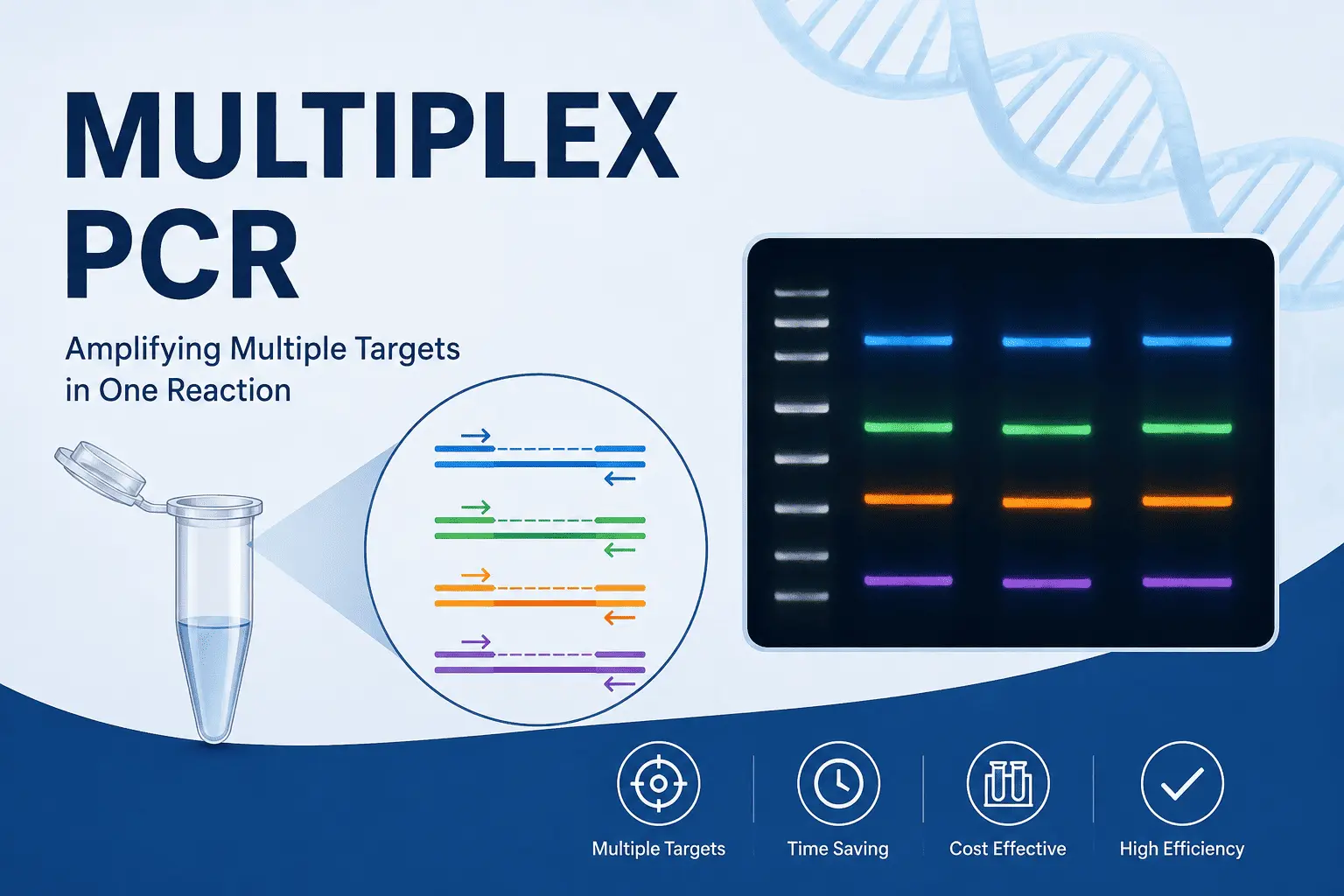
Multiplex PCR is a variation of the polymerase chain reaction (PCR) that allows researchers to amplify several DNA targets simultaneously within a single reaction tube. Instead of using one pair of primers to amplify one target, multiplex PCR uses multiple primer pairs, with each pair designed to recognize a different DNA sequence.
This approach can significantly reduce the amount of sample, reagents, time, and laboratory work required when several genetic targets need to be analyzed. A single reaction can generate multiple amplification products that are subsequently identified using techniques such as agarose gel electrophoresis, capillary electrophoresis, or fluorescence-based detection.
Multiplex PCR is used across molecular biology, clinical diagnostics, genetics, infectious disease research, oncology, forensic science, and microbial identification. However, amplifying several targets in the same reaction is more technically demanding than conventional single-target PCR because all primer pairs and reaction components must function efficiently under the same conditions.
This guide explains the principle of multiplex PCR, its essential components, strategies for designing and optimizing multiplex assays, major applications, and practical approaches to troubleshooting common problems.
What Is Multiplex PCR and How Does It Work?
Definition of Multiplex PCR
Multiplex PCR is a PCR method in which two or more DNA regions are amplified simultaneously in a single reaction. Each target is amplified by its own forward and reverse primer pair.
For example, a conventional PCR designed to detect three genes would normally require three separate reactions. In a multiplex PCR, the three primer pairs can potentially be combined into one tube, allowing all three targets to be amplified simultaneously.
The resulting products may differ in size, sequence, or fluorescent label depending on the detection strategy. In conventional multiplex PCR, different amplicon sizes are often used so that the products can be separated and visualized on an agarose gel.
The main distinction is therefore straightforward:
- Singleplex PCR: one target and one primer pair per reaction.
- Multiplex PCR: multiple targets and multiple primer pairs in the same reaction.
Principle of Multiplex PCR
Multiplex PCR follows the same fundamental amplification mechanism as conventional PCR. The difference is that several amplification reactions occur simultaneously in the same tube.
During the denaturation step, double-stranded DNA is separated into individual strands by heating. During annealing, the different primer pairs bind to their complementary sequences. During extension, a thermostable DNA polymerase extends the bound primers and synthesizes new DNA strands.
These steps are repeated through multiple thermal cycles:
- Denaturation separates the DNA strands.
- Annealing allows the primers to bind to their respective targets.
- Extension allows DNA synthesis.
Ideally, every primer pair should amplify its intended target efficiently without interfering with the other primer pairs. Because all targets share the same thermal cycling program, primer compatibility is particularly important.
Multiplex PCR Workflow
A typical multiplex PCR workflow begins with obtaining a suitable DNA template. The DNA is extracted from the biological sample and assessed for adequate quality and concentration.
The next stage involves selecting the targets and designing compatible primer pairs. Primer specificity, melting temperature, expected amplicon size, and interactions between primers must all be considered before combining them.
The reaction is then prepared with the DNA template, multiple primer pairs, DNA polymerase, dNTPs, buffer, magnesium ions, and water. The mixture is placed in a thermocycler and subjected to the selected amplification program.
After PCR, the products are analyzed using an appropriate detection method. In conventional assays, agarose gel electrophoresis can separate products according to size. More advanced multiplex assays can use fluorescent detection or other analytical platforms.
Types of Multiplex PCR
Several forms of multiplex PCR can be developed depending on the biological material and detection method.
Conventional multiplex PCR produces multiple DNA amplicons that are usually analyzed by gel electrophoresis.
Multiplex RT-PCR is designed for RNA targets. Reverse transcription is first used to generate complementary DNA (cDNA), which is then amplified using multiple primer pairs.
Multiplex real-time PCR, or multiplex qPCR, combines simultaneous amplification of several targets with real-time fluorescence monitoring. Different fluorescent reporter systems can be used to distinguish targets.
Nested multiplex PCR uses an additional amplification stage to improve specificity for selected applications. It can be useful when target DNA is present at low levels or when greater amplification specificity is required.
Components of a Multiplex PCR Reaction
DNA Template
The DNA template contains the sequences that the selected primer pairs are intended to amplify. Template quality is especially important in multiplex PCR because several amplification reactions depend on the same sample.
Contaminants carried over from DNA extraction can inhibit polymerase activity and reduce amplification efficiency. Highly degraded DNA can also make some targets difficult to amplify, particularly when the assay contains amplicons of different lengths.
Template concentration should therefore be appropriate for the assay. Excessive DNA can sometimes increase nonspecific amplification, while insufficient template may result in weak or undetectable products.
Multiple Primer Pairs
The primer set is one of the most important components of a multiplex PCR. Each target requires a compatible forward and reverse primer.
The primers should have sufficiently similar melting temperatures so that they can anneal effectively during the same thermal cycling program. They should also have high target specificity and minimal potential for forming primer-dimers or unwanted interactions with other primers in the mixture.
Another important consideration is the relationship between primer pairs. A primer designed for target A should ideally not bind efficiently to target B or interact strongly with primers designed for other targets.
DNA Polymerase
The DNA polymerase performs the synthesis of the new DNA strands. For multiplex applications, polymerases with strong specificity and consistent amplification performance are generally preferred.
Hot-start DNA polymerases are particularly useful in many multiplex assays. These enzymes remain inactive at lower temperatures and become activated during the initial heating step. This can reduce nonspecific amplification and primer-dimer formation during reaction setup.
Some commercially available multiplex PCR systems also use specially formulated polymerases and buffers designed to support simultaneous amplification of multiple targets.
dNTPs, MgCl₂, and Buffer
The four deoxynucleoside triphosphates (dATP, dCTP, dGTP, and dTTP) provide the building blocks required for DNA synthesis.
Magnesium ions are essential cofactors for DNA polymerase activity. Their concentration can strongly influence both amplification yield and specificity. Too little magnesium may reduce amplification, whereas excessive magnesium can promote nonspecific products.
The PCR buffer maintains an appropriate chemical environment for the polymerase. In multiplex PCR, the buffer formulation becomes particularly important because several primer-template reactions must operate efficiently under the same conditions.
Additional Reaction Components
Nuclease-free water is used to bring the reaction to the desired final volume while minimizing contamination.
Depending on the assay, additives may sometimes improve amplification of difficult templates or GC-rich regions. However, additives should be evaluated carefully because an improvement for one target may negatively affect another.
The final reaction mixture therefore represents a balance between several components rather than an independent optimization of each target.
How to Design and Optimize a Multiplex PCR
Selecting Targets and Amplicon Sizes
Before designing primers, define exactly which targets need to be detected. Targets should provide useful information and be compatible with the intended detection method.
For conventional gel-based multiplex PCR, selecting amplicons with clearly different sizes can simplify interpretation. If two products have nearly identical lengths, separating them on a standard agarose gel may be difficult.
Amplicon length should also be appropriate for the template quality and PCR conditions. Shorter products are often easier to amplify from partially degraded DNA than very long products.
Primer Design for Multiplex PCR
Primer design requires more attention in multiplex PCR than in a conventional singleplex assay.
Primers should have compatible melting temperatures and similar general sequence characteristics. They should bind specifically to their intended targets while avoiding significant secondary structures, self-complementarity, and cross-complementarity with other primers.
A useful design process includes checking:
- Primer melting temperature.
- GC content.
- Expected amplicon size.
- Target specificity.
- Hairpin formation.
- Self-dimers.
- Heterodimers between different primers.
- Potential binding to unintended sequences.
In-silico analysis can help identify problematic primer combinations before laboratory testing.
Optimizing Primer Concentrations
Using identical concentrations for every primer pair is a useful starting point, but it does not necessarily produce balanced amplification.
Some targets naturally amplify more efficiently than others. A highly efficient primer pair may generate a very strong product and consume more reaction resources, while a weaker pair may produce only a faint product.
Individual primer concentrations can therefore be adjusted to balance the amplification products. Strong primer pairs may require lower concentrations, whereas weaker targets may benefit from relatively higher concentrations.
Optimization should be performed systematically so that changes can be linked to specific effects on the assay.
Optimizing Thermal Cycling Conditions
The annealing temperature is particularly important because all primer pairs must work during the same annealing step.
A temperature that is too low may allow nonspecific primer binding, whereas a temperature that is too high can reduce primer binding and produce weak amplification.
Gradient PCR can help identify a suitable temperature range. The number of cycles also matters. Increasing the cycle number may improve detection of low-abundance products but can simultaneously increase nonspecific amplification and background.
Extension time should be sufficient for the longest intended amplicon while avoiding unnecessarily prolonged cycling.
Optimizing Reaction Conditions
Several reaction variables may influence multiplex performance, including magnesium concentration, template amount, primer concentration, polymerase concentration, and reaction volume.
Optimization is most effective when variables are changed methodically. Altering many parameters simultaneously makes it difficult to determine which change produced an improvement.
A practical approach is to establish working conditions for individual primer pairs first and then combine them progressively. If the assay performs well in singleplex reactions but poorly after multiplexing, the problem is more likely related to primer competition, concentration imbalance, or interactions between targets.
Controls for Multiplex PCR
Appropriate controls are essential for distinguishing true amplification from contamination or technical failure.
A positive control contains a known template and demonstrates that the reaction can amplify the expected targets.
A no-template control (NTC) contains the reaction components without DNA template. It is used to detect contamination or nonspecific signal originating from the reaction mixture.
An internal amplification control can help determine whether a negative result reflects the true absence of a target or inhibition of the PCR reaction.
Controls should be interpreted alongside the test samples rather than considered an optional addition to the assay.
Applications of Multiplex PCR
Molecular Diagnostics
Multiplex PCR is particularly valuable when a diagnostic workflow requires the analysis of several genetic targets.
Instead of performing separate reactions for every marker, multiple targets can be evaluated from the same sample. This can reduce reagent consumption and simplify laboratory workflows.
Depending on the assay design, multiplex PCR can be used to identify genetic variants, disease-associated sequences, or molecular markers relevant to diagnosis.
Infectious Disease Detection
In infectious disease testing, different pathogens can produce similar clinical manifestations. Multiplex PCR allows several pathogen-specific targets to be examined simultaneously.
For example, a respiratory panel can be designed to detect multiple viral or bacterial targets from a single specimen. Similar approaches can be developed for gastrointestinal, respiratory, or other infectious disease panels.
Multiplex testing can be particularly useful when the differential diagnosis includes several possible pathogens.
Cancer Research and Molecular Oncology
Multiplex PCR has applications in cancer research where several molecular markers may need to be evaluated from the same biological sample.
It can be used to investigate combinations of genetic alterations, analyze selected cancer-associated markers, or support molecular characterization of tumor specimens.
Multiplex approaches may also be useful when sample quantities are limited, such as in small biopsies or other specimens containing limited amounts of DNA.
Genetics and Genotyping
Genotyping often requires the analysis of several genetic markers. Multiplex PCR can amplify multiple loci simultaneously, making it possible to evaluate several markers in one reaction.
This strategy has been applied to genetic variation studies, marker analysis, and other applications where multiple genomic regions need to be characterized.
Forensic Science
Forensic DNA analysis is a major application of multiplex amplification. Modern forensic assays can amplify multiple short tandem repeat (STR) loci simultaneously.
Using several markers increases the amount of genetic information obtained from a sample while reducing the number of separate reactions required.
Fluorescently labeled primers and capillary electrophoresis are commonly used in sophisticated forensic multiplex systems to distinguish amplification products according to their size and fluorescent characteristics.
Research and Other Applications
Multiplex PCR can also be adapted to a wide range of research applications.
In microbial research, several species-specific targets can be amplified simultaneously for identification or screening. In food analysis, multiplex assays can help detect different organisms or biological components in complex samples.
Multiplex RT-PCR can be used to investigate several RNA targets, while other assay formats can support transgene detection and molecular screening.
The flexibility of primer design means that multiplex PCR can be adapted to many experimental questions as long as the selected targets can be amplified under compatible conditions.
Multiplex PCR Troubleshooting: Common Problems and Solutions
Some Targets Amplify While Others Do Not
One of the most common multiplex PCR problems is unequal amplification. Some expected products appear clearly, while others are absent or extremely weak.
This can occur because primer pairs have different amplification efficiencies. Competition can also favor targets that amplify more efficiently.
A useful strategy is to test the missing target separately using singleplex PCR. If it works individually, the problem is likely associated with multiplex competition or primer concentration. Adjusting the concentration of the relevant primer pair may help restore balance.
Nonspecific Amplification
Unexpected amplification products can result from nonspecific primer binding.
Possible causes include an annealing temperature that is too low, excessive primer concentration, poor primer specificity, or unsuitable reaction conditions.
Increasing the annealing temperature can increase stringency. Reducing primer concentrations may also decrease nonspecific amplification. If the problem persists, redesigning the affected primer pair may be necessary.
Primer-Dimer Formation
Primer-dimers occur when primers interact with one another instead of binding to their intended templates.
The risk increases when multiple primers are present in the same reaction because the number of possible interactions is much higher than in singleplex PCR.
Primer design software can be used to identify strong complementarity between primers. Redesigning problematic primers, adjusting concentrations, or using a hot-start polymerase can help reduce primer-dimer formation.
Uneven Band Intensities
In a conventional multiplex PCR gel, some bands may appear much stronger than others.
This does not necessarily mean that the assay has failed. Different targets naturally have different amplification efficiencies, template abundances, and primer characteristics.
If balanced signal intensity is required, individual primer concentrations can be adjusted. Reducing the concentration of an excessively strong primer pair can allow weaker targets to compete more effectively.
No Amplification
Complete absence of amplification can have several causes.
The DNA template may be degraded or contain inhibitors. Reaction components may have been omitted or incorrectly prepared. The thermal cycling program may be unsuitable, or the polymerase may not function properly.
A systematic diagnostic approach is useful. First verify the reaction setup and controls. Then test individual primer pairs in singleplex reactions. This can determine whether the problem originates from the template, reagents, primers, or multiplex interactions.
Smearing or Unexpected Bands
Smearing on an agarose gel may indicate nonspecific amplification, excessive template or primer concentrations, suboptimal magnesium concentration, or an excessive number of cycles.
Unexpected discrete bands can similarly result from nonspecific primer binding.
Optimizing annealing temperature, reducing reaction component concentrations where appropriate, and redesigning problematic primers can improve specificity.
A Practical Troubleshooting Strategy
Multiplex PCR troubleshooting is most effective when performed step by step rather than by changing every parameter at once.
A useful sequence is:
- Confirm that the DNA template is suitable.
- Verify the positive and negative controls.
- Test each primer pair independently.
- Confirm that each singleplex reaction produces the expected product.
- Check primer-primer interactions.
- Evaluate the relative amplification efficiency of each target.
- Adjust individual primer concentrations.
- Optimize the annealing temperature.
- Recombine the primer pairs progressively.
- Confirm the final multiplex assay using appropriate controls.
This approach makes it easier to identify the source of the problem and prevents unnecessary optimization of components that are already performing correctly.
Conclusion
Multiplex PCR extends the conventional PCR principle by allowing multiple DNA targets to be amplified simultaneously in a single reaction. This makes it a valuable technique when several genetic markers, pathogens, or molecular targets need to be analyzed efficiently.
The major challenge is achieving balanced amplification among all targets. Primer compatibility, target selection, amplicon size, reaction composition, and thermal cycling conditions must therefore be considered together rather than independently.
Successful multiplex PCR usually begins with well-designed primers and reliable singleplex reactions before moving to systematic multiplex optimization. Appropriate positive, negative, and internal controls are also essential for interpreting the results confidently.
Because of its efficiency and flexibility, multiplex PCR has become an important tool in molecular diagnostics, infectious disease testing, genetics, cancer research, forensic science, and many other areas of molecular biology.


