

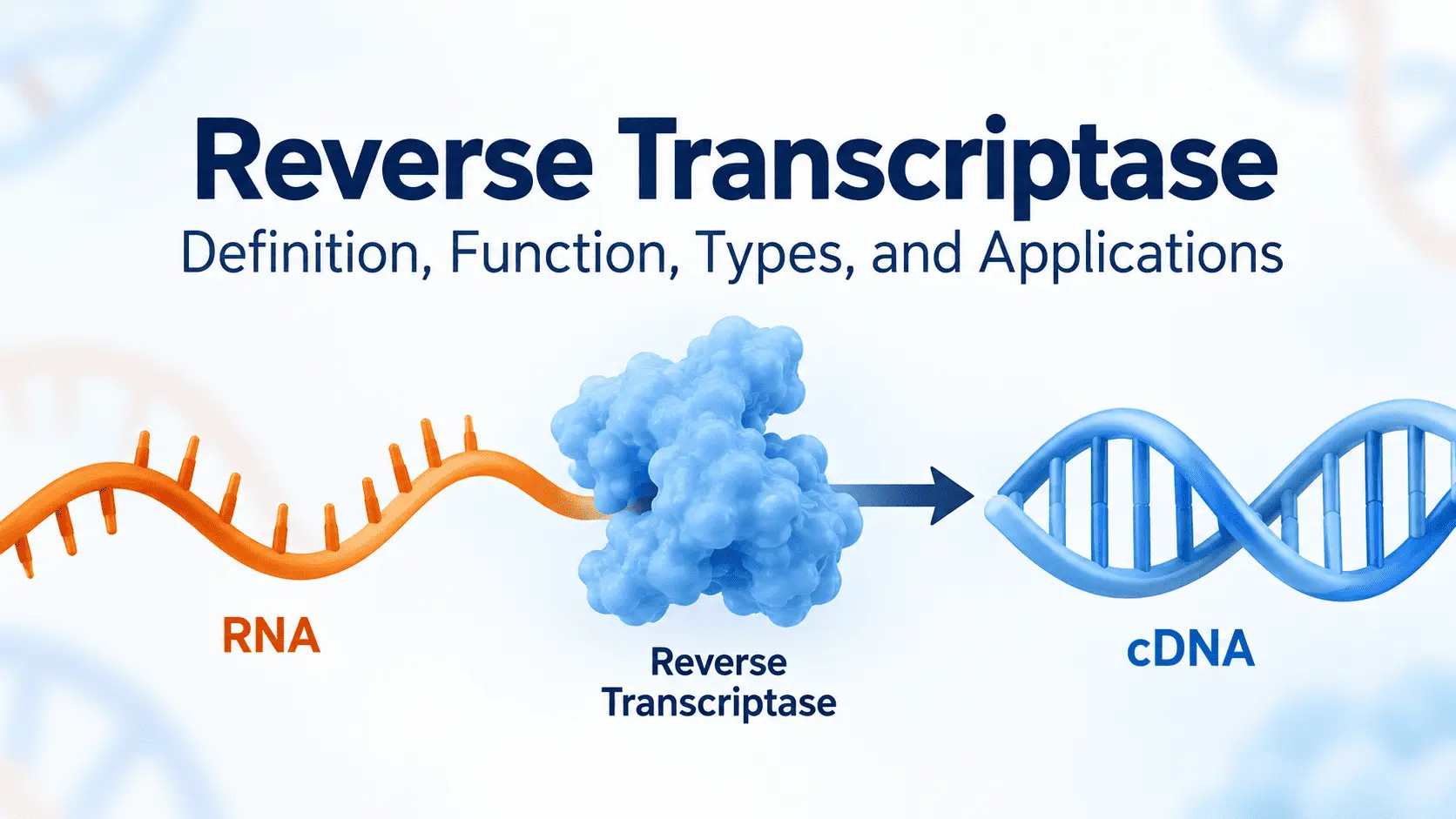
Reverse transcriptase is an enzyme that synthesizes DNA using RNA as a template. This process, known as reverse transcription, is fundamental to molecular biology because it allows researchers to convert RNA molecules into complementary DNA, or cDNA, which can then be amplified, detected, sequenced, or analyzed.
Unlike conventional DNA replication, where DNA serves as the template for the synthesis of new DNA, reverse transcription moves information from RNA back into DNA. This ability is particularly important when studying RNA molecules such as messenger RNA (mRNA), viral RNA, and various non-coding RNAs.
Reverse transcriptase has become an essential tool in molecular biology laboratories. It is widely used in RT-PCR, RT-qPCR, cDNA synthesis, gene expression analysis, RNA virus detection, cloning, and many other applications.
The enzyme was originally discovered through studies of retroviruses, which use reverse transcription as part of their replication cycle. Today, purified reverse transcriptases from different biological sources are commercially available and have been optimized for laboratory applications.
In this article, we will explore what reverse transcriptase is, how it works, the main types used in molecular biology, and its applications in research and diagnostics.
What Is Reverse Transcriptase?
Reverse transcriptase is an RNA-dependent DNA polymerase, meaning that it can use an RNA molecule as a template to synthesize a complementary DNA strand.
The DNA produced from an RNA template is called complementary DNA (cDNA) because its nucleotide sequence is complementary to the original RNA template.
For example, if an RNA molecule contains the sequence:
5′-AUGCGA-3′
the complementary DNA strand produced during reverse transcription will contain the corresponding complementary bases.
The basic reaction can therefore be represented as:
RNA → cDNA
This is the opposite direction from the usual flow of genetic information commonly described as:
DNA → RNA → protein
The ability to convert RNA into DNA is particularly useful because DNA is generally more stable than RNA and can be readily amplified using techniques such as PCR.
Reverse Transcriptase vs. DNA Polymerase
Although reverse transcriptase and DNA polymerase both synthesize DNA, they differ in their template requirements.
A conventional DNA polymerase generally uses DNA as a template, whereas reverse transcriptase can use RNA as a template.
| Feature | Reverse Transcriptase | DNA Polymerase |
|---|---|---|
| Main template | RNA | DNA |
| Product | DNA/cDNA | DNA |
| Main biological role | Reverse transcription | DNA replication/repair |
| Common laboratory use | cDNA synthesis, RT-PCR | PCR, DNA amplification |
| Requires primer | Yes | Yes |
Some reverse transcriptases also possess additional enzymatic activities. Depending on the enzyme, these can include RNase H activity, which allows degradation of the RNA strand in an RNA-DNA hybrid.
Reverse Transcriptase in Retroviruses
Reverse transcriptase was discovered in the context of retroviruses. These viruses contain RNA genomes but use a DNA intermediate during their replication cycle.
After entering a host cell, the viral RNA genome can serve as a template for reverse transcriptase. The enzyme synthesizes DNA from the viral RNA. The resulting viral DNA can subsequently become integrated into the host genome.
This mechanism is characteristic of retroviruses and is an important example of how reverse transcriptase functions naturally.
Human immunodeficiency virus (HIV), for example, is a retrovirus that relies on reverse transcriptase during its replication cycle.
The biological importance of this enzyme also explains why reverse transcriptase has been extensively studied as a target for antiviral drugs.
Components Required for Reverse Transcription
A typical laboratory reverse transcription reaction requires several essential components:
- RNA template: The RNA molecule that will be converted into cDNA.
- Reverse transcriptase: The enzyme responsible for DNA synthesis.
- Primer: Provides a free 3′-OH group from which DNA synthesis begins.
- dNTPs: Deoxynucleotide triphosphates used to synthesize the DNA strand.
- Reaction buffer: Provides appropriate chemical conditions for enzyme activity.
- Magnesium ions: Usually required as cofactors for polymerase activity.
Depending on the experimental design, different types of primers can be used, including oligo(dT) primers, random primers, and gene-specific primers.
How Does Reverse Transcriptase Work?
The process by which reverse transcriptase converts RNA into DNA is called reverse transcription.
At its simplest, the process involves using an RNA molecule as a template and synthesizing a complementary DNA strand.
The precise mechanism depends on the enzyme and the reaction conditions, but the general process can be divided into several steps.
1. Primer Binding
Reverse transcriptase cannot normally begin DNA synthesis from nothing. It requires a primer containing a free 3′-OH group.
The primer binds to a complementary region of the RNA template.
Three commonly used primer strategies are:
Oligo(dT) primers:
These primers bind to the poly(A) tail found on many eukaryotic mRNAs. They are useful when the objective is to synthesize cDNA primarily from polyadenylated RNA.
Random primers:
Random short oligonucleotides bind at multiple locations along RNA molecules. They can be useful for generating cDNA from a broad range of RNA species.
Gene-specific primers:
These primers are designed to bind to a particular RNA transcript. They can provide targeted reverse transcription when studying a specific gene.
2. DNA Strand Synthesis
Once the primer is attached to the RNA template, reverse transcriptase adds dNTPs sequentially.
The enzyme reads the RNA template and incorporates complementary DNA nucleotides.
The result is an RNA-DNA hybrid containing the original RNA strand and newly synthesized cDNA.
This is the key reaction:
RNA template + primer + dNTPs + reverse transcriptase → RNA-cDNA hybrid
3. RNA Removal or Degradation
Depending on the reverse transcriptase used, the RNA strand may be degraded after the first DNA strand has been synthesized.
Some reverse transcriptases possess RNase H activity. RNase H recognizes RNA-DNA hybrids and degrades the RNA component.
Other engineered reverse transcriptases may have reduced or absent RNase H activity. This can sometimes be advantageous for applications requiring longer or more complete cDNA molecules.
4. Second-Strand DNA Synthesis
In some reverse transcription workflows, the first DNA strand is sufficient for downstream applications, particularly RT-PCR.
However, when double-stranded cDNA is required, a second DNA strand can be synthesized.
The final product is double-stranded cDNA that can be used for applications such as cloning, sequencing, or library preparation.
Factors Affecting Reverse Transcription Efficiency
The efficiency and quality of cDNA synthesis can vary considerably depending on experimental conditions.
RNA quality is one of the most important factors. Degraded RNA can result in incomplete or biased cDNA synthesis.
RNA secondary structure can also interfere with reverse transcriptase. Highly structured RNA regions may prevent the enzyme from efficiently progressing along the template.
Reaction temperature is another important factor. Different reverse transcriptases have different optimal temperatures. Higher temperatures can sometimes help destabilize RNA secondary structures.
The amount and quality of the primer also influence the reaction.
Finally, substances carried over from RNA extraction can inhibit reverse transcriptase. Common contaminants may include salts, phenol, ethanol, guanidine compounds, or other components from extraction procedures.
For this reason, RNA purification and appropriate reaction conditions are essential for obtaining reliable cDNA.
Types of Reverse Transcriptase Enzymes
Several reverse transcriptases are used in molecular biology. They differ in their origin, temperature tolerance, processivity, fidelity, RNase H activity, and suitability for particular applications.
M-MLV Reverse Transcriptase
Moloney Murine Leukemia Virus (M-MLV) reverse transcriptase is one of the most widely used reverse transcriptases in molecular biology.
It was originally derived from Moloney murine leukemia virus and has been extensively adapted for laboratory applications.
M-MLV reverse transcriptase is commonly used for:
- cDNA synthesis
- RT-PCR
- RT-qPCR
- Gene expression studies
- Cloning of expressed genes
Different engineered versions of M-MLV reverse transcriptase are available. These variants may have improved thermal stability, processivity, or other properties compared with the original enzyme.
AMV Reverse Transcriptase
Avian Myeloblastosis Virus (AMV) reverse transcriptase is another commonly used enzyme.
AMV reverse transcriptase originates from an avian retrovirus and has traditionally been valued for its ability to operate at relatively higher temperatures than some older reverse transcriptases.
This characteristic can be useful when working with RNA molecules that contain substantial secondary structure.
AMV reverse transcriptase has been used in:
- cDNA synthesis
- RT-PCR
- RNA analysis
- Molecular cloning
Thermostable Reverse Transcriptases
Modern molecular biology has also introduced reverse transcriptases with improved thermal stability.
These enzymes can operate effectively at higher temperatures, which can be advantageous when RNA templates form stable secondary structures.
RNA molecules are not always simple linear strands. They can fold into complex structures through interactions between complementary nucleotide sequences.
At higher temperatures, some of these structures become less stable. A thermostable reverse transcriptase can therefore move through difficult RNA regions more efficiently.
Thermostable enzymes are particularly useful in applications requiring:
- Long cDNA synthesis
- Structured RNA analysis
- High-temperature reverse transcription
- Difficult RNA templates
- Rapid RT-PCR workflows
Comparing Reverse Transcriptases
There is no single reverse transcriptase that is ideal for every experiment.
Important characteristics to consider include:
Temperature range:
The optimal reaction temperature varies among enzymes.
Processivity:
Processivity refers to the ability of an enzyme to continue synthesis along a template without dissociating.
Fidelity:
Fidelity describes how accurately the enzyme copies the template.
RNase H activity:
Some enzymes have strong RNase H activity, while others have reduced or absent activity.
Inhibitor tolerance:
Some engineered enzymes are more resistant to substances that may remain after RNA extraction.
The appropriate enzyme therefore depends on the RNA template and the intended downstream application.
Reverse Transcriptase in RT-PCR and Molecular Biology
One of the most important laboratory applications of reverse transcriptase is reverse transcription polymerase chain reaction, commonly called RT-PCR.
PCR itself amplifies DNA. Because RNA cannot directly serve as the standard template for conventional PCR, reverse transcriptase is first used to convert RNA into cDNA.
The cDNA can then be amplified by PCR.
The overall workflow is:
RNA → reverse transcription → cDNA → PCR amplification
This combination makes it possible to study RNA molecules using PCR-based methods.
Reverse Transcriptase in RT-qPCR
Reverse transcriptase is also essential in reverse transcription quantitative PCR (RT-qPCR).
RT-qPCR is widely used to measure RNA abundance and study gene expression.
During the first stage, RNA is converted into cDNA. During the subsequent quantitative PCR stage, the cDNA is amplified and fluorescence is measured in real time.
The resulting data can be used to compare the relative expression of genes between different samples or experimental conditions.
For example, researchers may use RT-qPCR to investigate whether a particular gene is expressed at higher or lower levels in:
- Tumor versus normal tissue
- Treated versus untreated cells
- Different developmental stages
- Different disease states
Reverse transcription is therefore a critical step in many gene expression experiments.
One-Step vs. Two-Step RT-PCR
RT-PCR can generally be performed using either a one-step or two-step approach.
In one-step RT-PCR, reverse transcription and PCR amplification occur sequentially in the same reaction system.
This approach is convenient and reduces sample handling.
In two-step RT-PCR, reverse transcription is performed separately to generate cDNA. An aliquot of the resulting cDNA is then used for PCR.
The two-step approach provides greater flexibility because the same cDNA preparation can potentially be used for multiple downstream PCR reactions.
Reverse Transcriptase in Molecular Diagnostics
Reverse transcriptase also has important applications in molecular diagnostics, particularly for detecting RNA viruses.
Many clinically important viruses have RNA genomes. To amplify viral RNA using PCR-based methods, the RNA must first be converted into DNA.
The workflow therefore follows:
Viral RNA → cDNA → amplification → detection
This principle has been widely used in laboratory diagnosis of RNA viral infections.
Reverse transcriptase can also be used in research involving cancer-associated RNA molecules, circulating RNA, messenger RNA, microRNAs, and other forms of RNA.
The Importance of Controls
Reliable reverse transcription experiments require appropriate controls.
A no-template control (NTC) is used to identify contamination introduced into the amplification reaction.
A no-RT control is particularly important when studying RNA. In this control, the reverse transcriptase is omitted.
The no-RT control can help identify amplification originating from contaminating genomic DNA rather than RNA-derived cDNA.
This distinction is particularly important for gene expression experiments because genomic DNA contamination can produce misleading PCR signals.
Reverse Transcriptase Applications and Experimental Considerations
The versatility of reverse transcriptase makes it useful across many areas of molecular biology.
cDNA Synthesis
One of the most common applications is the preparation of cDNA from RNA.
Once generated, cDNA can be used for:
- PCR
- qPCR
- Cloning
- Sequencing
- Gene expression analysis
- cDNA library construction
Because DNA is more stable than RNA under many laboratory conditions, converting RNA into cDNA provides a convenient way to preserve and analyze RNA-derived genetic information.
Gene Expression Analysis
Reverse transcription is fundamental to the study of gene expression.
Researchers can isolate RNA from cells or tissues and convert the RNA population into cDNA.
Specific transcripts can then be analyzed using PCR or quantitative PCR.
In cancer research, for example, reverse transcription can be used to investigate the expression of genes associated with proliferation, apoptosis, invasion, angiogenesis, immune responses, or treatment resistance.
RNA Virus Detection
Another major application is the analysis of RNA viruses.
Reverse transcriptase converts viral RNA into DNA, allowing PCR-based amplification and detection.
This principle is widely used in molecular diagnostic workflows and viral research.
Analysis of Non-Coding RNAs
Reverse transcriptase is also important for studying non-coding RNAs, including microRNAs and other regulatory RNA molecules.
MicroRNAs are short RNA molecules that regulate gene expression by interacting with target messenger RNAs.
Because of their small size and distinctive structure, microRNA analysis may require specialized reverse transcription strategies, including stem-loop or other sequence-specific primers.
Reverse transcription therefore provides an important bridge between RNA biology and DNA-based analytical methods.
Cloning and Sequencing
Reverse transcriptase can also be used to generate cDNA for cloning expressed genes.
Researchers can isolate mRNA from a biological sample, convert it into cDNA, and amplify the coding sequences of interest.
The resulting DNA can then be cloned into an appropriate vector or prepared for sequencing.
This approach is particularly useful when researchers want to study genes based on their expressed RNA transcripts rather than genomic DNA.
Choosing a Reverse Transcriptase
The choice of enzyme should be based on the characteristics of the experiment rather than simply selecting the most commonly used enzyme.
Important questions include:
What type of RNA is being studied?
mRNA, viral RNA, microRNA, ribosomal RNA, and other RNA molecules can require different approaches.
Is the RNA highly structured?
If the template contains extensive secondary structure, a thermostable reverse transcriptase may be advantageous.
Is full-length cDNA required?
For long transcripts, an enzyme with high processivity may be preferable.
Is high sensitivity required?
For low-abundance RNA targets, enzyme performance and reaction optimization become particularly important.
Will the cDNA be used for quantitative analysis?
For RT-qPCR, consistent and reproducible reverse transcription is essential because differences introduced during cDNA synthesis can influence quantitative results.
Common Reverse Transcription Problems
Several problems can occur during reverse transcription.
Low cDNA yield may result from degraded RNA, insufficient RNA input, inappropriate reaction conditions, or inefficient enzyme activity.
Poor amplification after reverse transcription may also be caused by inhibitors carried over from RNA extraction.
Genomic DNA contamination can produce false-positive or artificially elevated signals, particularly when PCR primers do not distinguish between cDNA and genomic DNA.
RNA degradation is another common problem. RNases are widespread and can rapidly degrade RNA if appropriate precautions are not taken.
Researchers should therefore use RNase-free materials, maintain appropriate sample handling conditions, and verify RNA quality whenever possible.
Improving Reverse Transcription Efficiency
Several general strategies can improve the reliability of reverse transcription.
Start with high-quality RNA and avoid unnecessary freeze-thaw cycles.
Choose primers that are appropriate for the RNA population being studied.
Use the recommended temperature and reaction conditions for the selected enzyme.
For structured RNA templates, consider an enzyme capable of operating at an appropriate higher temperature.
Finally, include suitable controls and optimize the reaction when working with difficult or low-abundance targets.
These steps can help produce more consistent cDNA and improve the reliability of downstream PCR-based experiments.
Conclusion
Reverse transcriptase is a key enzyme in molecular biology that enables the conversion of RNA into complementary DNA (cDNA). This process, known as reverse transcription, provides an essential connection between RNA-based biological information and DNA-based analytical techniques.
Originally recognized for its role in retroviral replication, reverse transcriptase is now widely used in laboratory research and molecular diagnostics.
Different reverse transcriptases have different properties, including thermal stability, processivity, fidelity, and RNase H activity. Selecting the appropriate enzyme depends on the RNA template and the intended application.
Its importance is particularly evident in RT-PCR and RT-qPCR, where reverse transcription is used to convert RNA into a form that can be amplified and quantified. The enzyme is also widely used for cDNA synthesis, gene expression analysis, RNA virus detection, non-coding RNA research, cloning, and sequencing.
Understanding how reverse transcriptase works and how experimental factors influence reverse transcription is therefore essential for obtaining reliable results from RNA-based molecular biology experiments.


