

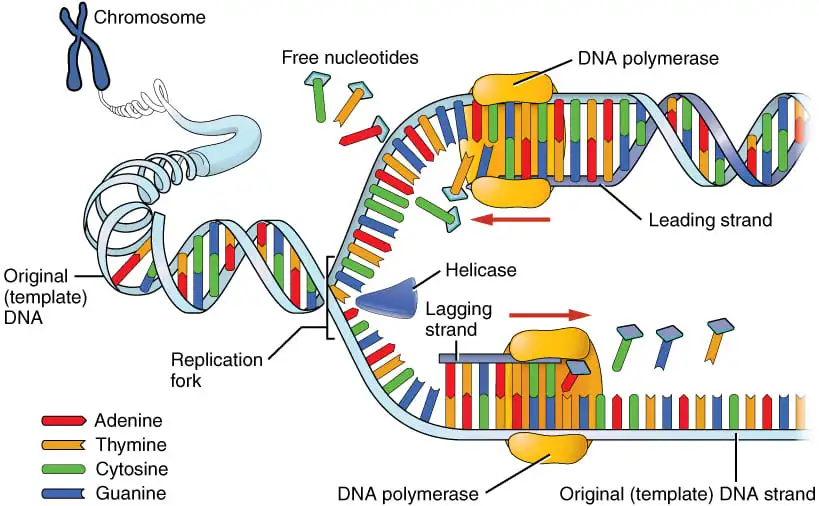
DNA replication is the process by which cells duplicate their genetic material before division, ensuring the faithful transmission of DNA to daughter cells. It is a highly regulated molecular event that relies on specialized enzymes to copy the genome with remarkable accuracy.
In this blog post, we will explore the fundamental principles of DNA replication, the key enzymes involved in this process, and the regulatory mechanisms that ensure precise and controlled genome duplication.
I. Fundamental Principles of DNA Replication
DNA replication follows a set of core principles that ensure the genome is copied accurately and efficiently. These principles are conserved across all living organisms and form the foundation of our understanding of how genetic information is transmitted from one cell generation to the next.
1. Semi-Conservative Nature of DNA Replication
DNA replication is described as semi-conservative, meaning that each newly synthesized DNA molecule contains one parental (original) strand and one newly formed strand. This model was experimentally demonstrated by the classic Meselson–Stahl experiment, which showed that parental DNA strands serve as templates for the synthesis of complementary strands. Semi-conservative replication ensures the preservation of genetic information while allowing for accurate duplication.
2. Directionality and Polarity of DNA Synthesis
DNA synthesis occurs in a strict 5′ to 3′ direction, as DNA polymerases can only add nucleotides to the free 3′ hydroxyl group of a growing DNA strand. Because the two DNA strands are antiparallel, this directionality has important consequences for how replication proceeds on each strand, leading to continuous synthesis on one strand and discontinuous synthesis on the other.
3. Origins of Replication
DNA replication begins at specific genomic regions known as origins of replication. In prokaryotes, replication typically starts from a single origin, allowing duplication of the circular chromosome. In contrast, eukaryotic genomes contain multiple origins distributed along each chromosome, enabling the timely replication of large and complex genomes. The controlled activation of these origins is critical for proper cell cycle progression and genome stability.
II. Molecular Machinery of DNA Replication
DNA replication depends on a coordinated set of enzymes and protein complexes. Each component has a specific role, ensuring that DNA is unwound, copied, and stabilized efficiently.
1. DNA Polymerases: The Core Enzymes
DNA polymerases synthesize new DNA strands by adding nucleotides to a growing chain.
Key points:
- DNA synthesis occurs only in the 5′ → 3′ direction
- Polymerases require:
- A DNA template
- A free 3′-OH group (provided by a primer)
Major polymerases:
- Prokaryotes
- DNA polymerase III → main replicative enzyme
- DNA polymerase I → primer removal and gap filling
- Eukaryotes
- DNA polymerase α → initiates synthesis with RNA–DNA primer
- DNA polymerase δ → lagging strand synthesis
- DNA polymerase ε → leading strand synthesis
2. Topoisomerase, Helicase, Primase, and Single-Strand Binding Proteins
These proteins prepare the DNA template for replication.
Topoisomerase
- Relieve DNA supercoiling
- Prevent replication fork collapse
- Allow continuous fork movement
Helicase
- Unwinds the DNA double helix
- Breaks hydrogen bonds between base pairs
- Creates the replication fork
Primase
- Synthesizes short RNA primers
- Provides a starting point for DNA polymerases
Single-strand binding proteins (SSBs)
- Bind exposed single-stranded DNA
- Prevent strand reannealing
- Protect DNA from degradation
3. Sliding Clamps and Clamp Loaders
These factors increase the efficiency of DNA synthesis.
Sliding clamps
- Hold DNA polymerase tightly on the DNA
- Increase processivity (number of nucleotides added without dissociation)
- Examples:
- β-clamp (prokaryotes)
- PCNA (eukaryotes)
Clamp loaders
- Load sliding clamps onto DNA
- Use ATP to open and close the clamp around the DNA strand
This molecular machinery works as a highly organized system, allowing rapid and accurate genome duplication.
III. Leading and Lagging Strand Synthesis
Because DNA strands are antiparallel and DNA polymerases synthesize DNA only in the 5′ → 3′ direction, replication proceeds differently on each strand at the replication fork.
1. Leading Strand Synthesis
The leading strand is synthesized continuously in the same direction as the movement of the replication fork.
Key features:
- Requires only one RNA primer
- DNA polymerase follows the helicase as it unwinds DNA
- Synthesis is smooth and uninterrupted
Main enzymes involved:
- DNA polymerase III (prokaryotes)
- DNA polymerase ε (eukaryotes)
2. Lagging Strand Synthesis
The lagging strand is synthesized discontinuously in short segments called Okazaki fragments, in the opposite direction of fork movement.
Key features:
- Requires multiple RNA primers
- DNA synthesis occurs in short bursts
- Each fragment is synthesized independently
Steps involved:
- Primase synthesizes RNA primers
- DNA polymerase extends each primer
- RNA primers are removed
- Gaps are filled with DNA
Okazaki fragment length:
- ~1,000–2,000 nucleotides (prokaryotes)
- ~100–200 nucleotides (eukaryotes)
3. DNA Ligase and Fragment Maturation
Once Okazaki fragments are synthesized, they must be joined to form a continuous strand.
DNA ligase functions:
- Seals nicks between adjacent DNA fragments
- Forms phosphodiester bonds
- Completes lagging strand synthesis
Final outcome:
- Two continuous daughter DNA strands
- One leading strand and one lagging strand per replication fork
This coordinated process ensures that both DNA strands are fully and accurately replicated despite their opposite orientations.
IV. Regulation of DNA Replication
DNA replication must occur once and only once per cell cycle. Tight regulation is essential to prevent incomplete replication or re-replication, both of which can lead to genomic instability.
1. Cell Cycle Control of DNA Replication
Replication is restricted to the S phase of the cell cycle.
Key regulatory points:
- Replication origins are prepared in G1 phase
- DNA synthesis occurs in S phase
- Entry into mitosis is blocked until replication is complete
Major regulators:
- Cyclin-dependent kinases (CDKs)
- Control timing of origin activation
- Checkpoint proteins
- Halt the cell cycle if replication errors are detected
2. Replication Licensing and Origin Activation
Replication origins must be licensed before they can fire.
Licensing occurs in G1 phase and involves:
- Origin Recognition Complex (ORC) binding to DNA
- Recruitment of:
- Cdc6
- Cdt1
- Loading of the MCM helicase complex
Key rule:
- Each origin is licensed only once per cycle
3. Prevention of Re-Replication
To maintain genome integrity, cells actively prevent origins from firing more than once.
Mechanisms include:
- CDK-mediated inhibition of licensing factors after S phase begins
- Degradation or inactivation of Cdt1
- Separation of licensing (G1) and firing (S phase) phases
4. Replication Checkpoints and Stress Response
Cells monitor replication progression in real time.
Replication stress triggers:
- Fork stalling
- DNA damage signals
Key pathways:
- ATR–CHK1 signaling
- Stabilizes stalled replication forks
- Delays cell cycle progression
- Promotes DNA repair
Through these regulatory layers, cells ensure precise and coordinated genome duplication, preserving genetic stability across cell divisions.
V. Fidelity and Proofreading Mechanisms
DNA replication is an extremely accurate process, with multiple control systems in place to minimize errors. High fidelity is essential to preserve genome integrity and prevent the accumulation of mutations.
1. Base Selection and Polymerase Accuracy
The first level of fidelity occurs during nucleotide incorporation.
Key features:
- DNA polymerases select nucleotides based on complementary base pairing
- Correct base pairing ensures proper hydrogen bonding
- Incorrect nucleotides are incorporated at a very low frequency
Result:
- Error rate of ~1 mistake per 10⁵ nucleotides before proofreading
2. Proofreading Activity of DNA Polymerases
Most replicative DNA polymerases possess a built-in proofreading function.
How proofreading works:
- Incorrect nucleotide incorporation distorts the DNA helix
- DNA polymerase pauses synthesis
- The enzyme shifts the DNA to its 3′ → 5′ exonuclease site
- The incorrect nucleotide is removed
- DNA synthesis resumes correctly
Polymerases with proofreading activity:
- DNA polymerase III (prokaryotes)
- DNA polymerase δ and ε (eukaryotes)
3. Post-Replication Mismatch Repair
Some replication errors escape proofreading and are corrected afterward.
Mismatch repair (MMR) system:
- Detects mismatched base pairs and small insertions/deletions
- Identifies the newly synthesized strand
- Removes the incorrect DNA segment
- Resynthesizes the correct sequence
Impact:
- Reduces error rate to ~1 mutation per 10⁹–10¹⁰ nucleotides
4. Replication Stress and Genome Stability
Errors increase when replication forks are disrupted.
Causes of replication stress:
- DNA damage
- Nucleotide depletion
- Difficult-to-replicate DNA regions
Cellular responses:
- Fork stabilization
- Activation of DNA damage checkpoints
- Repair pathway recruitment
Together, proofreading and repair mechanisms ensure that DNA replication remains one of the most precise biological processes, safeguarding long-term genome stability.
VI. DNA Replication in Prokaryotes vs Eukaryotes
Although the core principles of DNA replication are conserved, significant differences exist between prokaryotic and eukaryotic cells. These differences reflect genome size, organization, and regulatory complexity.
1. Genome Structure and Origins of Replication
Prokaryotes:
- Usually have a single circular chromosome
- Replication starts from one origin (oriC)
- Replication proceeds bidirectionally
Eukaryotes:
- Have multiple linear chromosomes
- Each chromosome contains many origins of replication
- Multiple replication forks operate simultaneously
2. Replication Machinery and Enzymatic Complexity
Prokaryotic replication:
- Fewer proteins involved
- DNA polymerase III is the main replicative enzyme
- Faster and less complex regulation
Eukaryotic replication:
- More complex protein machinery
- Multiple specialized DNA polymerases
- Replication tightly linked to the cell cycle
3. Speed and Timing of DNA Replication
Replication speed:
- Prokaryotes: ~1,000 nucleotides/second
- Eukaryotes: ~50–100 nucleotides/second
Timing differences:
- Prokaryotes replicate continuously when conditions allow
- Eukaryotes replicate only during S phase
4. Telomere Replication in Eukaryotes
Linear chromosomes create a unique challenge during replication.
The end-replication problem:
- DNA polymerases cannot fully replicate chromosome ends
- Leads to progressive telomere shortening
Solution:
- Telomerase extends telomeres
- Maintains chromosome stability in stem cells and cancer cells
5. Chromatin Context and Replication
Eukaryotic DNA is packaged into chromatin, adding another regulatory layer.
Key points:
- Euchromatin replicates early
- Heterochromatin replicates late
- Histone modifications influence origin activation
These differences highlight how DNA replication has evolved to accommodate increasing genome complexity while maintaining accuracy and control.
VII. DNA Replication and Human Disease
Precise regulation of DNA replication is essential for maintaining genome integrity. When replication control or fidelity is disrupted, cells accumulate mutations and chromosomal abnormalities that contribute to human disease.
1. Replication Errors and Genome Instability
Defects in replication machinery increase mutation rates.
Common causes:
- Faulty DNA polymerases
- Defective proofreading activity
- Impaired mismatch repair
Consequences:
- Point mutations
- Insertions and deletions
- Chromosomal rearrangements
These changes promote genome instability, a hallmark of many diseases.
2. DNA Replication and Cancer Development
Cancer cells often show abnormal replication dynamics.
Key features in cancer:
- Uncontrolled origin firing
- High levels of replication stress
- Frequent replication fork stalling
Outcomes:
- Accumulation of oncogenic mutations
- Chromosome instability (CIN)
- Tumor progression and therapy resistance
3. Replication Stress as a Therapeutic Vulnerability
Cancer cells rely heavily on stress-response pathways to survive.
Therapeutic strategies include:
- Targeting ATR–CHK1 checkpoint pathways
- Inhibiting DNA polymerases
- Blocking nucleotide synthesis
These approaches selectively affect rapidly dividing tumor cells.
4. Genetic Disorders Linked to Replication Defects
Inherited mutations in replication or repair genes cause rare disorders.
Examples:
- Bloom syndrome
- Werner syndrome
- Fanconi anemia
Shared features:
- Growth defects
- Cancer predisposition
- Chromosome instability
Understanding how DNA replication contributes to disease has direct implications for diagnostics, prognosis, and the development of targeted therapies.
Conclusion
DNA replication is a highly coordinated molecular process that ensures accurate duplication of the genome before cell division. Through precise enzymatic control, proofreading, and regulatory checkpoints, cells maintain genome stability across generations. Understanding the mechanisms and regulation of DNA replication is essential in molecular biology, particularly for explaining how replication defects contribute to cancer and other human diseases.


