

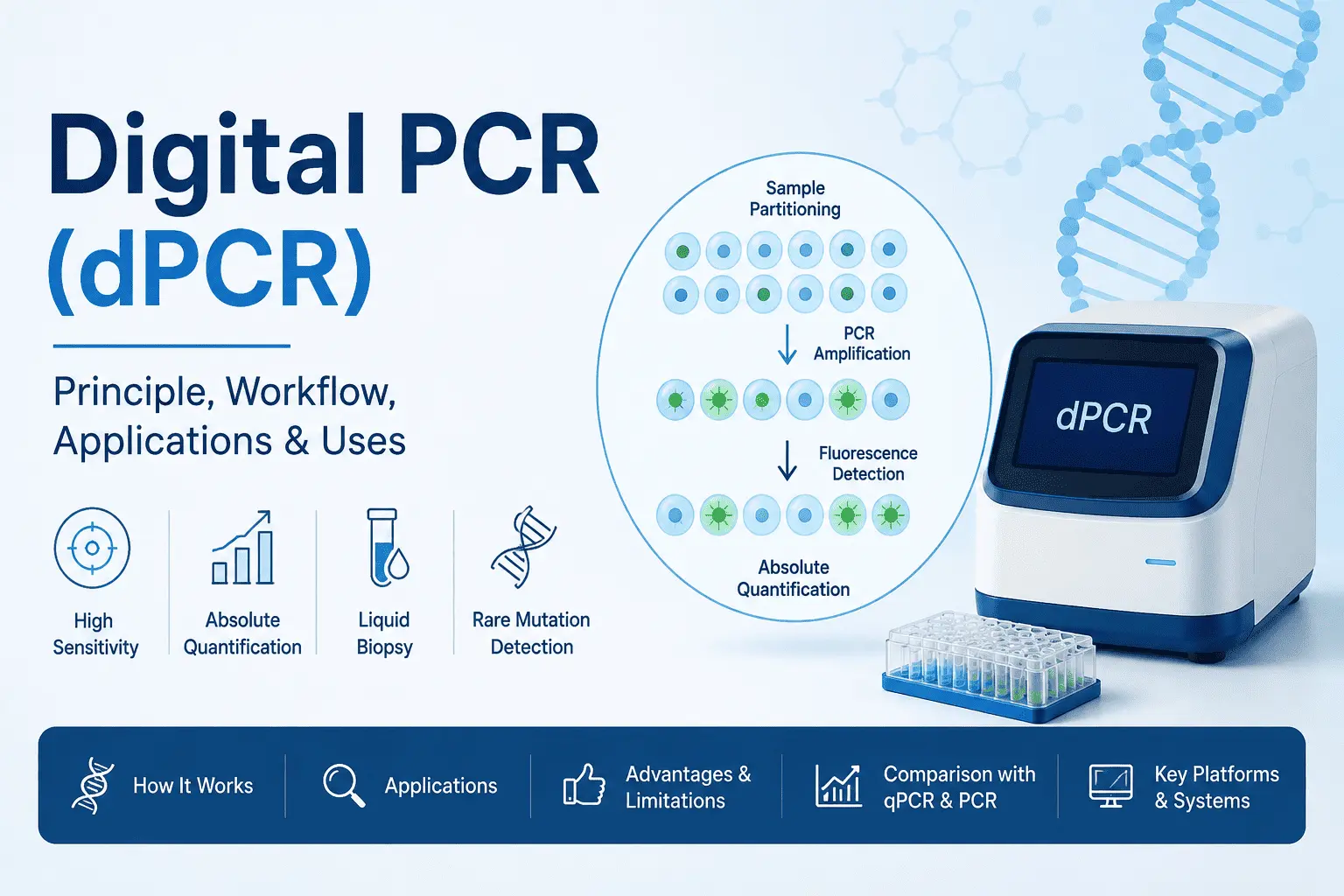
Digital PCR (dPCR) is a highly sensitive molecular biology technique used for the absolute quantification of DNA and RNA molecules. By partitioning a sample into thousands of individual reactions, dPCR enables precise detection of low-abundance targets and rare genetic variants, making it an essential tool in modern research and clinical diagnostics.
In this guide, you’ll learn how Digital PCR works, its main applications, advantages and limitations, how it compares with conventional PCR and qPCR, and the key platforms used in laboratories today.
What Is Digital PCR and How Does It Work?
Digital PCR (dPCR) is an advanced version of the polymerase chain reaction (PCR) used to detect and accurately quantify DNA and RNA molecules. Unlike conventional PCR or quantitative PCR (qPCR), digital PCR measures the absolute number of target molecules in a sample without requiring a standard curve.
Its high sensitivity and precision make it a valuable tool for detecting rare genetic mutations, measuring low-abundance nucleic acids, and analyzing complex biological samples.
The Principle of Digital PCR
Digital PCR works by dividing a single PCR reaction into thousands of tiny, independent reactions, known as partitions. Each partition contains either:
- One target DNA or RNA molecule
- Or no target molecule at all
After PCR amplification:
- Partitions containing the target produce a fluorescent signal (positive).
- Partitions without the target remain non-fluorescent (negative).
The instrument counts the number of positive and negative partitions and uses Poisson statistics to calculate the absolute concentration of the target nucleic acid in the original sample.
Step-by-Step Digital PCR Workflow
A typical digital PCR experiment includes the following steps.
- Sample Preparation
DNA or RNA is extracted from the biological sample.
If RNA is analyzed, it is first converted into complementary DNA (cDNA). - Reaction Setup
The PCR reaction mixture is prepared using:
DNA or RNA template
Primers
Fluorescent probes
DNA polymerase
dNTPs
PCR buffer - Sample Partitioning
The reaction mixture is divided into thousands of tiny partitions.
Depending on the system, these partitions may be:
Water-in-oil droplets
Microfluidic chambers
Microwells on a chip - PCR Amplification
The partitions undergo thermal cycling.
During amplification:
Partitions containing the target DNA become fluorescent.
Empty partitions remain negative. - Fluorescence Detection
After PCR, the instrument scans every partition.
Each partition is classified as either:
Positive, or
Negative - Data Analysis
The software counts the number of positive partitions and calculates the absolute concentration of the target using Poisson statistics.
The final result is reported as the number of DNA or RNA copies per unit volume.
Types of Digital PCR (Droplet-Based and Chip-Based)
Modern digital PCR systems use two main partitioning technologies.
Droplet-Based Digital PCR
Droplet-based digital PCR (ddPCR) divides the reaction mixture into thousands to millions of microscopic droplets suspended in oil.
Key features include:
- High sensitivity
- Excellent precision
- High sample throughput
- Ideal for detecting rare mutations and liquid biopsy biomarkers
This is currently the most widely used form of digital PCR.
Chip-Based Digital PCR
Chip-based digital PCR uses microfluidic chips or microwell plates to partition the sample into thousands of fixed reaction chambers.
Key advantages include:
- Uniform partition size
- Simple workflow
- Reduced sample handling
- High reproducibility
Chip-based systems are widely used in research laboratories and clinical diagnostic applications.
Applications of Digital PCR in Research and Medicine
Digital PCR has become an essential tool in molecular biology because it can accurately detect and quantify very small amounts of DNA and RNA. Its high sensitivity allows researchers and clinicians to identify rare genetic changes that may be missed by other PCR techniques.
Today, digital PCR is widely used in cancer research, infectious disease diagnosis, genetic testing, and precision medicine.
Cancer Research and Liquid Biopsy
Cancer is one of the most important fields where digital PCR is applied.
The technique can detect tiny amounts of circulating tumor DNA (ctDNA) released by cancer cells into the bloodstream. This makes it possible to analyze tumor genetics using a simple blood sample instead of an invasive tissue biopsy.
Common applications include:
- Detecting cancer-associated mutations
- Monitoring treatment response
- Identifying minimal residual disease (MRD)
- Detecting cancer recurrence at an early stage
- Measuring circulating tumor DNA (ctDNA)
- Studying tumor heterogeneity
Because digital PCR can identify mutations present at very low frequencies, it has become a valuable tool for liquid biopsy research and clinical oncology.
Infectious Disease Detection
Digital PCR provides highly sensitive detection of bacterial, viral, and fungal pathogens.
It is especially useful when pathogen levels are very low or when accurate viral load measurement is required.
Examples of applications include:
- SARS-CoV-2 (COVID-19) detection
- HIV viral load monitoring
- Hepatitis B and Hepatitis C testing
- Human papillomavirus (HPV) detection
- Tuberculosis research
- Detection of antimicrobial resistance genes
Compared with conventional PCR, digital PCR is often less affected by PCR inhibitors, improving accuracy in difficult clinical samples.
Genetic Testing and Rare Mutation Detection
Digital PCR is widely used to identify rare genetic variants that may be present in only a small percentage of cells.
Its high sensitivity makes it ideal for detecting mutations that are difficult to identify using conventional methods.
Common applications include:
- Detection of inherited genetic mutations
- Somatic mutation analysis
- Single nucleotide variant (SNV) detection
- Rare allele identification
- Non-invasive prenatal testing (NIPT)
- Validation of next-generation sequencing (NGS) results
The technique is also valuable for studying mosaicism and low-frequency genetic variants.
Gene Expression and Copy Number Variation Analysis
Digital PCR enables accurate measurement of gene expression and DNA copy number changes.
Unlike qPCR, it provides absolute quantification without relying on reference standards.
Researchers commonly use dPCR for:
- Measuring gene expression levels
- Copy number variation (CNV) analysis
- Quantifying microRNAs (miRNAs)
- Detecting gene amplifications and deletions
- Biomarker validation
- Evaluating CRISPR gene-editing outcomes
Its high precision makes it particularly useful when analyzing low-copy targets or small differences in gene expression.
Advantages and Limitations of Digital PCR
Digital PCR offers several advantages over conventional PCR and qPCR, particularly when high sensitivity and precise quantification are required. However, like any molecular biology technique, it also has certain limitations that should be considered before selecting it for a specific application.
Key Advantages of Digital PCR
Digital PCR has become increasingly popular because of its ability to provide highly reliable and reproducible results.
Its main advantages include:
- Absolute quantification: Measures the exact number of DNA or RNA molecules without requiring a standard curve.
- High sensitivity: Detects very low concentrations of target nucleic acids.
- Excellent precision: Produces highly reproducible results, even with low-copy-number samples.
- Rare mutation detection: Identifies mutations present at very low frequencies, making it ideal for cancer research and liquid biopsy.
- Resistance to PCR inhibitors: Delivers reliable results in complex biological samples that may inhibit conventional PCR.
- Wide dynamic range: Accurately quantifies both low- and high-abundance targets.
- Improved reproducibility: Reduces variability between experiments and laboratories.
- Multiplexing capability: Many dPCR systems can detect multiple targets in a single reaction, saving time and sample volume.
Limitations and Challenges
Despite its many strengths, digital PCR also has some drawbacks.
Common limitations include:
- High instrument cost: dPCR instruments are more expensive than conventional PCR and qPCR systems.
- Higher consumable costs: Specialized chips, cartridges, or droplets increase the cost per experiment.
- Lower sample throughput: Some platforms process fewer samples at a time than high-throughput qPCR systems.
- Longer workflow: Additional partitioning and data analysis steps can increase processing time.
- Specialized training required: Users need experience with instrument operation and data interpretation.
- Limited multiplexing: Although improving, multiplexing capabilities are generally lower than some advanced qPCR assays.
For these reasons, digital PCR is often chosen for applications where maximum sensitivity and accuracy outweigh higher costs.
Digital PCR vs. Conventional PCR and qPCR
Although conventional PCR, quantitative PCR (qPCR), and digital PCR (dPCR) all amplify DNA, they differ in how they detect and measure nucleic acids.
Digital PCR vs. Conventional PCR
| Feature | Conventional PCR | Digital PCR |
|---|---|---|
| Primary purpose | DNA detection | Absolute DNA/RNA quantification |
| Quantification | No | Yes |
| Standard curve | Not required | Not required |
| Sensitivity | Moderate | Very high |
| Rare mutation detection | Limited | Excellent |
| Result | Qualitative | Quantitative |
Digital PCR vs. Quantitative PCR (qPCR)
| Feature | qPCR | Digital PCR |
|---|---|---|
| Quantification | Relative or absolute (with standard curve) | Absolute |
| Standard curve | Usually required | Not required |
| Detection method | Real-time fluorescence | End-point fluorescence after partitioning |
| Sensitivity | High | Very high |
| Precision | High | Excellent |
| Low-copy target detection | Good | Excellent |
| Resistance to PCR inhibitors | Moderate | Higher |
When to Choose Digital PCR
Digital PCR is the preferred method when the highest level of sensitivity and precision is required.
Choose digital PCR when you need to:
- Detect rare genetic mutations.
- Quantify very low levels of DNA or RNA.
- Measure circulating tumor DNA (ctDNA) in liquid biopsy samples.
- Analyze copy number variations (CNVs).
- Validate next-generation sequencing (NGS) results.
- Detect minimal residual disease (MRD).
- Perform absolute nucleic acid quantification without a standard curve.
For routine DNA amplification or simple target detection, conventional PCR is often sufficient. When relative gene expression analysis or high-throughput quantification is needed, qPCR remains a cost-effective choice. However, for applications requiring exceptional accuracy and sensitivity, digital PCR is generally the best option.
Key Digital PCR Systems and Platforms
Several manufacturers have developed digital PCR platforms that differ in their partitioning technology, throughput, and intended applications. While all of these systems perform absolute nucleic acid quantification, they vary in workflow, sample capacity, and multiplexing capabilities.
Droplet-Based Digital PCR Systems
Droplet-based systems generate thousands of microscopic droplets, with each droplet acting as an individual PCR reaction. These platforms are widely used in research because they offer high sensitivity and excellent reproducibility.
Bio-Rad QX700™
The Bio-Rad QX700™ is a droplet digital PCR (ddPCR) system designed for high-performance molecular analysis. It partitions each sample into thousands of uniform droplets, enabling precise detection and absolute quantification of DNA and RNA targets.
Key features include:
- Droplet-based partitioning technology
- High sensitivity for rare mutation detection
- Accurate copy number variation (CNV) analysis
- Suitable for liquid biopsy and cancer research
- User-friendly software for data analysis
Thermo Fisher QuantStudio Absolute Q™
The Thermo Fisher QuantStudio Absolute Q™ combines sample partitioning, PCR amplification, and data analysis in a single integrated instrument, simplifying the digital PCR workflow.
Key features include:
- Automated sample processing
- Fast turnaround time
- High sensitivity and precision
- Supports multiplex assays
- Ideal for both research and clinical laboratories
Microfluidic and Nanoplate-Based Digital PCR Systems
Instead of droplets, these platforms partition samples into thousands of fixed microchambers or nanoplate wells. This approach provides highly uniform partitions and simplifies sample handling.
Qiagen QIAcuityDx
The Qiagen QIAcuityDx platform uses nanoplate-based digital PCR technology to deliver accurate and reproducible nucleic acid quantification.
Key features include:
- Nanoplate partitioning technology
- Automated workflow
- High multiplexing capability
- Suitable for clinical diagnostics and translational research
- Scalable throughput for different laboratory needs
Stilla Nio®PCR
The Stilla Nio®PCR system is a microfluidic digital PCR platform designed for highly sensitive molecular testing. It combines sample partitioning and fluorescence detection to deliver reliable quantitative results.
Key features include:
- Microfluidic partitioning technology
- High analytical sensitivity
- Multiplex detection of multiple targets
- Streamlined workflow
- Applications in oncology, infectious diseases, and genetic research
Conclusion
Digital PCR has transformed molecular biology by providing highly sensitive and accurate absolute quantification of DNA and RNA molecules. Its ability to detect rare genetic variants and low-abundance targets has made it an essential tool in cancer research, infectious disease diagnostics, genetic testing, and precision medicine. As digital PCR technology continues to advance, it is expected to play an even greater role in research and clinical laboratories, supporting more precise and reliable molecular analyses.


 is, how it works, its workflow, applications, advantages, limitations, and comparison with qPCR and conventional PCR.)