

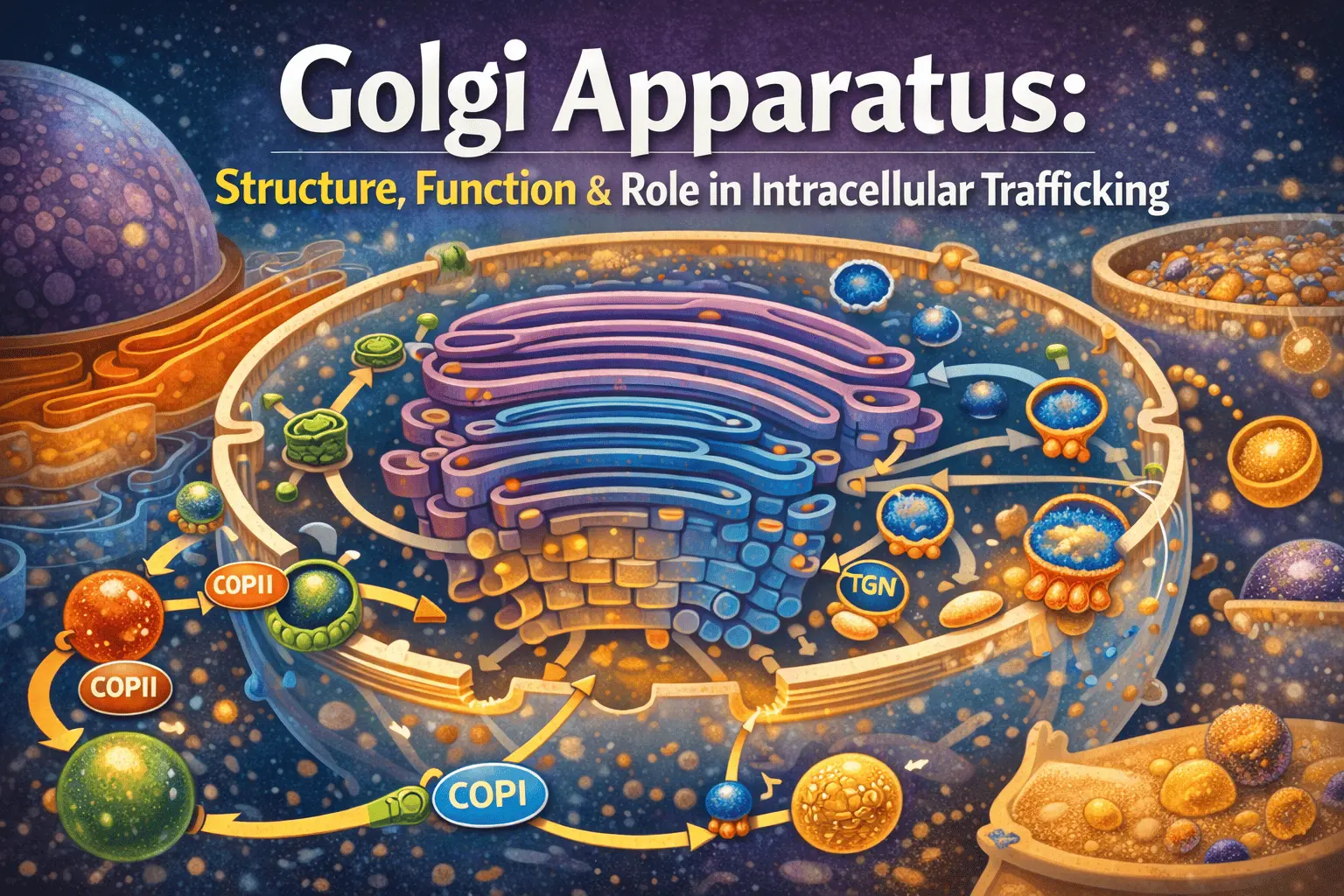
The Golgi apparatus is a central organelle of the eukaryotic endomembrane system, responsible for the modification, sorting, and distribution of proteins and lipids. Often described as the “post office” of the cell, the Golgi does far more than package molecules—it is a highly organized and dynamic processing hub that ensures proteins reach their correct destinations with precise biochemical modifications.
Discovered in 1898 by Camillo Golgi using silver staining techniques, the Golgi apparatus was initially controversial due to limitations in microscopy. Today, advanced imaging and molecular biology techniques have confirmed its essential role in intracellular trafficking and cellular organization.
Functionally positioned between the endoplasmic reticulum (ER) and the plasma membrane, the Golgi apparatus receives newly synthesized proteins from the ER, modifies them, sorts them, and directs them toward their final intracellular or extracellular destinations.
In this article, we explore its structural organization, molecular mechanisms of modification, vesicular trafficking pathways, and physiological significance in cellular homeostasis.
1. Golgi Apparatus Structure
1.1 General Architecture
The Golgi apparatus is composed of flattened, membrane-bound sacs known as cisternae, arranged in stacked layers. A typical Golgi stack contains 4–8 cisternae, although this number varies depending on cell type and physiological state.
The Golgi is a polarized organelle, meaning it has a defined structural and functional directionality. It is generally located in the perinuclear region, near the centrosome, facilitating efficient communication with the ER and cytoskeletal transport systems.
1.2 Cis, Medial, and Trans Compartments
The Golgi stack is divided into distinct functional regions:
- Cis-Golgi network (CGN) – the entry face receiving vesicles from the ER
- Medial cisternae – the central processing region
- Trans-Golgi network (TGN) – the exit face where sorting occurs
This compartmentalization allows stepwise modification of cargo proteins as they move from the cis to the trans side. Each cisterna contains specific enzymes responsible for sequential biochemical transformations, particularly glycosylation reactions.
1.3 Golgi in Different Cell Types
The size and complexity of the Golgi apparatus vary depending on cellular function. In highly secretory cells—such as endocrine cells or plasma cells—the Golgi is especially prominent and well-developed. These cells require extensive protein processing and vesicular trafficking.
During mitosis, the Golgi undergoes fragmentation into vesicular and tubular structures. After cytokinesis, it reassembles in daughter cells, highlighting its dynamic and regulated structural nature.
1.4 Dynamic Nature of the Golgi
Two major models explain intra-Golgi transport:
- Vesicular transport model – cargo moves forward via vesicles between stable cisternae.
- Cisternal maturation model – cisternae themselves mature and progress from cis to trans, carrying cargo forward while enzymes recycle backward.
Current evidence supports a hybrid understanding in which elements of both models contribute to Golgi dynamics. This structural plasticity allows the Golgi to adapt to varying cellular demands.
2. Molecular Mechanisms of Protein Modification
2.1 Post-Translational Modifications
One of the primary functions of the Golgi apparatus is post-translational modification of proteins synthesized in the rough ER.
Key modifications include:
- N-linked glycosylation processing
- O-linked glycosylation
- Proteolytic cleavage
- Sulfation of tyrosine residues
- Phosphorylation of specific sugar residues
These modifications alter protein stability, folding, targeting, and biological activity.
2.2 Glycosylation Pathways
Glycosylation is the most prominent modification occurring in the Golgi. N-linked glycans initially added in the ER undergo trimming and remodeling across cis, medial, and trans cisternae. O-linked glycosylation, in contrast, begins within the Golgi itself.
Each cisterna contains a distinct set of glycosyltransferases and glycosidases, enabling sequential processing. This spatial enzyme distribution ensures accuracy and efficiency.
Glycosylation affects:
- Protein folding
- Cell-cell recognition
- Immune interactions
- Protein stability
- Extracellular matrix composition
Defects in glycosylation pathways can lead to severe developmental and metabolic disorders.
2.3 Lipid Modification and Synthesis
The Golgi apparatus is also involved in lipid metabolism. It plays a key role in:
- Synthesis of glycosphingolipids
- Production of sphingomyelin
- Remodeling of membrane lipid composition
These processes are essential for maintaining membrane integrity and supporting vesicle formation.
By regulating lipid composition, the Golgi contributes to membrane curvature, vesicle budding, and organelle identity.
2.4 Quality Control and Processing Fidelity
Although primary protein quality control occurs in the ER, the Golgi participates in ensuring proper processing fidelity. Misprocessed proteins can be redirected for degradation, and trafficking checkpoints help prevent mistargeted cargo.
Coordination between the ER and Golgi ensures that only properly folded and modified proteins proceed through the secretory pathway.
3. Vesicular Trafficking and Protein Sorting
3.1 Cargo Transport from ER to Golgi
Newly synthesized proteins exit the ER in COPII-coated vesicles, which bud from ER exit sites. These vesicles fuse with the ER-Golgi intermediate compartment (ERGIC) before reaching the cis-Golgi network.
Retrograde transport from Golgi back to ER occurs via COPI-coated vesicles, ensuring recycling of resident proteins and maintenance of organelle identity.
3.2 Intra-Golgi Transport
Within the Golgi stack, cargo progresses from cis to medial to trans compartments. As mentioned earlier, this may occur via vesicle-mediated transport or cisternal maturation.
Enzymes that define each cisterna are selectively retained or recycled backward to preserve compartment identity.
3.3 Sorting at the Trans-Golgi Network
The trans-Golgi network (TGN) is the major sorting hub of the cell. Here, proteins are directed toward distinct destinations:
- Lysosomes (via mannose-6-phosphate tagging)
- Secretory vesicles
- Plasma membrane
- Constitutive secretion pathways
The TGN acts as a decision-making center, determining the final fate of processed cargo.
3.4 Vesicle Coat Proteins and Targeting Specificity
Vesicle formation and targeting rely on coat proteins and membrane fusion machinery:
- COPII – ER to Golgi transport
- COPI – retrograde Golgi to ER transport
- Clathrin – TGN to endosomes and lysosomes
Target specificity is mediated by SNARE proteins, which ensure that vesicles fuse only with the correct membrane.
This precision prevents mistargeting and maintains intracellular organization.
To explore how vesicular trafficking connects to membrane internalization and endosomal sorting, read our comprehensive guide on Endocytosis and its molecular mechanisms.
4. Golgi Apparatus Function
4.1 Secretion and Extracellular Matrix Production
The Golgi apparatus is essential for secretion. Hormones, growth factors, digestive enzymes, and extracellular matrix proteins are processed and packaged for release.
Secretory cells depend heavily on Golgi function to maintain physiological activity.
4.2 Membrane Renewal and Surface Protein Delivery
The plasma membrane is continuously renewed through vesicle fusion. The Golgi supplies:
- Membrane lipids
- Transmembrane proteins
- Receptors
- Adhesion molecules
This constant membrane turnover is critical for cell communication and environmental interaction.
4.3 Role in Cell Polarity
In polarized cells, such as epithelial cells and neurons, the Golgi apparatus directs proteins to specific membrane domains. This polarized trafficking is essential for maintaining directional transport and tissue organization.
Golgi positioning near the centrosome also supports spatial organization of secretion.
4.4 Golgi and Cell Division
During mitosis, the Golgi fragments into vesicles and tubules. This fragmentation ensures equal partitioning between daughter cells.
After cytokinesis, the Golgi reassembles, restoring its stacked architecture. This dynamic restructuring demonstrates its integration with the cell cycle.
4.5 Clinical and Biological Relevance
Golgi dysfunction is associated with:
- Congenital disorders of glycosylation
- Neurodegenerative diseases
- Cancer progression
- Viral infection mechanisms
Alterations in Golgi structure and trafficking pathways can disrupt cellular homeostasis and contribute to pathological states.
Conclusion
The Golgi apparatus is far more than a cellular packaging center—it is a sophisticated processing and sorting hub that integrates structural organization, biochemical modification, and intracellular trafficking. Through its polarized architecture and enzymatic compartmentalization, it ensures accurate protein maturation and targeted delivery.
Its dynamic nature, involvement in secretion, membrane renewal, and cell division highlights its central role in cellular physiology. Understanding the Golgi apparatus provides essential insight into how cells coordinate communication, organization, and homeostasis.
References
Textbooks
- Alberts, B., Johnson, A., Lewis, J., Morgan, D., Raff, M., Roberts, K., & Walter, P. (2022). Molecular biology of the cell (7th ed.). Garland Science.
- Cooper, G. M., & Hausman, R. E. (2019). The cell: A molecular approach (8th ed.). Sinauer Associates.
- Lodish, H., Berk, A., Kaiser, C. A., Krieger, M., Bretscher, A., Ploegh, H., Amon, A., & Scott, M. P. (2021). Molecular cell biology (9th ed.). W. H. Freeman.
- Karp, G. (2020). Cell and molecular biology: Concepts and experiments (9th ed.). Wiley.
- Pollard, T. D., Earnshaw, W. C., Lippincott-Schwartz, J., & Johnson, G. T. (2017). Cell biology (3rd ed.). Elsevier.
Review Articles
- Glick, B. S., & Luini, A. (2011). Models for Golgi traffic: A critical assessment. Cold Spring Harbor Perspectives in Biology, 3(11), a005215. https://doi.org/10.1101/cshperspect.a005215
- Emr, S., Glick, B. S., Linstedt, A. D., Lippincott-Schwartz, J., Luini, A., Malhotra, V., Marsh, B. J., Nakano, A., Pfeffer, S. R., Rabouille, C., Rothman, J. E., & Warren, G. (2009). Journeys through the Golgi—Taking stock in a new era. The Journal of Cell Biology, 187(4), 449–453. https://doi.org/10.1083/jcb.200909011
- NCBI Bookshelf. (2023). The Golgi apparatus. In Molecular Biology of the Cell. National Center for Biotechnology Information. https://www.ncbi.nlm.nih.gov/books/NBK26941/
- De Matteis MA, Luini A. Exiting the Golgi complex. Nat Rev Mol Cell Biol. 2008 Apr;9(4):273-84. doi: 10.1038/nrm2378. PMID: 18354421.
- Lowe M. Structural organization of the Golgi apparatus. Curr Opin Cell Biol. 2011 Feb;23(1):85-93. doi: 10.1016/j.ceb.2010.10.004.
The Golgi apparatus modifies, sorts, and packages proteins and lipids received from the endoplasmic reticulum. It prepares these molecules for secretion or delivery to specific destinations inside or outside the cell.
If the Golgi apparatus is absent, proteins and lipids cannot be properly processed or transported. This disrupts secretion, membrane renewal, and intracellular trafficking, leading to severe cellular dysfunction.
Most animal cells contain one Golgi apparatus made of multiple stacked cisternae. In contrast, plant cells typically have several smaller Golgi stacks dispersed throughout the cytoplasm.


