

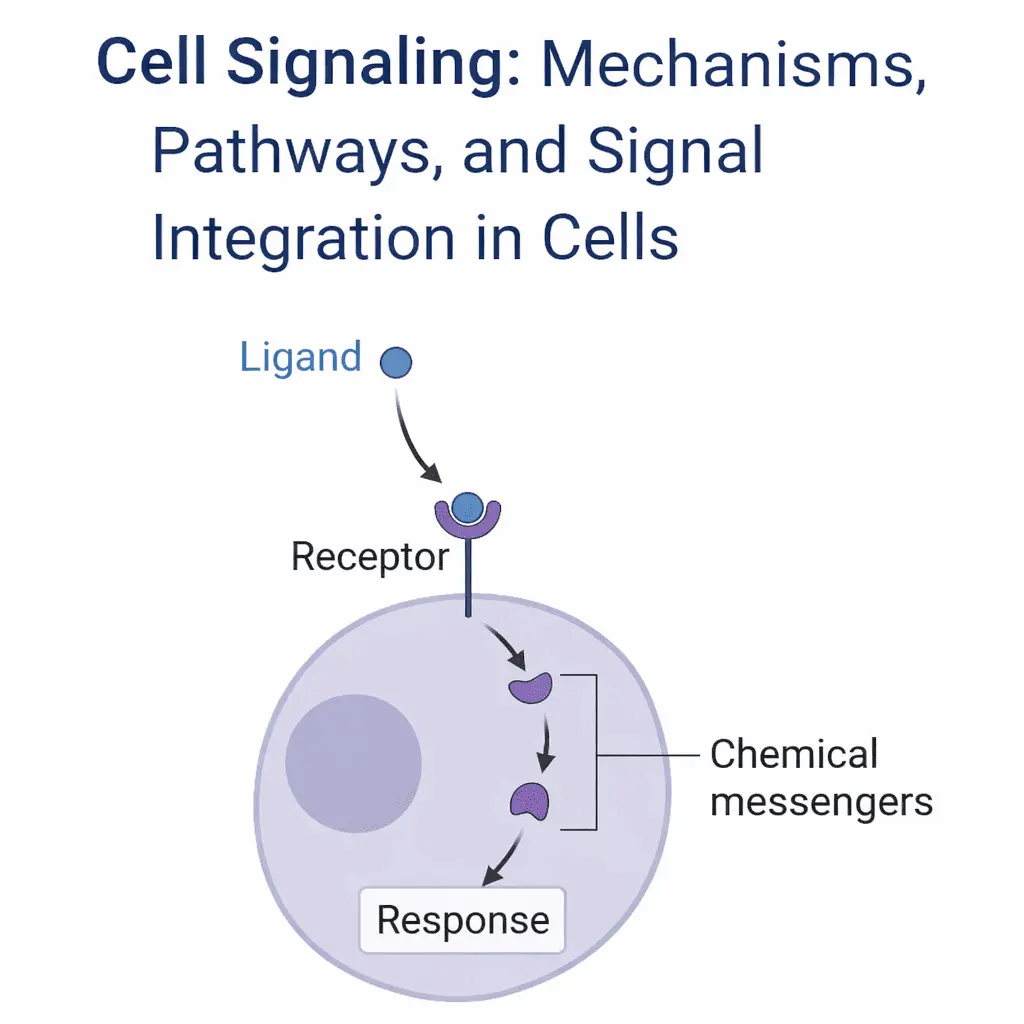
Cell signaling is the fundamental process by which cells communicate with each other and respond to their environment. Through precise molecular interactions, cells detect external signals, transmit information internally, and generate specific biological responses.
This communication system allows multicellular organisms to coordinate growth, maintain tissue organization, regulate metabolism, and preserve homeostasis. At the cellular level, signaling ensures that activities such as gene expression, protein activation, and structural changes occur in a controlled and integrated manner.
In this article, we will explore the core principles of cell signaling, including the types of signaling mechanisms, the components of signaling pathways, receptor classes, second messengers, signal amplification, integration, and termination.
Why Cell Signaling Is Essential for Life
In multicellular organisms, survival depends on coordination. Individual cells must act in harmony rather than independently. Cell signaling provides the communication network that allows this coordination, ensuring that tissues and organs function as integrated systems rather than as isolated units.
Cell Signaling for Coordination in Multicellular Organisms
Cells specialize to perform distinct functions, but they must remain synchronized.
- Ensures proper communication between different cell types
- Coordinates organ development and function
- Allows tissues to respond collectively to physiological demands
- Maintains structural organization within organs
Cell Signaling for Regulation of Growth and Division
Cell number must be tightly controlled to maintain normal physiology.
- Controls progression through the cell cycle
- Ensures cells divide only when appropriate
- Regulates cell size and growth rate
- Coordinates tissue renewal and repair
Precise signaling mechanisms determine when a cell should proliferate, pause, differentiate, or remain quiescent.
Tissue Organization and Polarity
Cells must know their position within a tissue and behave accordingly.
- Establishes apical–basal polarity in epithelial tissues
- Regulates cell–cell adhesion
- Maintains tissue architecture
- Guides cell migration during development
Signaling pathways interact with structural components such as the cytoskeleton and cell junctions to preserve organized tissue structure.
Cell Signaling for Maintenance of Homeostasis
Homeostasis requires constant monitoring and adjustment.
- Regulates metabolic activity
- Controls ion balance (e.g., calcium signaling)
- Adjusts cellular responses to stress
- Coordinates adaptive responses to environmental changes
Through feedback mechanisms, signaling pathways help maintain stable internal conditions despite external fluctuations.
Adaptation to Environmental Signals
Cells continuously sense and respond to their surroundings.
- Detect nutrients and growth factors
- Respond to mechanical forces
- Interpret chemical gradients
- Adjust gene expression accordingly
Types of Cell Signaling
Cells communicate in different ways depending on the distance between them and the nature of the signal. These communication modes represent distinct types of cell signaling, each adapted to specific physiological needs.
Types of cell Signaling include:
- Autocrine Signaling
- Paracrine Signaling
- Endocrine Signaling
- Juxtacrine (Contact-Dependent) Signaling
Autocrine Cell Signaling
In autocrine signaling, a cell releases a signaling molecule that binds to receptors on its own surface.
Key characteristics:
- The signaling cell and target cell are the same
- Often reinforces or modulates a cellular response
- Common in regulating cell growth and differentiation
- Allows self-regulation and fine-tuning of cellular activity
Autocrine signaling is especially important when cells need to sustain or amplify their own activity under controlled conditions.
Paracrine Cell Signaling
Paracrine signaling occurs when a cell releases signaling molecules that act on nearby cells.
Key characteristics:
- Short-distance communication
- Signals diffuse through the extracellular space
- Rapid and localized effects
- Common during tissue development and repair
Because these signals act locally, they are typically degraded or taken up quickly to prevent widespread effects.
Endocrine Cell Signaling
In endocrine signaling, specialized cells release hormones into the bloodstream, allowing signals to travel long distances.
Key characteristics:
- Long-distance communication
- Slower onset compared to local signaling
- Hormones circulate systemically
- Targets only cells with the appropriate receptors
Endocrine signaling enables coordination between distant organs and maintains whole-body physiological balance.
Juxtacrine (Contact-Dependent) Cell Signaling
Juxtacrine signaling requires direct physical contact between cells.
Key characteristics:
- No diffusion of signaling molecules
- Membrane-bound ligands interact with receptors on adjacent cells
- Essential for tissue organization and development
- Ensures highly specific cell-to-cell communication
Because it depends on direct contact, juxtacrine signaling provides precise spatial control.
Comparison of Signaling Types
| Type of Signaling | Distance | Speed | Example Function |
|---|---|---|---|
| Autocrine | Self | Fast | Self-regulation |
| Paracrine | Local | Fast | Tissue coordination |
| Endocrine | Long-distance | Slower | Systemic regulation |
| Juxtacrine | Direct contact | Immediate | Tissue patterning |
Core Components of a Cell Signaling Pathway
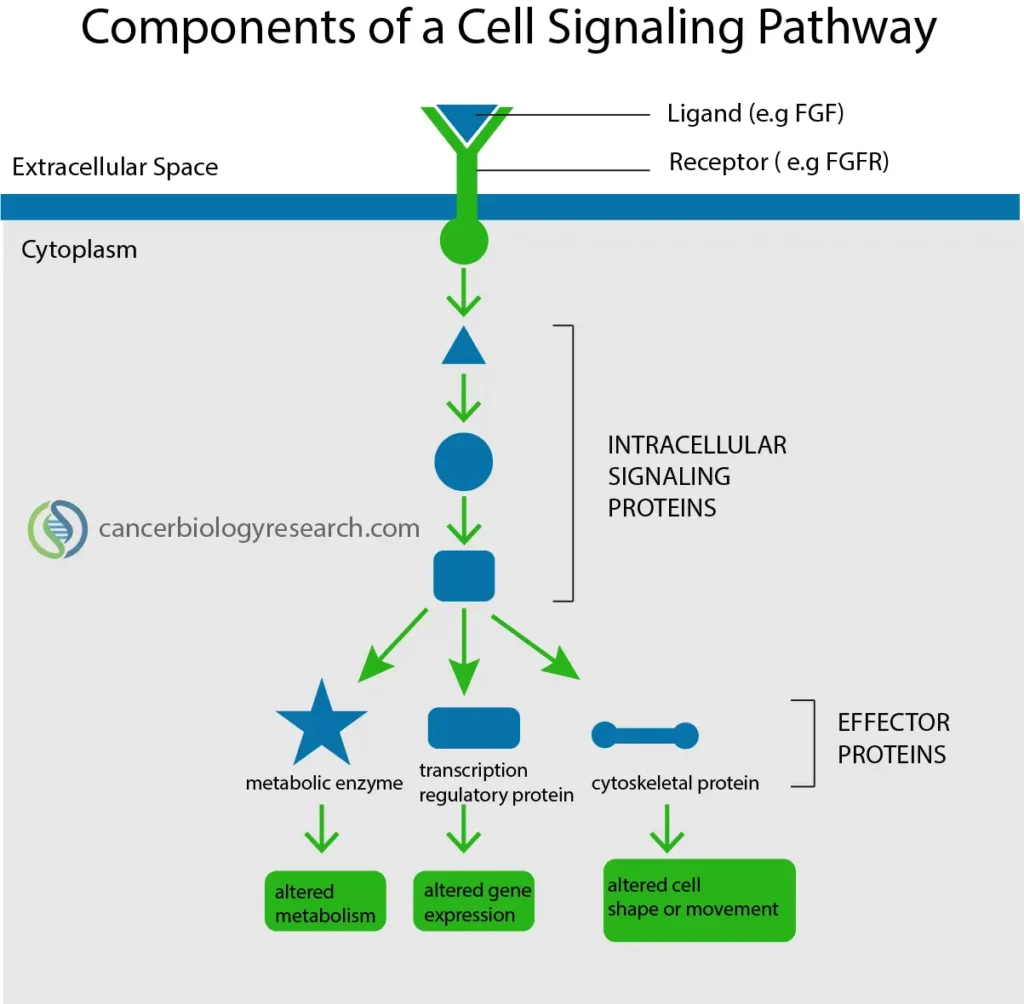
Regardless of the signaling type, most cell signaling pathways follow a common organizational logic. A signal is produced, detected, transmitted, and translated into a functional response.
Stages of a signaling pathway:
- Signaling Molecules (Ligands)
- Receptors
- Intracellular Signal Transducers
- Effector Proteins
- Cellular Response
Signaling Molecules (Ligands)
A signaling pathway begins with a ligand, a molecule that carries information from one cell to another.
Characteristics of ligands:
- Bind specifically to receptors
- Can be proteins, peptides, small molecules, or gases
- May act locally or systemically
- Trigger a response without being permanently altered
Examples of signaling molecules:
- Hormones
- Growth factors
- Neurotransmitters
- Cytokines
- Lipid-derived mediators
The nature of the ligand often determines whether it binds to a cell surface receptor or an intracellular receptor.
Receptors
A receptor is a protein that recognizes and binds a specific ligand. This interaction initiates the signaling process.
Key features of receptors:
- High specificity for their ligand
- Undergo conformational change upon binding
- Translate extracellular information into intracellular signals
- Can be located on the plasma membrane or inside the cell
Receptors function as molecular switches, converting ligand binding into biochemical activity.
Intracellular Signal Transducers
Once activated, receptors relay the signal through intracellular molecules known as signal transducers.
These may include:
- Protein kinases
- Phosphatases
- G proteins
- Adaptor proteins
- Scaffold proteins
Functions of signal transducers:
- Amplify the signal
- Relay information through cascades
- Integrate multiple signaling inputs
- Direct signals toward specific cellular targets
This step, often referred to as signal transduction, allows a single receptor activation event to generate a coordinated intracellular response.
Effector Proteins
Effector proteins are the molecules that directly produce the cellular outcome.
They may:
- Activate or repress gene expression
- Modify metabolic enzyme activity
- Regulate ion channels
- Alter cytoskeletal organization
- Control secretion or movement
Effectors translate molecular signals into functional changes within the cell.
Cellular Response to Cell Signaling
The final stage of a cell signaling pathway is the cellular response.
Responses can be:
- Rapid (seconds to minutes), such as enzyme activation
- Intermediate (minutes to hours), such as cytoskeletal rearrangement
- Long-term (hours to days), such as gene expression changes
The type of response depends on:
- The signaling pathway involved
- The cell type
- The physiological context
Classification of Cell Surface Receptors
Cell surface receptors are transmembrane proteins that detect extracellular signals and initiate intracellular responses. Because many signaling molecules are unable to cross the plasma membrane, these receptors play a central role in cell signaling by converting external information into biochemical activity inside the cell.
Cell surface receptors are commonly classified into three major families based on their structure and mechanism of action.
Ion-Channel–Linked Receptors (Ligand-Gated Ion Channels)
These receptors function as both a receptor and an ion channel.
Mechanism:
- Ligand binding causes a conformational change
- The channel opens or closes
- Specific ions move across the membrane
- Rapid change in membrane potential or intracellular ion concentration occurs
Key features:
- Very fast response (milliseconds)
- Direct coupling between ligand binding and cellular effect
- Often involved in electrical signaling
Because they directly control ion flow, these receptors produce immediate cellular responses.
G Protein–Coupled Receptors (GPCRs)
G protein–coupled receptors represent one of the largest receptor families in eukaryotic cells.
Structural features:
- Seven transmembrane α-helices
- Extracellular ligand-binding domain
- Intracellular domain that interacts with heterotrimeric G proteins
Mechanism:
- Ligand binds receptor
- Receptor activates an associated G protein
- G protein regulates downstream effectors
- Second messengers are often generated
Key characteristics:
- Signal amplification
- Indirect activation of intracellular pathways
- Broad physiological roles
GPCR signaling is highly versatile and can regulate processes such as metabolism, secretion, and cytoskeletal organization.
Enzyme-Linked Receptors
Enzyme-linked receptors possess intrinsic enzymatic activity or directly associate with enzymes.
The most well-known subgroup includes receptors with kinase activity like Receptor Tyrosine Kinases (RTKs).
Mechanism:
- Ligand binding induces receptor dimerization
- Activation of intracellular enzymatic domain
- Phosphorylation of specific amino acid residues
- Recruitment of adaptor proteins
- Activation of downstream signaling cascades
Key characteristics:
- Often regulate growth and differentiation
- Initiate phosphorylation-based signaling cascades
- Produce longer-lasting cellular responses compared to ion channels
These receptors are critical for controlling cell behavior through regulated enzymatic activity.
Comparison of Major Cell Surface Receptor Classes
| Receptor Type | Speed of Response | Mechanism | Signal Amplification |
|---|---|---|---|
| Ion-channel–linked | Very fast | Direct ion flow | Minimal |
| GPCRs | Moderate | G protein activation | High |
| Enzyme-linked | Slower | Enzymatic phosphorylation | High |
Intracellular Receptors and Lipid-Soluble Signals
Not all signaling molecules require a membrane receptor. Some signals are able to cross the plasma membrane and bind to receptors located inside the cell. These pathways represent a distinct mechanism of cell signaling, characterized by direct regulation of gene expression.
Lipid-Soluble Signaling Molecules
Lipid-soluble molecules can diffuse through the phospholipid bilayer because of their hydrophobic nature.
Common characteristics:
- Small and nonpolar or weakly polar
- Transported in the bloodstream bound to carrier proteins
- Able to pass through the plasma membrane
- Often produce slower but longer-lasting responses
Examples include steroid hormones and other hydrophobic signaling molecules.
Location of Intracellular Receptors
Intracellular receptors are found either:
- In the cytoplasm, where they bind ligand and then move to the nucleus
- Directly in the nucleus, where they act as transcription regulators
In the absence of ligand, some cytoplasmic receptors remain inactive by association with inhibitory proteins.
Mechanism of Intracellular Signaling
The signaling process generally follows these steps:
- The lipid-soluble ligand diffuses across the membrane
- The ligand binds to its intracellular receptor
- The receptor undergoes a conformational change
- The receptor–ligand complex binds to specific DNA sequences
- Gene transcription is activated or repressed
Unlike membrane receptor pathways, this mechanism does not rely on second messengers or kinase cascades.
Functional Consequences
Because intracellular receptors directly influence transcription:
- Responses are typically slower (hours)
- Effects are longer lasting
- Changes involve new protein synthesis
- Regulation is highly specific to target genes
This form of signaling is particularly important for controlling long-term cellular programs such as differentiation, metabolism, and developmental processes.
Comparison with Cell Surface Receptor Signaling
| Feature | Cell Surface Receptors | Intracellular Receptors |
|---|---|---|
| Ligand Type | Hydrophilic | Lipid-soluble |
| Location | Plasma membrane | Cytoplasm or nucleus |
| Speed | Fast to moderate | Slower |
| Primary Mechanism | Second messengers, cascades | Direct gene regulation |
Second Messengers in Cell Signaling
Many cell surface receptors do not act alone. Instead, they trigger the production of small intracellular molecules known as second messengers, which relay and amplify the signal inside the cell. These molecules are central to efficient cell signaling, allowing a single ligand–receptor interaction to generate a strong and coordinated response.
What Are Second Messengers?
Second messengers are small, diffusible molecules produced or released inside the cell after receptor activation.
Key characteristics:
- Generated rapidly upon receptor stimulation
- Diffuse through the cytoplasm
- Amplify the original signal
- Activate downstream effector proteins
- Temporarily increase in concentration
Key Second Messengers molecules include:
- Cyclic AMP (cAMP)
- Calcium Ions (Ca²⁺)
- Inositol 1,4,5-Trisphosphate (IP₃)
- Diacylglycerol (DAG)
They act as intermediaries between membrane receptors and intracellular targets.
Here you find a dedicated article about second messengers and their role in signaling.
Signal Amplification Through Second Messengers
Second messengers enable amplification because:
- One receptor can activate multiple enzymes
- Each enzyme can generate many messenger molecules
- Each messenger can activate multiple downstream targets
This cascade effect ensures that small extracellular signals produce meaningful intracellular responses.
Signal Amplification and Cascades in Cell Signaling
One of the most powerful features of cell signaling is its ability to amplify small external signals into large intracellular responses. A single ligand binding event at the cell surface can ultimately influence thousands of molecules inside the cell. This amplification is achieved through organized signaling cascades.
What Is Signal Amplification?
Signal amplification refers to the multiplication of a signal as it is transmitted through successive molecular steps.
Instead of a one-to-one interaction:
- One activated receptor can activate multiple intracellular proteins
- Each activated protein can influence many downstream targets
- The signal grows stronger at each stage
This ensures that even low concentrations of signaling molecules can produce significant biological effects.
Kinase Cascades
Many signaling pathways rely on protein kinases, enzymes that add phosphate groups to target proteins.
Key features of kinase cascades:
- Sequential phosphorylation events
- Amplification at each step
- Reversible regulation (via phosphatases)
- Tight control of activity
Because phosphorylation can rapidly change protein function, kinase cascades allow precise and dynamic regulation of cellular processes.
Sensitivity and Threshold Responses
Amplification allows cells to be highly sensitive to external signals.
- Small changes in ligand concentration can trigger measurable responses
- Cells can respond quickly even when signals are weak
- Threshold mechanisms ensure activation only when signal intensity is sufficient
This balance prevents unnecessary activation while maintaining responsiveness.
Advantages of Amplification Mechanisms
Signal amplification provides several biological advantages:
- Efficient detection of low-abundance signals
- Rapid propagation of information
- Strong and coordinated cellular responses
- Flexible regulation through feedback loops
Without amplification, many physiological signals would be too weak to influence cellular behavior effectively.
Examples of Major Intracellular Cell Signaling Pathways
Many well-characterized signaling cascades operate downstream of membrane receptors. These include:
- PI3K/AKT pathway.
- MAPK/ERK pathway.
- mTOR pathway.
- AMPK pathway.
- JAK/STAT pathway.
- Wnt/β-catenin pathway.
- Notch signaling pathway.
- TGF-β/SMAD pathway.
- NF-κB pathway.
- Calcium-dependent signaling mechanisms.
Each integrates specific environmental cues to regulate growth, metabolism, differentiation, and stress responses.
PI3K/AKT Pathway
- Regulates cell growth, survival, and metabolism
- Activated downstream of receptor tyrosine kinases and GPCRs
- Strongly connected to nutrient and growth factor signaling
MAPK/ERK Pathway
- Controls cell proliferation and differentiation
- Operates through sequential kinase activation (Raf → MEK → ERK)
- Classic example of a kinase cascade
mTOR Pathway
- Central regulator of protein synthesis and nutrient sensing
- Integrates growth factor and metabolic signals
- Controls cell growth and anabolic processes
AMPK Pathway
- Acts as a cellular energy sensor
- Activated under low energy conditions
- Regulates metabolism and restores energy balance
JAK/STAT Pathway
- Activated by cytokine receptors
- Directly transmits signals from membrane to nucleus
- Rapid transcriptional activation mechanism
Wnt/β-Catenin Pathway
- Regulates cell fate and developmental patterning
- Controls gene transcription via β-catenin stabilization
- Important for tissue organization
Notch Signaling Pathway
- Contact-dependent signaling mechanism
- Regulates differentiation and tissue development
- Involves receptor cleavage and nuclear translocation
TGF-β/SMAD Pathway
- Controls cell differentiation and extracellular matrix production
- Signals through SMAD transcription factors
- Important for tissue remodeling
NF-κB Signaling Pathway
- Regulates immune and stress responses
- Controlled by inhibitory proteins and phosphorylation cascades
- Rapid transcriptional response system
Calcium/Calmodulin Signaling Pathway
- Mediated by intracellular Ca²⁺ increases
- Activates calmodulin-dependent enzymes
- Controls contraction, secretion, and gene regulation
Signal Specificity and Fidelity in Cell Signaling
Given that many signaling pathways share similar components—such as kinases, second messengers, and adaptor proteins—how does a cell ensure that each signal produces the correct response? The answer lies in signal specificity and fidelity, two essential principles that maintain precision in cell signaling.
Receptor–Ligand Specificity
Specificity begins at the very first step of signaling.
- Receptors bind only particular ligands
- Binding depends on molecular shape and chemical compatibility
- Different cell types express distinct receptor sets
- The same ligand may trigger different responses in different cells
Because receptor expression varies across tissues, cellular responses are context-dependent.
Spatial Compartmentalization
Cells organize signaling components within specific regions.
- Receptors are localized in defined membrane domains
- Scaffold proteins group signaling molecules together
- Certain second messengers act in restricted microdomains
- Organelles help compartmentalize signaling events
This spatial organization prevents unwanted cross-activation of unrelated pathways.
Temporal Control
The duration of a signal strongly influences its outcome.
- Short-lived signals may activate rapid responses
- Sustained signals can trigger gene expression changes
- Oscillatory signaling patterns (e.g., calcium waves) encode information
Thus, timing is just as important as signal strength.
Scaffold and Adaptor Proteins
Scaffold proteins increase signaling precision by assembling pathway components into organized complexes.
Their roles include:
- Bringing kinases and substrates into close proximity
- Reducing interference with other pathways
- Increasing efficiency of signal transmission
- Enhancing pathway insulation
This molecular organization improves fidelity and minimizes noise.
Integration of Cellular Context
Signal specificity also depends on:
- Cell type
- Developmental stage
- Metabolic state
- Presence of other active pathways
A signaling molecule may produce different effects depending on the internal state of the cell.
Signal Integration and Crosstalk in Cell Signaling
Cells are constantly exposed to multiple signals at the same time. Rather than responding to each pathway independently, cells must interpret and combine this information to generate a coordinated outcome. This process is known as signal integration, and the interactions between pathways are referred to as crosstalk.
Together, these mechanisms add complexity and flexibility to cell signaling networks.
What Is Signal Integration in Cell Signaling?
Signal integration occurs when a cell processes inputs from multiple signaling pathways and produces a unified response.
Instead of:
- One signal → One response
Cells often experience:
- Multiple signals → One coordinated decision
For example, a cell may require both a growth signal and a nutrient signal before committing to division. This ensures that responses are appropriate to the overall physiological context.
Converging Pathways
In converging signaling pathways:
- Different receptors activate separate upstream pathways
- These pathways merge at a shared downstream target
- The final response depends on combined input
This allows cells to:
- Require multiple conditions before activation
- Fine-tune the strength of a response
- Increase decision accuracy
Convergence acts as a molecular “AND gate” in cellular logic.
Diverging Pathways
In diverging signaling pathways:
- A single activated receptor
- Triggers multiple downstream branches
- Leads to several simultaneous cellular effects
For example, one signaling event may:
- Alter gene expression
- Modify metabolic activity
- Rearrange the cytoskeleton
Divergence allows a coordinated, multi-layered response to one stimulus.
Crosstalk Between Pathways
Crosstalk occurs when one signaling pathway influences another.
This may happen through:
- Shared signaling proteins
- Kinase interactions
- Competition for adaptor molecules
- Regulation of receptor activity
Crosstalk can either:
- Enhance another pathway
- Inhibit another pathway
- Modify signal duration or intensity
This interconnectedness makes signaling networks highly dynamic.
Feedback Loops
Feedback mechanisms are central to signal integration.
Positive feedback:
- Amplifies signaling
- Reinforces pathway activation
Negative feedback:
- Limits signal duration
- Prevents overactivation
- Restores baseline conditions
Feedback loops increase stability and precision in cellular decision-making.
Rather than acting as isolated linear pathways, signaling systems function as interconnected networks.
Signal Termination and Desensitization
For cell signaling to remain precise and controlled, signals must not only be activated correctly—they must also be properly turned off. Continuous or uncontrolled signaling can disrupt cellular balance. Therefore, cells use multiple mechanisms to terminate signals and reduce sensitivity to persistent stimulation.
Why Signal Termination Is Necessary
Signal termination ensures that:
- Cellular responses are temporary
- Pathways reset after activation
- Cells remain responsive to new signals
- Homeostasis is maintained
Without termination mechanisms, signaling pathways would remain active indefinitely, leading to inappropriate cellular activity.
Ligand Removal or Degradation
One of the simplest ways to stop signaling is to remove the extracellular signal.
This can occur through:
- Enzymatic degradation of the ligand
- Diffusion away from the target cell
- Uptake and internalization
- Binding to carrier or inhibitory proteins
Reducing ligand availability limits receptor activation.
Receptor Inactivation and Internalization
Cells can directly regulate receptor activity.
Mechanisms include:
- Receptor phosphorylation that reduces activity
- Conformational changes preventing further signaling
- Endocytosis (internalization) of receptors
- Receptor degradation or recycling
This process contributes to desensitization, where cells become less responsive to repeated stimulation.
Inactivation of Intracellular Signaling Proteins
Downstream signaling components are tightly regulated.
Examples include:
- GTP hydrolysis in G proteins, returning them to inactive form
- Dephosphorylation of proteins by phosphatases
- Deactivation of kinases
- Dissociation of signaling complexes
These mechanisms rapidly shut down intracellular signaling cascades.
Degradation of Second Messengers
Second messengers are transient by design.
For example:
- cAMP is degraded by phosphodiesterases
- Ca²⁺ is pumped back into intracellular stores
- IP₃ is rapidly metabolized
By lowering second messenger levels, cells restore baseline conditions.
Feedback Inhibition
Negative feedback loops help limit signal intensity and duration.
- Downstream products inhibit upstream components
- Induced proteins suppress pathway activity
- Signaling duration is tightly controlled
Feedback regulation ensures balanced and proportional responses.
These processes ensure that signaling is dynamic, reversible, and tightly regulated.
References
Textbooks
- Alberts, B., Johnson, A., Lewis, J., Morgan, D., Raff, M., Roberts, K., & Walter, P. Molecular Biology of the Cell. 6th ed. Garland Science.
- Lodish, H., Berk, A., Kaiser, C. A., Krieger, M., Scott, M. P., Bretscher, A., Ploegh, H., & Amon, A. Molecular Cell Biology. 9th ed. W.H. Freeman.
- Cooper, G. M., & Hausman, R. E. The Cell: A Molecular Approach. 8th ed. Sinauer Associates.
- Karp, G. Cell and Molecular Biology: Concepts and Experiments. 8th ed. Wiley.
- Pollard, T. D., Earnshaw, W. C., Lippincott-Schwartz, J., & Johnson, G. Cell Biology. 3rd ed. Elsevier.
External Resources
- https://www.nature.com/scitable/topicpage/cell-signaling-14047077/
- https://openbooks.lib.msu.edu/isb202/chapter/cell-communication/
Cell signaling is the process by which cells communicate with each other through chemical signals. These signals allow cells to coordinate activities such as growth, metabolism, differentiation, and immune responses.
The main types include autocrine signaling, paracrine signaling, endocrine signaling, and juxtacrine signaling, depending on the distance between the signaling and target cells.
Signaling pathways are series of molecular events triggered when a ligand binds to a receptor. These pathways transmit signals through intracellular molecules to produce a specific cellular response.
Cell signaling regulates essential biological processes such as cell division, apoptosis, metabolism, and immune responses. Disruptions in signaling pathways can lead to diseases including cancer and metabolic disorders.


