

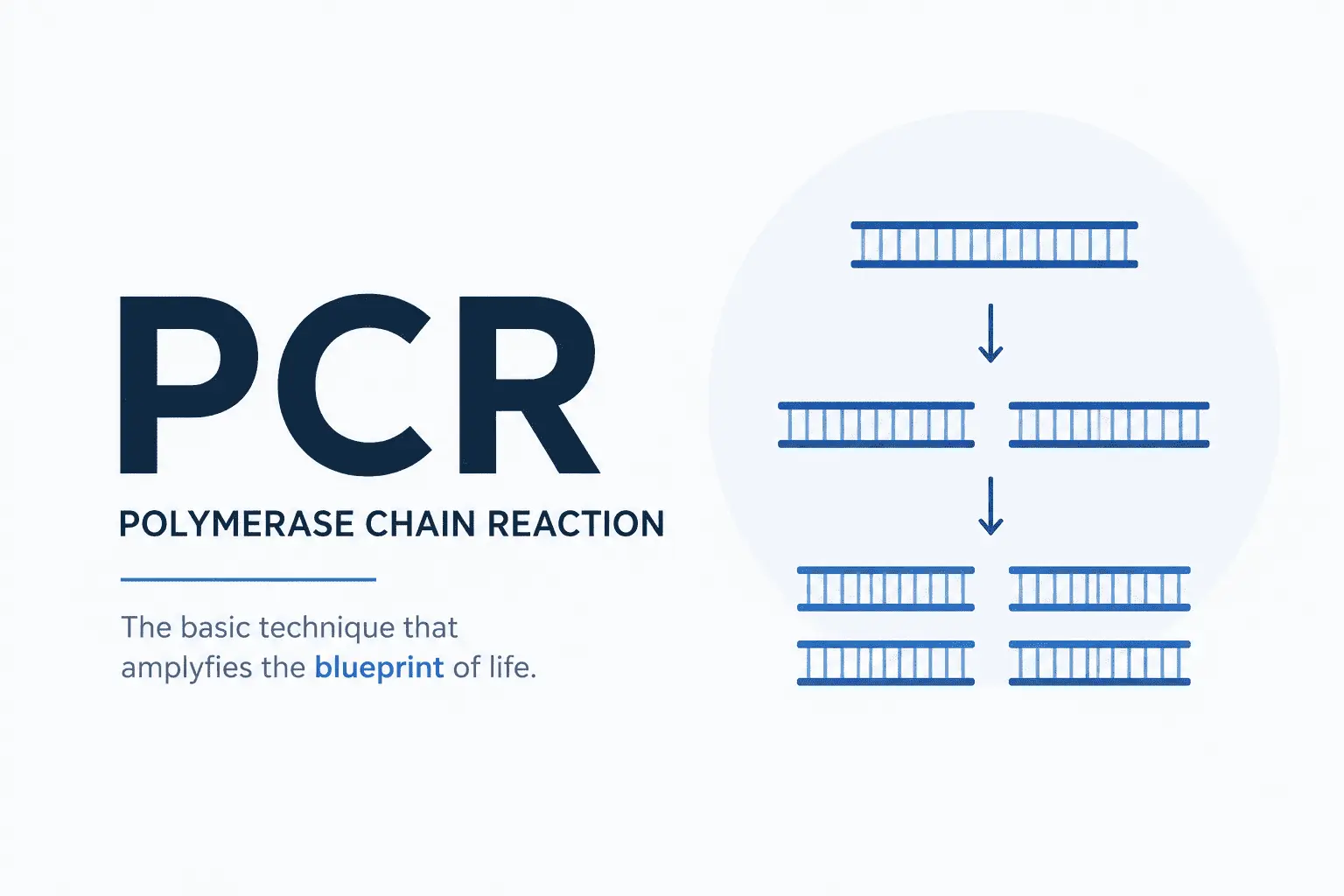
Polymerase Chain Reaction (PCR) is one of the most important techniques in modern molecular biology. It allows scientists to make millions of copies of a specific DNA segment starting from a very small amount of genetic material. Because of this powerful amplification ability, PCR is widely used in research laboratories, medical diagnostics, and forensic science.
Since its development in the 1980s, PCR has transformed how we study genes, detect diseases, and analyze genetic variations. Today, it is a routine method in applications ranging from infection detection to cancer biomarker analysis and gene expression studies.
In the following sections, we will explain how PCR works, its main steps, the different types of PCR, and the major fields where it is applied.
What Is PCR?
Polymerase Chain Reaction (PCR) is a laboratory technique used to selectively amplify a specific DNA sequence, generating millions of copies from a very small initial amount of DNA. This makes it possible to detect, analyze, and manipulate genetic material that would otherwise be too scarce to study.
At its core, PCR mimics the natural process of DNA replication but performs it in vitro (outside living cells) using controlled temperature cycles and specialized enzymes.
Basic Principle of PCR
The basic principle of PCR is based on repeated cycles of DNA synthesis. Each cycle theoretically doubles the amount of target DNA, leading to exponential amplification.
PCR relies on three fundamental ideas:
- DNA strands can be separated by heat
- Short DNA primers can bind (anneal) to specific target sequences
- DNA polymerase can extend these primers to synthesize new DNA strands
By repeating this process many times, a specific region of DNA is amplified while the rest of the genome remains largely unchanged.
Key Components of a PCR Reaction
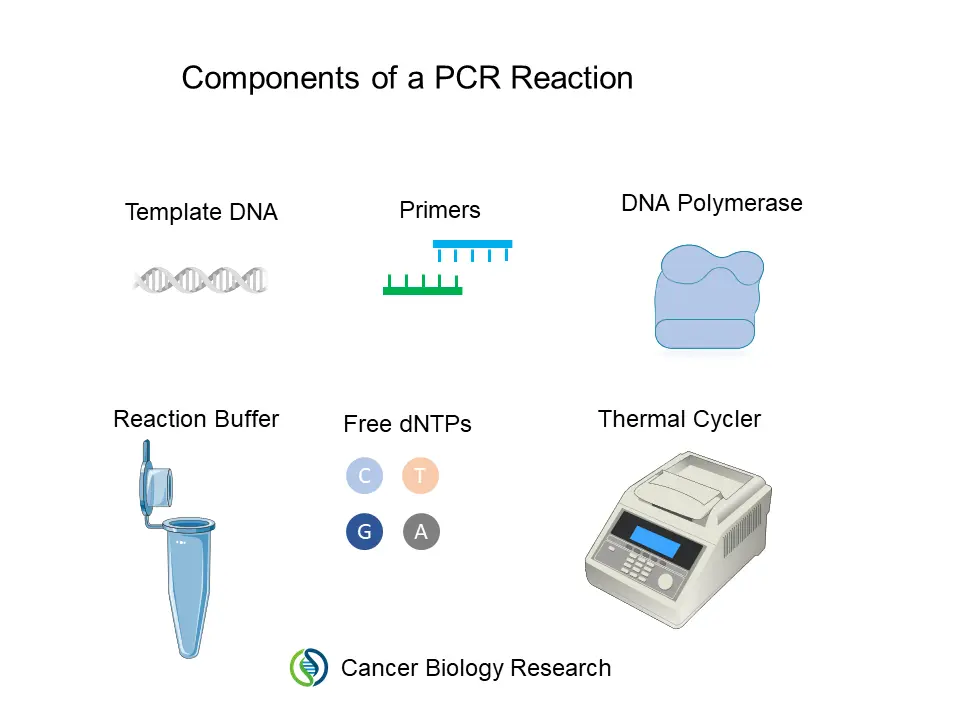
A successful PCR reaction requires several essential components, each with a specific role:
- Template DNA
The DNA sample containing the target sequence to be amplified. - Primers (Forward and Reverse)
Short single-stranded DNA sequences that bind to regions flanking the target DNA. They define the start and end points of amplification. For detailed guidance on selecting and optimizing PCR primers, see our complete guide to primer design for PCR. - DNA Polymerase
An enzyme that synthesizes new DNA strands.- Most commonly used: Taq polymerase, derived from Thermus aquaticus
- High-fidelity polymerases are used when sequence accuracy is critical
- Deoxynucleotide Triphosphates (dNTPs)
The building blocks (A, T, G, C) used by the polymerase to construct new DNA strands. - Reaction Buffer and Mg²⁺ Ions
Provide optimal chemical conditions for enzyme activity and primer binding.
Thermal Cycler and Temperature Control
PCR requires precise and rapid temperature changes, which are performed by a machine called a thermal cycler.
The thermal cycler:
- Heats the reaction to separate DNA strands
- Lowers the temperature to allow primer binding
- Raises it again for DNA synthesis
These temperature shifts are repeated for 25–40 cycles, enabling continuous DNA amplification with high specificity and efficiency. Modern thermal cyclers can also measure fluorescence in real time for quantitative PCR applications.
Polymerase Chain Reaction Test: COVID-19 Example
A polymerase chain reaction test, commonly called a PCR test, is a laboratory method used to detect specific genetic material in a sample. It is particularly useful for identifying infectious agents, including viruses.
During the COVID-19 pandemic, RT-PCR became one of the most widely used molecular tests for detecting SARS-CoV-2. Because the virus contains RNA rather than DNA, the viral RNA is first converted into complementary DNA (cDNA) using reverse transcriptase. The target viral sequence is then amplified through repeated PCR cycles.
If the viral genetic material is detected above the test’s threshold, the result is reported as positive. If the target sequence is not detected, the result is generally reported as negative.
Steps of PCR
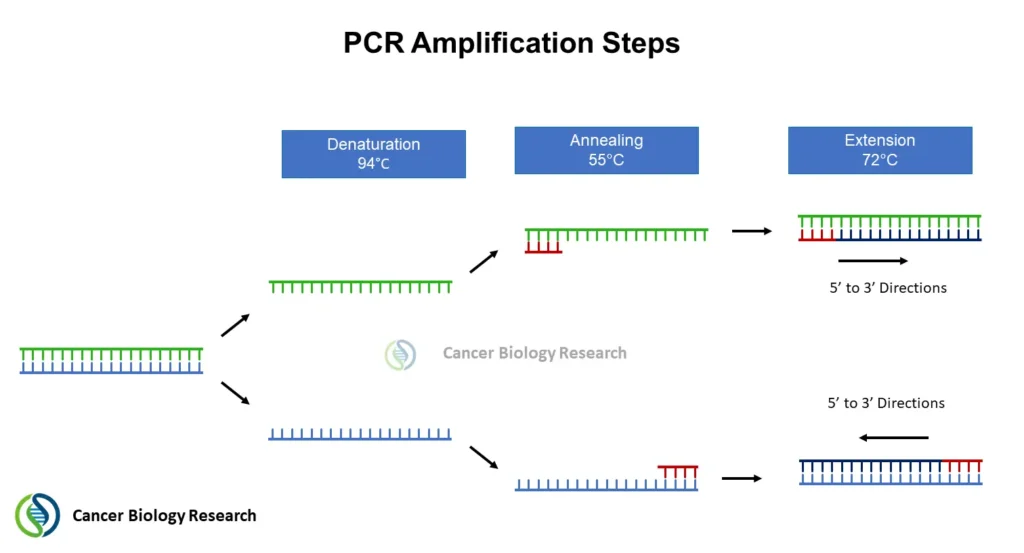
PCR amplifies DNA through a series of repeated temperature-controlled steps known as cycles. Each cycle consists of three main stages: denaturation, annealing, and extension. Together, these steps allow precise and exponential copying of the target DNA sequence.
Denaturation
Denaturation is the first step of each PCR cycle.
- The reaction is heated to about 94–98 °C
- This high temperature breaks the hydrogen bonds between DNA strands
- Double-stranded DNA becomes single-stranded, making the template accessible for primer binding
This step is essential because DNA polymerase can only copy single-stranded DNA templates.
Annealing
Annealing allows primers to bind to their complementary sequences on the template DNA.
- Temperature is lowered to 50–65 °C (depends on primer design)
- Forward and reverse primers attach to opposite strands
- Primer specificity determines which DNA region will be amplified
If the annealing temperature is too low, primers may bind non-specifically. If it is too high, primers may not bind efficiently, reducing amplification.
Extension (Elongation)
During extension, new DNA strands are synthesized.
- Temperature is raised to around 72 °C (optimal for Taq polymerase)
- DNA polymerase adds nucleotides to the primer ends
- New strands are synthesized in the 5′ → 3′ direction
The length of this step depends on the size of the DNA fragment being amplified.
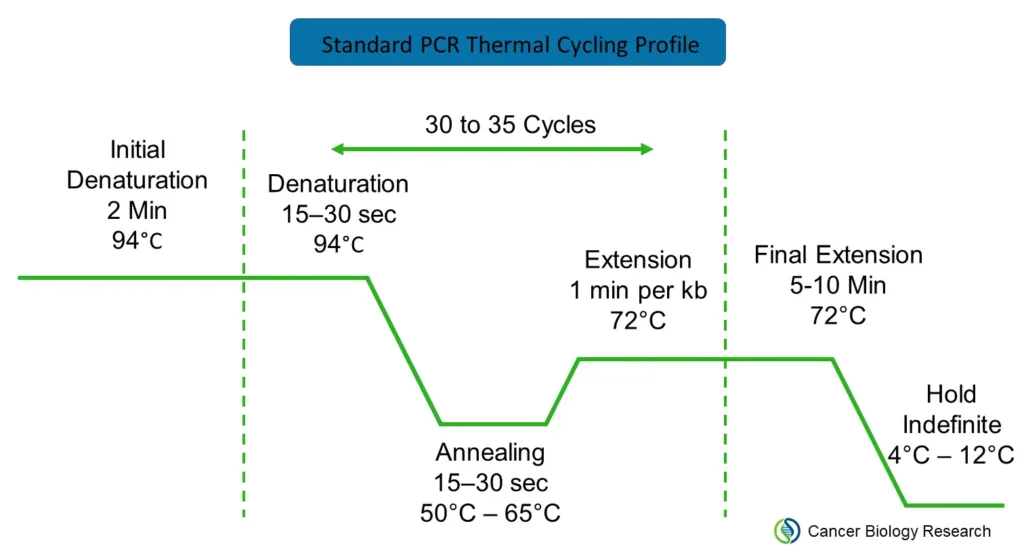
Standard PCR Thermal Cycling Profile
The diagram below summarizes a standard PCR thermal cycling profile, including the typical temperatures and durations used for each step.
Exponential Amplification Across Cycles
PCR is powerful because amplification is exponential, not linear.
- After 1 cycle → 2 copies
- After 2 cycles → 4 copies
- After 30 cycles → over 1 billion copies
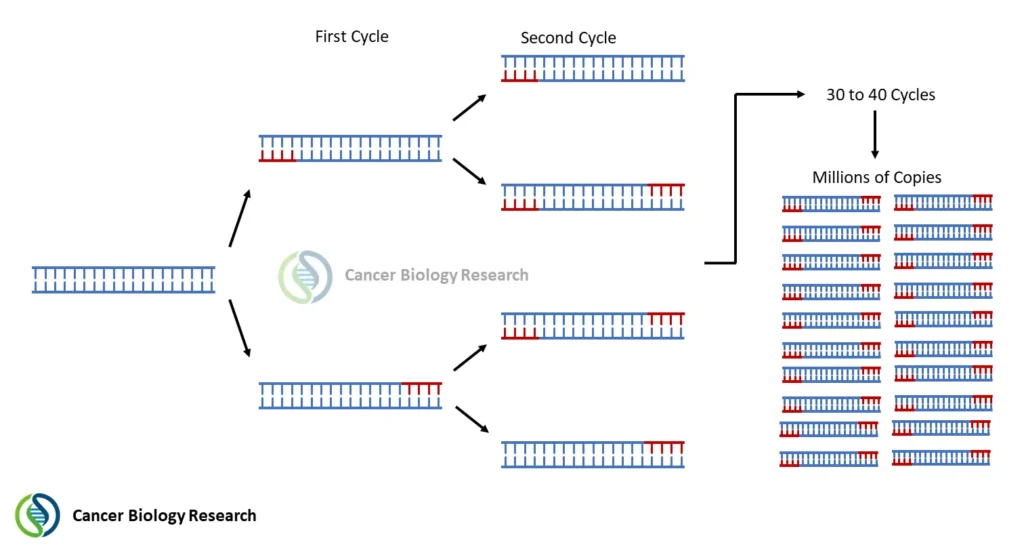
Each newly synthesized DNA molecule becomes a template in the next cycle. After many cycles, the target DNA fragment becomes the dominant product in the reaction mixture, allowing easy detection by methods such as gel electrophoresis or fluorescence-based systems.
Types of PCR
Over time, PCR has evolved into multiple specialized formats designed to answer different biological and clinical questions. While all PCR methods rely on the same basic amplification principle, they differ in how products are detected and what type of nucleic acid is analyzed.
Conventional (End-Point) PCR
This is the original and simplest form of PCR.
- Amplified DNA is detected after all cycles are completed
- Products are visualized using agarose gel electrophoresis
- Results are mainly qualitative (presence or absence of a DNA fragment)
Main applications:
- Detection of specific genes
- Genotyping
- Cloning and sequencing preparation
- Teaching and basic laboratory experiments
Quantitative PCR (qPCR / Real-Time PCR)
qPCR measures DNA amplification in real time using fluorescent signals.
- Fluorescence increases as DNA accumulates
- Allows quantification of starting material
- Can use intercalating dyes (e.g., SYBR Green) or sequence-specific probes
Main applications:
- Gene expression analysis
- Viral and bacterial load measurement
- Detection of copy number variations
- Monitoring treatment response in clinical settings
qPCR is widely used in diagnostics because it is sensitive, fast, and highly quantitative.
Reverse Transcription PCR (RT-PCR)
RT-PCR is used when the starting material is RNA instead of DNA.
- RNA is first converted into complementary DNA (cDNA) using reverse transcriptase
- The cDNA is then amplified by standard PCR
- Can be combined with qPCR (RT-qPCR) for quantitative analysis
Main applications:
- Measuring gene expression levels
- Studying microRNAs and non-coding RNAs
- Detecting RNA viruses
- Cancer transcriptome studies and biomarker discovery
This method is especially important in molecular oncology and immunology research.
Specialized PCR Variants
Several advanced PCR formats are used for specific purposes:
- Multiplex PCR
Amplifies multiple targets in a single reaction using several primer pairs.
Useful for pathogen panels and genetic screening. - Nested PCR
Uses two rounds of amplification for higher specificity.
Helpful when target DNA is very low or contaminated. - Digital PCR (dPCR)
Divides samples into thousands of small reactions to allow absolute quantification.
Highly sensitive for detecting rare mutations, especially in liquid biopsy.
To explore these methods in greater detail, see our comprehensive guide to the 40 Most Important Types of PCR, which explains the principles, applications, and key differences between the major PCR variants.
Applications of PCR
Because of its high sensitivity and specificity, PCR has become a core technology across many scientific and clinical fields. It allows reliable detection of genetic material even when only trace amounts are present, making it invaluable in diagnostics, research, and legal investigations.
Clinical Diagnostics
PCR plays a central role in modern medical testing.
- Infectious disease detection
Identification of bacterial and viral pathogens directly from patient samples, even at early stages of infection. - Genetic disorder screening
Detection of inherited mutations associated with metabolic and developmental diseases. - Cancer diagnostics and monitoring
Identification of tumor-specific mutations, gene amplifications, and fusion genes.
Used in liquid biopsy to detect circulating tumor DNA. - Therapy monitoring
Measuring minimal residual disease and treatment response, especially in hematological cancers.
PCR-based tests are fast, sensitive, and can be highly specific to particular genetic targets.
Molecular Biology and Biomedical Research
PCR is a routine tool in almost every molecular biology laboratory.
- Gene cloning and sequencing preparation
Amplifying target genes before insertion into vectors or sequencing workflows. - Mutation and polymorphism analysis
Studying single nucleotide variants and small insertions or deletions. - Gene expression studies
Using RT-qPCR to quantify mRNA and microRNA levels under different conditions. - Pathway and signaling research
Tracking changes in gene expression linked to cell signaling, stress responses, and disease mechanisms.
In cancer research, PCR is widely used to study oncogenes, tumor suppressors, and regulatory RNAs involved in tumor progression and therapy resistance.
Forensic and Environmental Applications
PCR is also essential outside clinical and academic laboratories.
- Forensic identification
DNA profiling from very small biological samples such as blood, hair roots, or saliva. - Paternity and kinship testing
Comparing genetic markers between individuals. - Wildlife and biodiversity studies
Species identification and population genetics using environmental DNA (eDNA). - Environmental monitoring
Detection of pathogens or genetically modified organisms in water and soil samples.
The ability to amplify degraded or minimal DNA makes PCR especially valuable in real-world samples where material is often limited.
Advantages and Limitations of Polymerase Chain Reaction
Advantages
- Rapid amplification: PCR can produce millions to billions of copies of a specific DNA sequence within a few hours.
- High sensitivity: It can amplify DNA from very small amounts of starting material.
- High specificity: Properly designed primers allow selective amplification of a specific target sequence.
- Simple and automated: PCR is relatively easy to perform, and thermocyclers automatically control the required temperature cycles.
- Wide range of applications: PCR is widely used in disease diagnosis, genetic testing, pathogen detection, forensic analysis, mutation detection, DNA sequencing, and research.
- Versatile: RNA targets can also be analyzed using reverse-transcription PCR (RT-PCR), in which RNA is first converted into complementary DNA (cDNA).
Limitations
- Requires prior sequence information: Conventional PCR generally requires knowledge of the target sequence to design suitable primers.
- Risk of contamination: Even small amounts of contaminating DNA can be amplified, potentially producing false-positive results.
- Polymerase errors: DNA polymerases can introduce mutations during amplification, although high-fidelity enzymes can greatly reduce this problem.
- PCR inhibitors: Contaminants from biological samples or DNA extraction can inhibit the reaction and lead to unreliable results.
- Requires precise conditions: PCR depends on accurate temperature control, primer design, and reaction conditions.
- Limited target length: Conventional PCR is generally more suitable for relatively short DNA fragments; very long targets can be difficult to amplify.
- Additional analysis may be required: PCR products often need to be analyzed by methods such as gel electrophoresis or DNA sequencing to determine their size or sequence.
Conclusion
Polymerase Chain Reaction has become an essential technique in molecular biology because it enables rapid, specific, and sensitive amplification of DNA from very small samples. From basic research to clinical diagnostics and forensic science, PCR supports a wide range of applications that depend on accurate genetic analysis.
References
- Mullis K, Faloona F, Scharf S, Saiki R, Horn G, Erlich H. Specific enzymatic amplification of DNA in vitro: the polymerase chain reaction. Cold Spring Harb Symp Quant Biol. 1986;51 Pt 1:263-73. doi: 10.1101/sqb.1986.051.01.032.
- Templeton NS. The polymerase chain reaction. History, methods, and applications. Diagn Mol Pathol. 1992 Mar;1(1):58-72. doi: 10.1097/00019606-199203000-00008.
- Canene-Adams K. General PCR. Methods Enzymol. 2013;529:291-8. doi: 10.1016/B978-0-12-418687-3.00024-0.
- Artika IM, Dewi YP, Nainggolan IM, Siregar JE, Antonjaya U. Real-Time Polymerase Chain Reaction: Current Techniques, Applications, and Role in COVID-19 Diagnosis. Genes (Basel). 2022 Dec 16;13(12):2387. doi: 10.3390/genes13122387.
- Matsuda K. PCR-Based Detection Methods for Single-Nucleotide Polymorphism or Mutation: Real-Time PCR and Its Substantial Contribution Toward Technological Refinement. Adv Clin Chem. 2017;80:45-72. doi: 10.1016/bs.acc.2016.11.002.
- Bridge JA. Reverse transcription-polymerase chain reaction molecular testing of cytology specimens: Pre-analytic and analytic factors. Cancer Cytopathol. 2017 Jan;125(1):11-19. doi: 10.1002/cncy.21762.
- Valones MA, Guimarães RL, Brandão LA, de Souza PR, de Albuquerque Tavares Carvalho A, Crovela S. Principles and applications of polymerase chain reaction in medical diagnostic fields: a review. Braz J Microbiol. 2009 Jan;40(1):1-11. doi: 10.1590/S1517-83822009000100001.
- Lyons J. The polymerase chain reaction and cancer diagnostics. Cancer. 1992 Mar 15;69(6 Suppl):1527-31. doi: 10.1002/1097-0142(19920315)69:6+<1527::aid-cncr2820691304>3.0.co;2-n.
- Corman VM, Landt O, Kaiser M, et al. Detection of 2019 novel coronavirus (2019-nCoV) by real-time RT-PCR. Eurosurveillance. 2020;25(3):2000045. doi: 10.2807/1560-7917.ES.2020.25.30.2007303.


