


Tumors grow within a complex environment called the tumor microenvironment (TME), where cancer cells interact with blood vessels, stromal cells, and immune cells. These interactions strongly influence tumor growth and treatment response.
Among immune cells, macrophages are often the most abundant in tumors. Instead of attacking cancer cells, many are reprogrammed by tumor signals and become tumor-associated macrophages (TAMs) that support tumor progression, immune suppression, and metastasis.
Because of their central role in shaping the TME, TAMs are now recognized as key regulators of cancer progression and promising therapeutic targets.
Macrophages in Normal Physiology vs. Tumors
Macrophages are innate immune cells derived from circulating monocytes or from tissue-resident precursors established during development. In healthy tissues, they act as guardians that maintain homeostasis and protect against infection.
Roles of Macrophages in Normal Physiology
Under normal conditions, macrophages perform several essential functions:
- Phagocytosis of pathogens and dead cells
- Activation of immune responses by presenting antigens to T cells
- Wound healing and tissue repair through growth factor release
- Regulation of inflammation to prevent excessive tissue damage
These activities help restore tissue integrity after injury and support normal immune defense.
How Tumors Reprogram Macrophages
When macrophages enter the tumor microenvironment, they encounter signals such as cytokines, growth factors, hypoxia, and metabolic stress. These cues reprogram macrophage behavior, shifting them away from immune defense toward tumor-supportive functions.
Instead of eliminating cancer cells, tumor-associated macrophages:
- Promote tumor cell survival and proliferation
- Suppress cytotoxic T cell and NK cell activity
- Support blood vessel formation
- Facilitate tumor invasion and metastasis
This functional switch is not fixed. Macrophages are highly plastic, meaning they can change their phenotype depending on environmental signals. Tumors exploit this flexibility to convert protective immune cells into active contributors to disease progression.
Recruitment and Polarization of TAMs in the Tumor Microenvironment
Tumors actively attract macrophages by releasing chemokines and growth factors that stimulate monocyte recruitment from the bloodstream. Once these monocytes enter tumor tissue, they differentiate into macrophages and become part of the local immune landscape.
Mechanisms of Macrophage Recruitment
Several tumor- and stroma-derived signals drive macrophage infiltration, including:
- CCL2 (MCP-1), which recruits circulating monocytes
- CSF-1 (M-CSF), which promotes macrophage survival and expansion
- VEGF and CXCL12, which link immune cell recruitment to angiogenesis
High expression of these factors is often associated with increased TAM density and poor clinical outcomes.
Macrophage Polarization: M1-like vs. M2-like Phenotypes
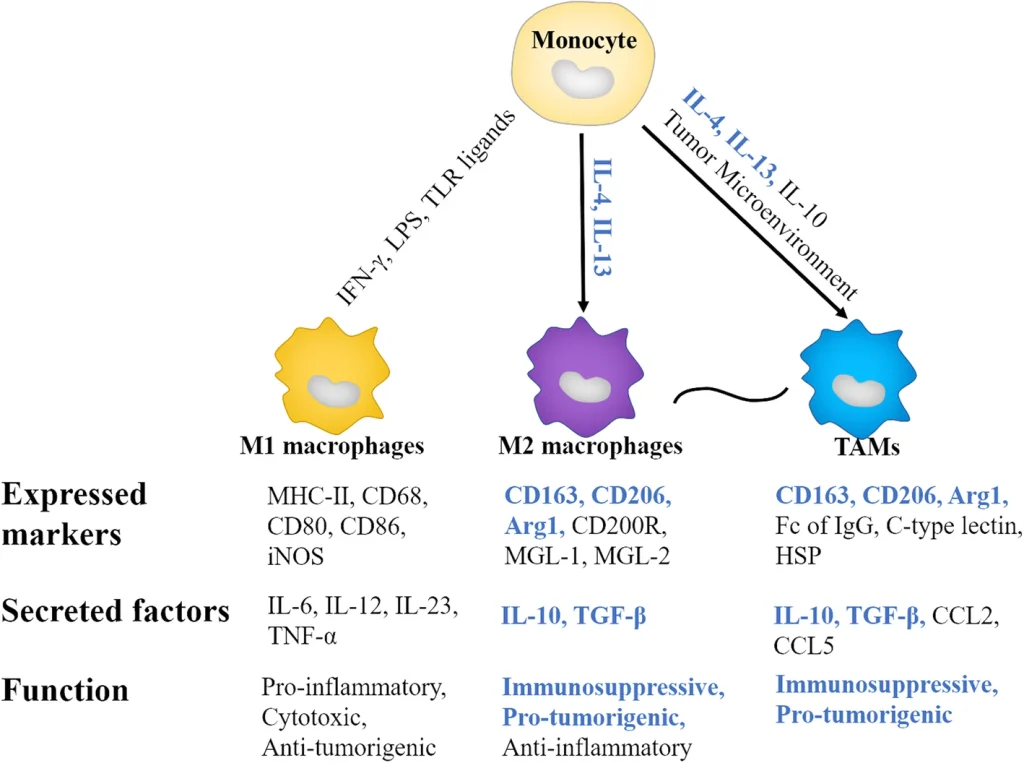
Source: Chen, Y., Song, Y., Du, W. et al. Tumor-associated macrophages: an accomplice in solid tumor progression. J Biomed Sci 26, 78 (2019). https://doi.org/10.1186/s12929-019-0568-z
Macrophages can adopt different functional states depending on environmental signals, a process known as polarization. This is commonly described using two simplified phenotypes:
- M1-like macrophages: pro-inflammatory, anti-tumor, and efficient at killing pathogens and tumor cells
- M2-like macrophages: anti-inflammatory, involved in tissue remodeling, angiogenesis, and immune suppression
In most solid tumors, TAMs show features closer to the M2-like phenotype, which favors tumor progression.
Tumor Signals Driving Pro-Tumoral Polarization
The tumor microenvironment contains many factors that push macrophages toward tumor-supportive roles, such as:
- IL-10 and TGF-β, which suppress immune activation
- Hypoxia, which induces angiogenic programs
- Tumor-derived metabolites, which alter macrophage energy metabolism
As a result, TAMs become specialized in supporting tumor growth rather than eliminating malignant cells.
Spatial Organization of TAMs in Tumors
TAMs are not evenly distributed within tumors. They often accumulate:
- Around blood vessels, where they promote angiogenesis
- At the invasive front, where they assist tumor cell migration
- In hypoxic regions, where they adapt to low oxygen and support survival pathways
This spatial positioning allows TAMs to regulate multiple stages of tumor progression simultaneously.
Pro-Tumoral Functions of Tumor-Associated Macrophages
Tumor-associated macrophages actively support cancer progression through multiple, interconnected mechanisms. Rather than acting as immune defenders, TAMs become key contributors to tumor growth, invasion, and immune escape.
Promotion of Tumor Cell Growth and Survival
TAMs secrete growth factors and cytokines that enhance tumor cell proliferation and protect cancer cells from apoptosis, including:
- EGF, which stimulates tumor cell migration and division
- IL-6 and TNF-α, which activate survival signaling pathways
- Growth factors that enhance resistance to cellular stress
These signals help tumors expand and adapt to hostile conditions such as hypoxia and nutrient limitation.
Angiogenesis and Lymphangiogenesis
To grow beyond a small size, tumors need new blood and lymphatic vessels. TAMs strongly promote this process by releasing:
- VEGF, a major driver of angiogenesis
- PDGF and angiopoietins, which stabilize new vessels
- Factors that promote lymphatic vessel formation, facilitating metastasis
By supporting vascular development, TAMs improve nutrient delivery while also creating routes for tumor cell dissemination.
Extracellular Matrix Remodeling and Invasion
TAMs modify the structure of surrounding tissues to allow tumor cells to invade:
- Secretion of matrix metalloproteinases (MMPs) that degrade extracellular matrix
- Release of enzymes that loosen tissue barriers
- Guidance of tumor cell migration along remodeled stromal tracks
This remodeling promotes local invasion and prepares paths for metastasis.
Support of Metastatic Spread
TAMs assist tumor cells at several stages of metastasis:
- Enhancing tumor cell intravasation into blood vessels
- Supporting survival of circulating tumor cells
- Contributing to pre-metastatic niche formation in distant organs
These activities increase the likelihood that cancer cells will successfully colonize secondary sites.
Suppression of Anti-Tumor Immunity
One of the most critical roles of TAMs is the inhibition of effective immune responses:
- Inhibition of cytotoxic T cell and NK cell activity
- Promotion of regulatory T cell expansion
- Expression of immune checkpoint ligands and suppressive cytokines
This creates an immunosuppressive environment that protects tumor cells from immune-mediated elimination.
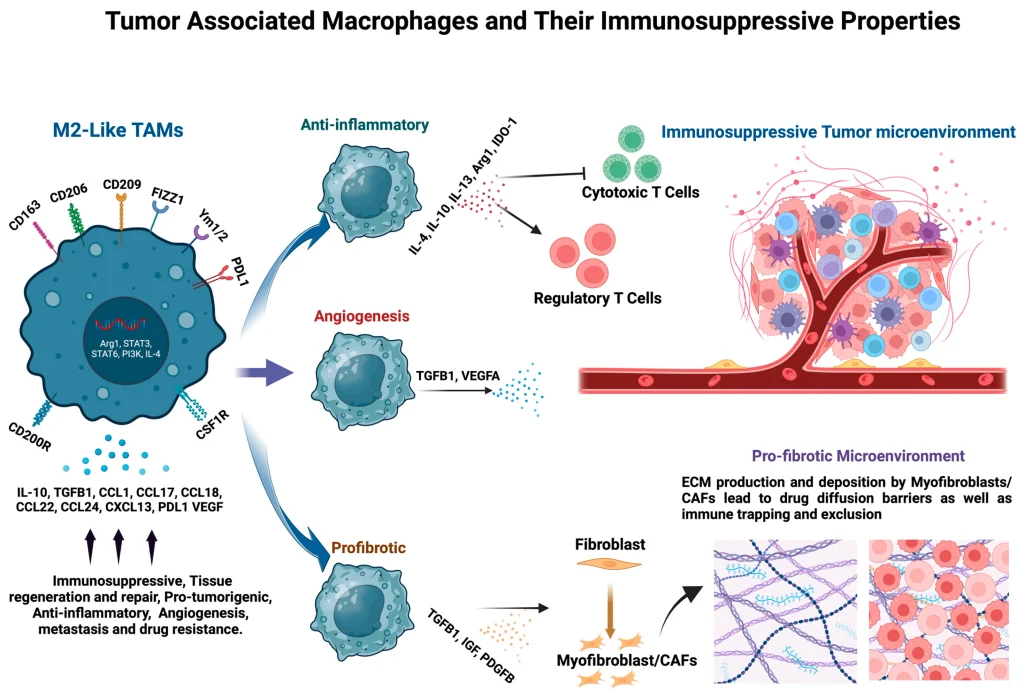
Source: Ghebremedhin, A.; Athavale, D.; Zhang, Y.; Yao, X.; Balch, C.; Song, S. Tumor-Associated Macrophages as Major Immunosuppressive Cells in the Tumor Microenvironment. Cancers 2024, 16, 3410. https://doi.org/10.3390/cancers16193410
TAMs and Therapy Resistance
Beyond promoting tumor growth, tumor-associated macrophages also contribute to resistance against cancer therapies. Their presence in the tumor microenvironment can reduce the effectiveness of chemotherapy, radiotherapy, and immunotherapy, making tumors harder to eliminate.
Resistance to Chemotherapy
TAMs can protect tumor cells from chemotherapy through several mechanisms:
- Secretion of survival cytokines that activate anti-apoptotic pathways in cancer cells
- Release of growth factors that stimulate rapid tumor regrowth after treatment
- Enhancement of drug efflux and detoxification pathways in tumor cells
- Phagocytosis of dying cells that limits immune activation after therapy
These effects reduce tumor sensitivity and promote relapse.
Impact on Radiotherapy Response
Radiotherapy damages tumor DNA, but TAMs can limit its long-term effectiveness:
- Clearance of irradiated tumor cells without triggering strong immune responses
- Secretion of repair-promoting factors that aid tumor recovery
- Promotion of angiogenesis that restores blood supply after radiation damage
This supportive environment allows residual tumor cells to survive and repopulate the tumor.
Resistance to Immunotherapy
TAMs are major barriers to successful immunotherapy, especially immune checkpoint inhibitors:
- Suppression of T cell infiltration and activation
- Expression of checkpoint ligands that inhibit T cell function
- Secretion of IL-10 and TGF-β, reinforcing immune tolerance
- Recruitment of other suppressive immune cells
As a result, tumors with high TAM infiltration often show weaker responses to immunotherapy.
Therapy-Induced Reprogramming of TAMs
Some treatments unintentionally increase TAM recruitment or shift their phenotype toward more suppressive states:
- Chemotherapy-induced inflammation can attract new monocytes
- Radiation can enhance macrophage-driven tissue repair programs
- Tumor debris can further activate wound-healing pathways in macrophages
These responses highlight why targeting TAMs is increasingly viewed as necessary to improve therapeutic success.
Targeting Tumor-Associated Macrophages as a Therapeutic Strategy
Because tumor-associated macrophages play central roles in tumor progression and therapy resistance, they have become important targets for cancer treatment. Several strategies aim to reduce their numbers, block their recruitment, or reprogram them toward anti-tumor functions.
Depleting TAMs
One approach is to reduce the number of macrophages within tumors by interfering with survival signals:
- CSF-1/CSF-1R inhibitors block a key pathway required for macrophage maintenance
- This strategy can decrease TAM density and enhance responses to chemotherapy and immunotherapy
- However, complete depletion may affect normal immune functions
Blocking Macrophage Recruitment
Preventing monocytes from entering tumors can limit TAM accumulation:
- Inhibition of CCL2–CCR2 signaling reduces monocyte trafficking
- Targeting chemokine gradients disrupts continuous TAM replenishment
- This approach is often explored in combination with standard therapies
Reprogramming TAMs Toward Anti-Tumor Phenotypes
Instead of removing macrophages, therapies can convert pro-tumoral TAMs into anti-tumoral cells:
- Activation of innate immune receptors to restore inflammatory functions
- Modulation of metabolic pathways to shift macrophage behavior
- This strategy preserves macrophage presence while changing their role
Enhancing Macrophage-Mediated Phagocytosis
Some therapies aim to boost the ability of macrophages to directly eliminate tumor cells:
- Blocking “don’t eat me” signals on cancer cells enhances phagocytosis
- Combination with antibody therapies can improve tumor clearance
- This approach links macrophage activation with adaptive immune responses
Combination Strategies with Immunotherapy
Targeting TAMs is often most effective when combined with other treatments:
- Reducing immune suppression improves T cell-based therapies
- TAM-targeted drugs can increase checkpoint inhibitor responsiveness
- Combination regimens aim to reshape the entire tumor immune ecosystem
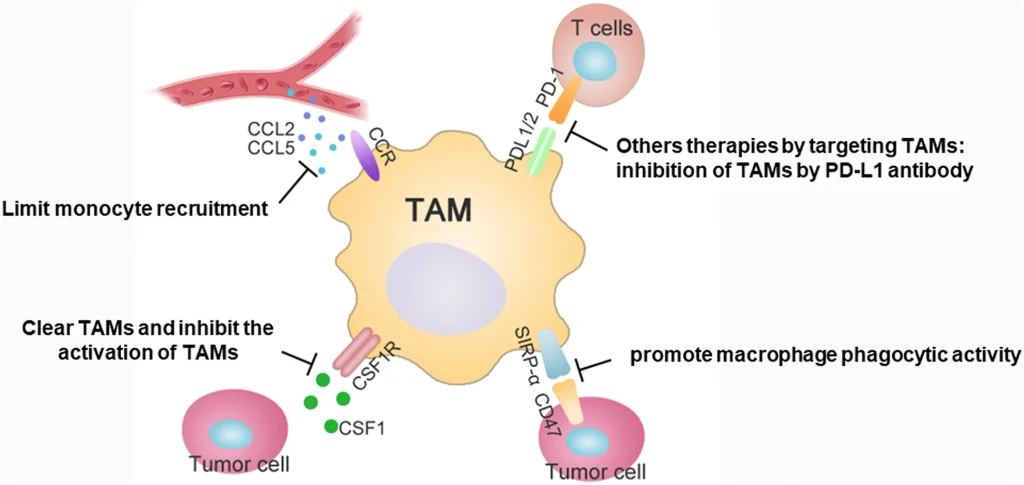
Source: Chen, Y., Song, Y., Du, W. et al. Tumor-associated macrophages: an accomplice in solid tumor progression. J Biomed Sci 26, 78 (2019). https://doi.org/10.1186/s12929-019-0568-z
Conclusion
Tumor-associated macrophages are key regulators of the tumor microenvironment, influencing tumor growth, immune suppression, metastasis, and therapy response. Their high plasticity allows tumors to convert them into powerful allies that support disease progression. Understanding how TAMs are recruited and reprogrammed has opened new opportunities for therapeutic intervention. Targeting TAMs, especially in combination with immunotherapy and conventional treatments, represents a promising strategy to improve cancer outcomes by reshaping the tumor immune landscape.


