

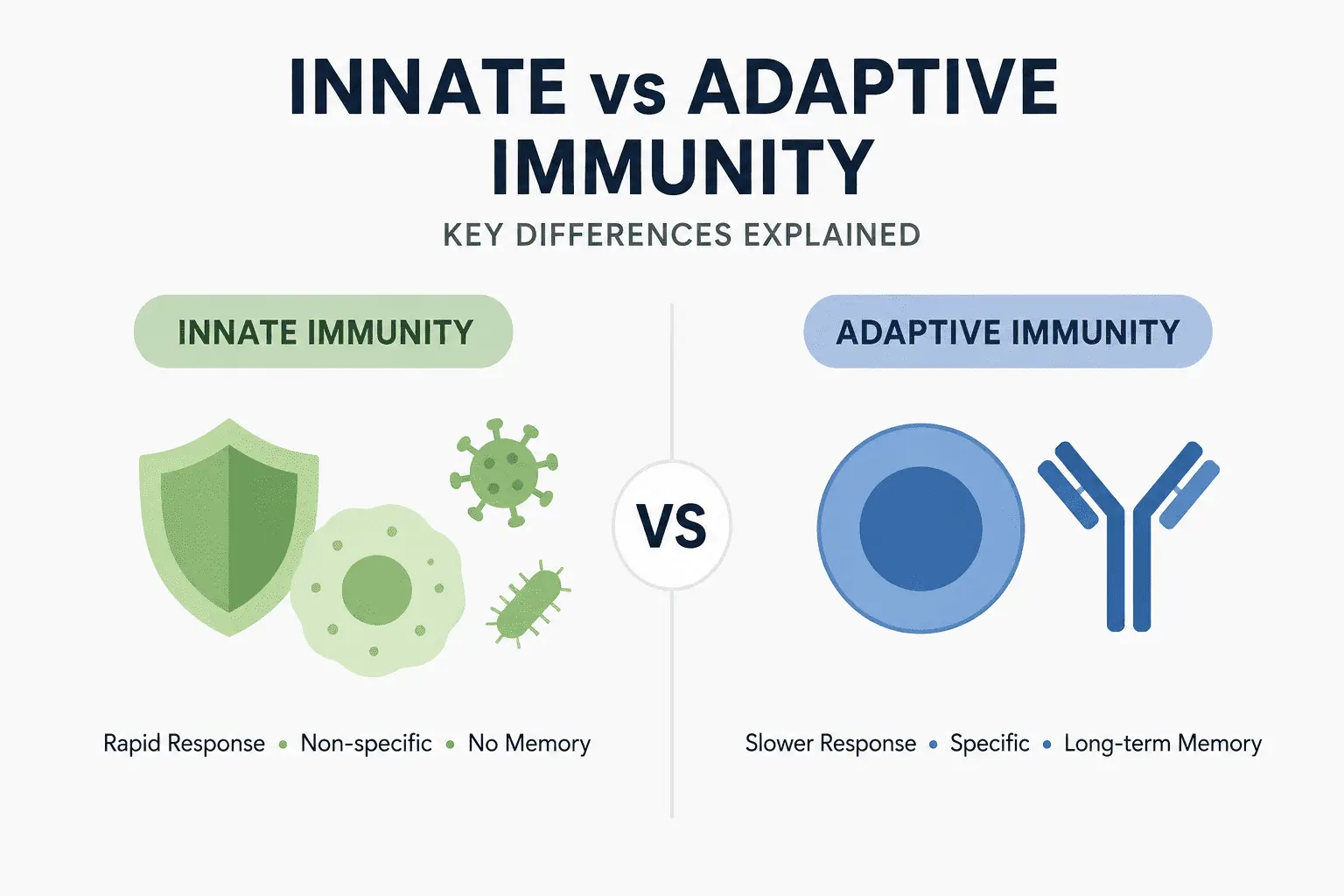
The immune system is a highly coordinated network of cells, tissues, and molecules that protects the body against infections and harmful substances. It operates through two main defense strategies: innate immunity and adaptive immunity.
Innate immunity provides a rapid, non-specific response, acting as the body’s first line of defense. In contrast, adaptive immunity develops more slowly but offers highly specific and long-lasting protection through immunological memory.
Understanding the differences between these two systems is essential for grasping how the body responds to pathogens and maintains immune protection.
In this article, we will explore the key features of innate and adaptive immunity, compare their major differences, and explain how they work together to mount an effective immune response.
1. What Is Innate Immunity?
Innate immunity is the body’s immediate defense system against invading pathogens. It is present from birth and responds rapidly to a wide range of threats without prior exposure. This system plays a crucial role in controlling infections during their early stages.
Key Characteristics of Innate Immunity
Innate immunity is defined by its speed and broad recognition capacity. Instead of targeting specific pathogens, it detects common molecular patterns shared by many microorganisms. These structures, known as pathogen-associated molecular patterns (PAMPs), are recognized by pattern recognition receptors (PRRs) expressed on immune cells, triggering fast defensive responses.
Components of Innate Immunity
Innate immunity relies on both physical barriers and cellular defenses. The skin and mucosal surfaces act as the first line of protection by preventing pathogen entry. Once pathogens bypass these barriers, immune cells such as macrophages and neutrophils eliminate them through phagocytosis. Natural killer cells also contribute by targeting infected or abnormal cells.
Soluble Factors and Immune Signaling
In addition to cells, innate immunity includes soluble molecules that enhance pathogen clearance. These include antimicrobial peptides and circulating proteins that help identify and eliminate pathogens. Signaling molecules released during infection coordinate the activity of immune cells and amplify the response.
Role in Inflammation and Immune Activation
Innate immunity is responsible for initiating inflammation, a protective response that increases blood flow and recruits immune cells to the site of infection. This process creates an environment that supports efficient pathogen elimination and prepares the immune system for subsequent responses.
Limitations of Innate Immunity
Despite its rapid action, innate immunity does not provide long-term protection. It lacks immunological memory and responds in the same way to repeated exposures. Its main role is to contain infections early and support the activation of more specialized immune mechanisms.
2. What Is Adaptive Immunity?
Adaptive immunity is a specialized defense system that develops in response to specific pathogens. Unlike innate immunity, it is not immediate but builds over time as the immune system identifies and targets particular antigens. This system provides precise and long-lasting protection.
Key Characteristics of Adaptive Immunity
Adaptive immunity is highly specific, meaning it can distinguish between different pathogens at the molecular level. It relies on unique antigen receptors expressed on lymphocytes, allowing the immune system to recognize and respond to a vast diversity of antigens. Another defining feature is its ability to generate immunological memory, leading to faster and stronger responses upon repeated exposure.
Main Cellular Components
The adaptive immune response is primarily mediated by lymphocytes. T lymphocytes are involved in cell-mediated immunity, with CD4⁺ T cells coordinating immune responses and CD8⁺ T cells directly eliminating infected cells. B lymphocytes are responsible for humoral immunity and differentiate into plasma cells that produce antibodies targeting specific antigens.
Antigen Recognition and Activation
Adaptive immunity is activated when lymphocytes encounter specific antigens. This process often requires antigen presentation by specialized cells, which enables T cells to recognize and respond to foreign molecules. Once activated, lymphocytes undergo clonal expansion, producing a population of cells that specifically target the invading pathogen.
Immunological Memory
One of the most important features of adaptive immunity is the formation of memory cells. These long-lived cells persist after the initial infection has been cleared and allow the immune system to respond more rapidly and effectively upon re-exposure to the same pathogen.
Functional Outcome of Adaptive Responses
Adaptive immunity leads to the elimination of pathogens through targeted mechanisms. Antibodies can neutralize pathogens or mark them for destruction, while cytotoxic T cells directly kill infected cells. This coordinated response ensures efficient and specific immune protection.
3. Key Differences Between Innate and Adaptive Immunity
Innate and adaptive immunity work together to protect the body, but they differ significantly in their mechanisms, speed, and specificity.
Speed of Response
Innate immunity responds rapidly, often within minutes to hours after pathogen entry. In contrast, adaptive immunity requires more time to develop, as lymphocytes must first recognize specific antigens and undergo activation and expansion.
Specificity and Recognition
Innate immunity recognizes general molecular patterns shared by many pathogens, allowing for a broad but non-specific response. Adaptive immunity, however, is highly specific and can distinguish between closely related antigens through specialized receptors on lymphocytes.
Immunological Memory
Innate immunity does not retain memory of past infections and responds in the same way upon repeated exposure. Adaptive immunity generates memory cells, enabling faster and more effective responses during subsequent encounters with the same pathogen.
Cellular and Molecular Components
The two systems rely on different types of cells and molecules. Innate immunity involves barriers, phagocytic cells, and soluble mediators, while adaptive immunity depends on lymphocytes and antigen-specific receptors.
Comparative Table
| Feature | Innate Immunity | Adaptive Immunity |
|---|---|---|
| Onset of response | Rapid (minutes to hours) | Delayed (days) |
| Specificity | Non-specific | Highly antigen-specific |
| Receptors | Germline-encoded (PRRs) | Somatically generated receptors |
| Diversity | Limited | Very high |
| Memory | Absent | Present |
| Response to repeated exposure | Same response each time | Faster and stronger response |
| Main cells | Macrophages, neutrophils, NK cells | T cells, B cells |
| Function | Early defense and containment | Targeted elimination and long-term protection |
This comparison highlights how innate immunity provides immediate, broad protection, while adaptive immunity ensures precise and durable defense.
4. How Innate and Adaptive Immunity Work Together
Innate and adaptive immunity are not independent systems; they function as an integrated defense network. The innate immune response not only provides immediate protection but also plays a critical role in activating and shaping adaptive immunity.
Initiation of Adaptive Responses
The connection between the two systems begins with antigen-presenting cells such as dendritic cells. These cells detect pathogens, process their antigens, and present them to T lymphocytes. This step is essential for initiating a specific adaptive immune response.
Role of Cytokines and Immune Signaling
Innate immune cells release signaling molecules that influence the activation and differentiation of lymphocytes. These signals determine the type and strength of the adaptive response, ensuring it is appropriate for the invading pathogen.
Coordination During Infection
During an infection, innate immunity acts first to control pathogen spread. As the adaptive response develops, it enhances pathogen elimination through targeted mechanisms. The two systems work in a coordinated manner, with innate responses guiding and supporting adaptive functions.
Amplification of Immune Defense
Adaptive immunity strengthens the overall immune response by producing antigen-specific antibodies and effector T cells. These components improve the efficiency of pathogen clearance and can also enhance innate mechanisms, creating a more effective defense.
Conclusion
Innate and adaptive immunity represent two complementary arms of the immune system, each with distinct roles in host defense. While innate immunity provides rapid, broad protection, adaptive immunity ensures specificity and long-term memory.
Together, these systems form a coordinated response that allows the body to effectively detect, control, and eliminate pathogens. Understanding their differences and interactions is essential for building a solid foundation in immunology.
References
Textbooks
- Abbas, A. K., Lichtman, A. H., & Pillai, S. Cellular and Molecular Immunology (10th ed.). Elsevier.
- Murphy, K., & Weaver, C. Janeway’s Immunobiology (10th ed.). Garland Science.
- Parham, P. The Immune System (5th ed.). Garland Science.
- Sompayrac, L. How the Immune System Works (7th ed.). Wiley-Blackwell.
External Resources
- National Center for Biotechnology Information (NCBI) – Overview of the Immune System:
https://www.ncbi.nlm.nih.gov/books/NBK279396/ - Murphy, K. (2012). Janeway’s Immunobiology (online resources):
https://www.ncbi.nlm.nih.gov/books/NBK10757/ - Chaplin, D. D. (2010). Overview of the immune response. Journal of Allergy and Clinical Immunology, 125(2 Suppl 2), S3–S23.
https://doi.org/10.1016/j.jaci.2009.12.980 - Medzhitov, R., & Janeway, C. (2000). Innate immunity. New England Journal of Medicine, 343(5), 338–344.
https://doi.org/10.1056/NEJM200008033430506 - Iwasaki, A., & Medzhitov, R. (2015). Control of adaptive immunity by the innate immune system. Nature Immunology, 16(4), 343–353.
https://doi.org/10.1038/ni.3123


