

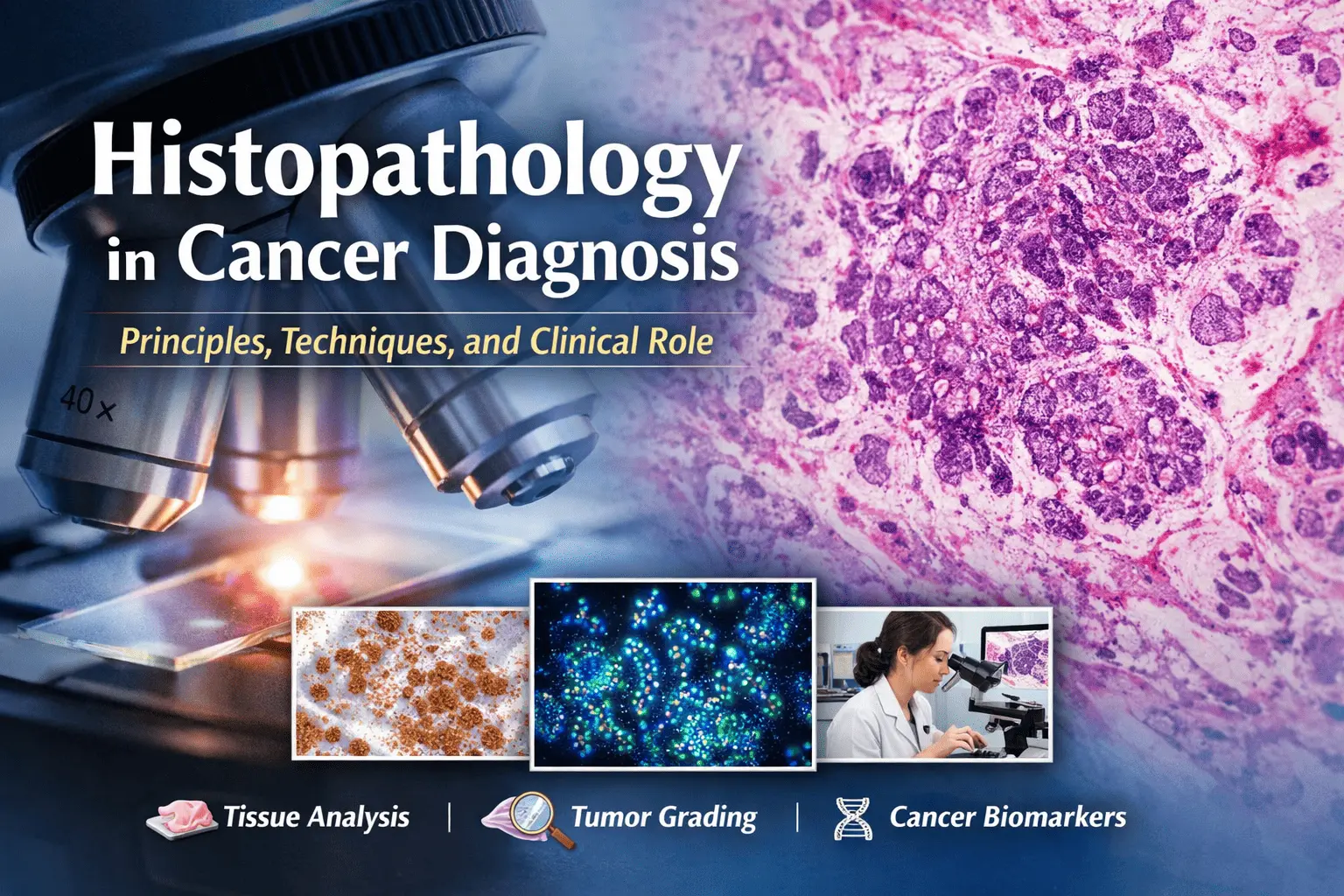
Histopathology is the microscopic examination of tissue to study disease. In cancer diagnosis, it is considered the gold standard because it provides direct visual evidence of malignancy. By analyzing tissue architecture and cellular morphology, histopathology allows pathologists to identify cancer, determine its type, and assess its aggressiveness.
Despite major advances in imaging and molecular diagnostics, histopathology remains essential for confirming cancer, guiding treatment decisions, and predicting patient outcomes.
This article explores the principles, techniques, diagnostic value, and clinical impact of histopathology in cancer.
Fundamentals of Histopathology in Cancer Diagnosis
Histopathology focuses on examining solid tissue samples under a microscope. Unlike cytopathology, which analyzes isolated cells, histopathology preserves tissue architecture, making it crucial for cancer diagnosis.
Types of Tissue Samples
Common sources of tissue for histopathological examination include:
- Biopsy specimens (needle, core, or excisional)
- Surgical resections
- Frozen sections used during surgery for rapid diagnosis
Basic Histopathology Workflow
The diagnostic process follows several standardized steps:
- Fixation – Preserves tissue structure (commonly using formalin)
- Processing – Dehydration and clearing of tissue
- Embedding – Tissue is embedded in paraffin wax
- Sectioning – Thin slices are cut using a microtome
- Staining – Enhances contrast for microscopic evaluation
This workflow ensures that cellular and structural details are well preserved for accurate diagnosis.
Histological Techniques Used in Cancer Detection
Hematoxylin and Eosin (H&E) Staining
H&E staining is the foundation of histopathological diagnosis:
- Hematoxylin stains nuclei blue or purple
- Eosin stains cytoplasm and extracellular matrix pink
This stain allows assessment of:
- Cellular atypia
- Tissue organization
- Tumor invasion
Special Stains
Special stains highlight specific tissue components:
- Connective tissue
- Mucins
- Basement membranes
They help refine tumor identification and differential diagnosis.
Immunohistochemistry (IHC)
IHC uses antibodies to detect specific proteins in tissue sections. It is widely used to:
- Identify tumor origin
- Classify poorly differentiated cancers
- Detect prognostic and predictive biomarkers
Advanced Techniques
- In situ hybridization for gene and RNA localization
- Digital pathology for slide scanning and remote analysis
These techniques enhance diagnostic accuracy and reproducibility.
Role of Histopathology in Tumor Classification and Grading
Histopathology is essential for distinguishing benign from malignant lesions. Malignant tumors typically show:
- Cellular pleomorphism
- Increased mitotic activity
- Loss of normal tissue architecture
- Invasive growth patterns
Tumor Classification
Histological features help determine:
- Tumor type (carcinoma, sarcoma, lymphoma, etc.)
- Tissue of origin
- Subtype classification
Tumor Grading
Grading reflects how aggressive a tumor appears microscopically and is based on:
- Degree of differentiation
- Nuclear abnormalities
- Mitotic count
Higher grades are usually associated with worse prognosis.
Contribution to Staging
Histopathology also evaluates:
- Depth of invasion
- Lymphovascular involvement
- Surgical margins
These findings are critical for accurate tumor staging.
Clinical Impact of Histopathology in Cancer Management
Histopathological findings directly influence clinical decision-making in oncology.
Guiding Treatment Choices
Based on histological diagnosis, clinicians can determine:
- Surgical strategy
- Need for chemotherapy or radiotherapy
- Eligibility for targeted or hormonal therapies
Prognostic and Predictive Value
Histopathology provides information on:
- Tumor aggressiveness
- Likelihood of recurrence
- Expected treatment response
Role in Personalized Medicine
Combined with molecular testing, histopathology supports:
- Precision oncology
- Patient-specific treatment planning
Limitations
Although powerful, histopathology has limitations:
- Sampling bias
- Interobserver variability
- Inability to detect all molecular alterations
This highlights the importance of integrating histopathology with molecular diagnostics.
Conclusion
Histopathology remains the cornerstone of cancer diagnosis, providing definitive evidence of malignancy and critical insights into tumor behavior. It plays a central role in tumor classification, grading, staging, and treatment planning.
While molecular and digital technologies continue to evolve, histopathology remains indispensable. The future of cancer diagnosis lies in the integration of histopathology with molecular pathology and artificial intelligence, ensuring more accurate, personalized, and effective cancer care.


