

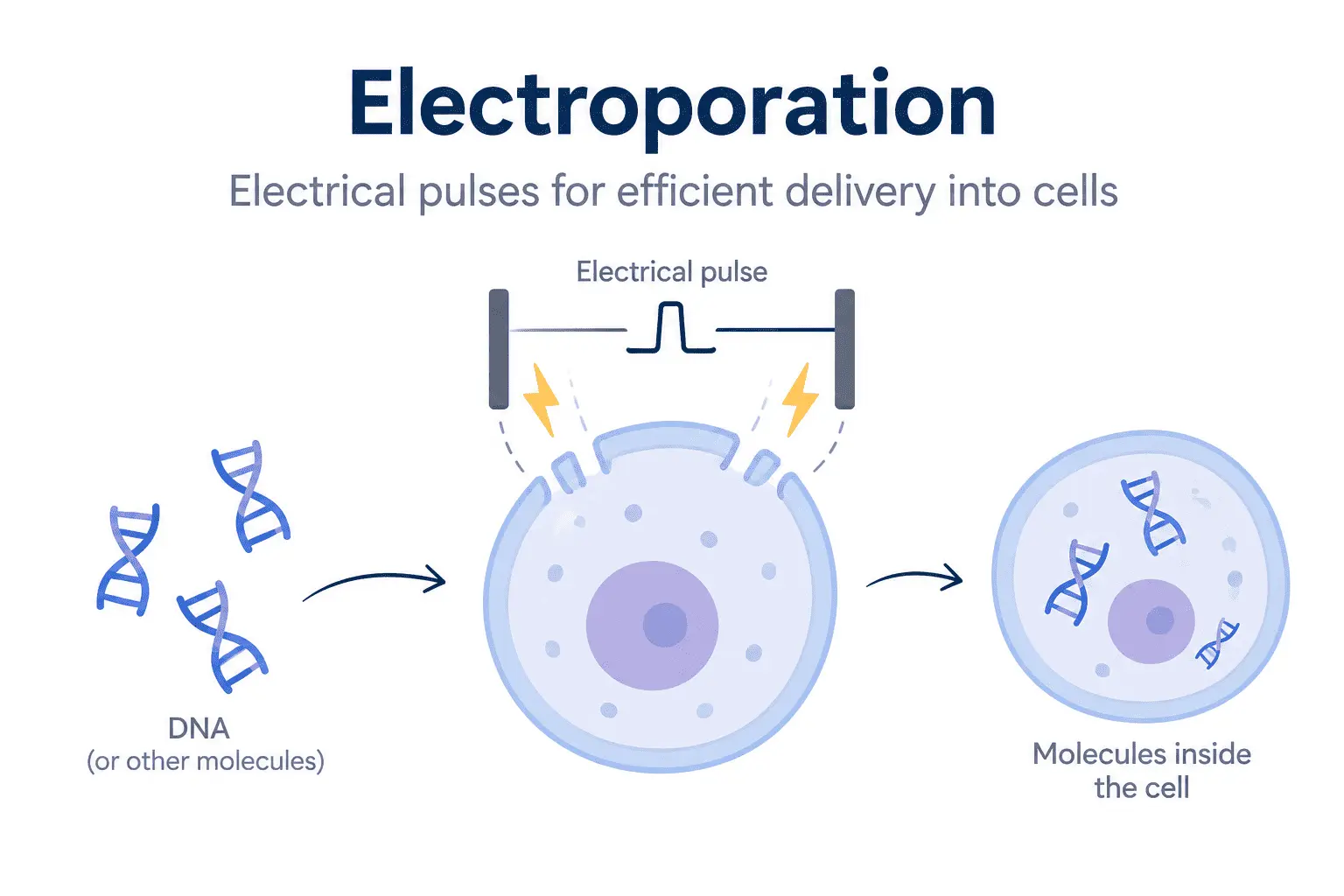
Electroporation is a widely used biological technique that enables researchers to introduce DNA, RNA, proteins, drugs, and other molecules into cells by applying short electrical pulses. The electrical treatment temporarily increases the permeability of the cell membrane, allowing molecules that normally cannot readily cross the membrane to enter the cell.
Because it can deliver genetic material without relying on viral vectors, electroporation has become an important tool in molecular biology, cell biology, biotechnology, genetic engineering, cancer research, immunology, and gene-editing research.
The technique can be used with many different cell types, including bacteria, yeast, mammalian cells, stem cells, and primary cells. Depending on the experimental objective, electroporation may be performed in vitro, using isolated cells in the laboratory, or in vivo, by applying electrical pulses directly to tissues.
One of the major advantages of electroporation is its versatility. It can be adapted to deliver different types of biological cargo, from plasmid DNA and messenger RNA to CRISPR-associated components and proteins. However, the electrical conditions must be carefully optimized because the same process that makes the membrane temporarily permeable can also damage or kill cells.
This article explains the principle of electroporation, how electroporation works, its major types, the general electroporation procedure, applications, advantages, limitations, and factors that influence its efficiency.
1. What Is Electroporation?
Definition of Electroporation
Electroporation, also called electropermeabilization, is a technique in which an external electric field is applied to cells to temporarily increase the permeability of their plasma membranes.
Under normal conditions, the cell membrane acts as a selective barrier. Its lipid bilayer prevents many large, charged, or hydrophilic molecules from freely entering the cell. This is particularly important when researchers want to introduce molecules such as DNA or RNA because these molecules do not efficiently cross intact lipid membranes.
During electroporation, a brief electrical pulse is applied to cells suspended in an appropriate conductive solution. The resulting electric field changes the electrical potential across the cell membrane. When the electrical conditions are sufficiently strong, transient disruptions or pores can form in the membrane.
These temporary openings allow external molecules to enter the cell.
After the electrical pulse ends, the membrane can recover and return toward its normal state. If the treatment is appropriately optimized, a substantial proportion of cells can survive and retain the delivered material.
Electroporation can therefore be viewed as a physical method of cellular delivery rather than a chemical or viral transfection method.
It is commonly used to introduce:
- Plasmid DNA
- Linear DNA fragments
- Messenger RNA (mRNA)
- Small interfering RNA (siRNA)
- CRISPR-related components
- Proteins
- Dyes and molecular probes
- Some drugs and other compounds
The exact cargo depends on the cell type and experimental objective.
Principle of Electroporation
The basic principle of electroporation is based on electrically induced changes in membrane permeability.
When cells are exposed to an external electric field, a voltage difference develops across their membranes. As the applied electric field increases, the induced membrane potential can become sufficiently large to destabilize the lipid bilayer.
This can result in the formation of temporary aqueous pathways within the membrane.
These pathways provide a route through which molecules can move into the cell.
The process can be divided conceptually into several stages:
1. Application of the electric field:
Cells are exposed to a short electrical pulse.
2. Membrane polarization:
The electrical field causes changes in the potential across the plasma membrane.
3. Membrane permeabilization:
When the induced membrane potential reaches an appropriate level, transient membrane pores can form.
4. Molecular entry:
DNA, RNA, proteins, or other molecules present outside the cell can enter through or around these transient openings.
5. Membrane resealing:
After the pulse, the membrane gradually recovers its barrier function.
The balance between membrane permeabilization and cell survival is critical. Insufficient electrical stimulation may produce poor delivery, whereas excessive stimulation can cause irreversible membrane damage and cell death.
How Electroporation Works
The outcome of electroporation depends on several physical and biological factors.
The electric field strength is particularly important. The electric field experienced by a cell depends on both the applied voltage and the distance between the electrodes. In simplified terms:
Electric field strength = applied voltage / electrode distance
The duration and characteristics of the electrical pulse also influence membrane permeabilization.
When an appropriate pulse is applied, the cell membrane undergoes temporary structural changes. Depending on the electrical conditions, these changes may remain reversible or become irreversible.
Reversible electroporation occurs when membrane permeability increases temporarily and the cell subsequently recovers. This is desirable for most molecular delivery applications.
Irreversible electroporation occurs when membrane damage becomes extensive enough that the cell cannot restore its normal membrane integrity. This can result in cell death.
The size, shape, and electrical properties of cells also influence their response. Consequently, an electroporation protocol that works well for one cell type may perform poorly with another.
2. Types of Electroporation
Electroporation can be classified according to where and how the technique is performed. The three broad categories commonly discussed are in vitro electroporation, in vivo electroporation, and microbial electroporation.
In Vitro Electroporation
In vitro electroporation involves treating isolated cells outside an organism.
This is one of the most common applications of the technique in laboratory research. Cells are mixed with the desired cargo and exposed to an electrical pulse using an electroporation device.
Mammalian cell electroporation can be particularly useful when conventional chemical transfection methods are inefficient.
For example, researchers may use electroporation to introduce plasmid DNA into cultured cells to study:
- Gene expression
- Protein function
- Signaling pathways
- Cellular differentiation
- Gene regulation
- Genetic modifications
Electroporation is also useful for cells that are difficult to transfect using lipid-based reagents.
Primary cells and some stem-cell populations can be particularly challenging to manipulate, making optimized electroporation systems valuable in experimental workflows.
In Vivo Electroporation
In vivo electroporation involves applying electrical stimulation directly to a tissue or biological site after the desired molecule has been delivered to the target area.
Instead of removing cells from the organism, electrodes are positioned around or near the target tissue, and controlled electrical pulses are applied.
The electrical treatment temporarily increases membrane permeability in cells within the treated region.
In vivo electroporation has been investigated for applications including:
- Gene delivery
- DNA vaccine research
- Gene therapy
- Cancer research
- Delivery of therapeutic molecules
- Tissue engineering
For example, researchers have investigated electroporation-assisted nucleic acid delivery to tissues such as muscle and tumors.
Because in vivo electroporation involves living tissues, factors such as tissue structure, electrode placement, electrical parameters, and tissue response must be carefully considered.
Microbial Electroporation
Electroporation is also widely used to introduce DNA into microorganisms.
In bacterial electroporation, cells are exposed to an electric pulse in the presence of DNA. The resulting transient membrane permeabilization allows DNA to enter the bacterial cell.
After recovery, cells containing the introduced DNA can be selected and analyzed.
This process is commonly referred to as electroporation-based transformation.
Microbial electroporation is particularly useful in recombinant DNA technology and molecular cloning.
It can be used to introduce:
- Plasmids
- Gene constructs
- Expression vectors
- Mutagenesis constructs
- DNA libraries
Electroporation can also be used with certain yeast and other microorganisms, although the appropriate conditions differ considerably between species and cell types.
3. Electroporation Procedure
The exact electroporation protocol varies substantially depending on the organism, cell type, electroporation system, cargo, and experimental objective. Nevertheless, the general workflow follows several common steps.
Preparation of Cells and Materials
The first step is to prepare healthy cells under appropriate culture or growth conditions.
For mammalian cells, the physiological state of the cells can have a major effect on electroporation performance. Researchers generally aim to work with healthy cells at an appropriate growth stage and cell density.
The material to be introduced into the cells must also be prepared.
Depending on the experiment, this could be:
- Plasmid DNA
- mRNA
- siRNA
- DNA fragments
- CRISPR-associated components
- Protein
- Other molecular cargo
The electroporation buffer is another important component. Its composition affects electrical conductivity, cell viability, and membrane behavior.
For microbial transformation, the preparation of competent cells is particularly important. Cells are prepared in a manner that makes them suitable for subsequent electrical transformation.
The cells and cargo are then combined under the conditions recommended for the specific electroporation system.
Electroporation Process
The cell-cargo mixture is transferred into an electroporation vessel, such as an appropriate cuvette or specialized electroporation device.
Electrodes within the system generate the electrical field.
The electroporator then delivers a controlled electrical pulse to the cells.
The electrical pulse temporarily alters membrane permeability, allowing the desired material to enter.
The cells are subsequently transferred into an appropriate recovery environment.
For mammalian cells, recovery conditions are important because the cells may be temporarily stressed by the electrical treatment. For bacterial transformation, a recovery phase allows transformed cells to resume growth before selection.
After recovery, downstream analysis depends on the experiment.
For example, researchers may evaluate:
- Transfection efficiency
- Gene expression
- Protein production
- Cell viability
- Genome editing
- Selection-marker expression
- Phenotypic changes
Factors Affecting Electroporation Efficiency
Electroporation efficiency is influenced by both physical parameters and biological characteristics.
Important factors include:
Cell type: Different cells have different membrane properties, sizes, shapes, and sensitivities to electrical stimulation.
Cell concentration: Cell density can influence both delivery efficiency and cell survival.
Cargo: DNA, RNA, proteins, and other molecules differ in size, charge, structure, and stability.
Electric field strength: Increasing the electric field generally increases membrane permeabilization, but excessive stimulation can reduce viability.
Pulse duration: Longer or stronger electrical exposure can increase membrane disruption but may also increase cellular damage.
Pulse waveform: Different electroporation systems use different electrical pulse formats, which can affect the cellular response.
Buffer composition: Conductivity and chemical composition can influence the electrical behavior of the system and cell viability.
Temperature: Temperature and handling conditions can influence cellular recovery and experimental reproducibility.
For these reasons, electroporation should generally be optimized empirically for the specific cell type and application rather than treating one set of conditions as universally applicable.
4. Applications of Electroporation
Electroporation has become an important technique across many areas of modern biology and biotechnology.
Gene and Nucleic Acid Delivery
One of the most important applications of electroporation is the delivery of nucleic acids into cells.
Plasmid DNA can be introduced into cells to produce a protein of interest or alter gene expression.
For example, a researcher studying a signaling pathway may introduce a plasmid encoding a specific protein and subsequently measure changes in cellular behavior.
Electroporation can also be used for RNA delivery.
Introducing mRNA provides a way to transiently produce a protein without requiring DNA to enter the nucleus and undergo transcription.
Similarly, siRNA can be introduced to reduce expression of a target gene through RNA interference.
Electroporation has also become particularly relevant to CRISPR-based genome editing.
Depending on the experimental system, electroporation can facilitate delivery of combinations of:
- Guide RNA
- Cas proteins
- Cas-encoding RNA
- DNA repair templates
- Other genome-editing components
This makes electroporation an important tool for researchers studying targeted genetic modifications.
Protein and Other Molecule Delivery
Although nucleic acids are among the most common cargos, electroporation is not limited to DNA and RNA.
The technique can also facilitate intracellular delivery of certain proteins and molecular probes.
Protein delivery can be useful when researchers want to introduce a biologically active protein directly into cells without requiring the cell to synthesize it.
For example, purified proteins involved in genome editing, signaling, or cellular regulation can potentially be introduced into cells using optimized electroporation approaches.
Electroporation can also be used experimentally to introduce fluorescent molecules and other probes into cells for imaging or cellular analysis.
The ability to deliver different types of molecules contributes to the versatility of the technique.
Research and Therapeutic Applications
Electroporation has applications extending from basic research to biotechnology and therapeutic research.
In cancer biology, electroporation has been investigated as a method for delivering genetic material and other therapeutic molecules to tumor cells.
In immunology, electroporation can be used to introduce nucleic acids into immune cells for research and cell-engineering applications.
It has also been used in the development and study of engineered cell therapies.
For example, researchers can use electroporation to introduce genetic constructs or genome-editing components into cells before analyzing their properties.
Electroporation has additionally been investigated in the context of DNA vaccines and gene therapy, where temporary membrane permeabilization can improve intracellular delivery of genetic material.
However, therapeutic applications require considerably more attention to safety, tissue response, delivery specificity, and reproducibility than routine laboratory electroporation.
5. Advantages, Limitations, and Troubleshooting
Advantages of Electroporation
Electroporation offers several advantages compared with some other cellular delivery methods.
High delivery efficiency:
When appropriately optimized, electroporation can provide efficient delivery of nucleic acids into many cell types.
Useful for difficult-to-transfect cells:
Some cells that respond poorly to conventional chemical transfection can be successfully manipulated using electroporation.
Broad cargo compatibility:
The technique can be used to deliver DNA, RNA, proteins, and other molecules.
Non-viral approach:
Unlike viral-vector-based delivery, electroporation does not require a viral vector to transport genetic material into the cell.
Rapid procedure:
The electrical pulse itself occurs over a very short period, although preparation and recovery require additional time.
Adaptability:
Electroporation can be performed with bacteria, yeast, mammalian cells, primary cells, and other biological systems.
These properties have made electroporation a valuable method for both routine laboratory experiments and advanced cell-engineering workflows.
Limitations and Common Problems
Despite its advantages, electroporation also has important limitations.
The most significant is the potential for cell damage and reduced viability.
The electrical conditions required to increase membrane permeability can simultaneously cause cellular stress. If the electrical field is too strong or the exposure is inappropriate, membrane damage may become irreversible.
Another limitation is that electroporation conditions are highly cell-type dependent.
A protocol developed for one cell line may not work effectively for another. Even closely related cell types can respond differently.
Common problems include:
Low transfection efficiency:
This may result from inappropriate electrical conditions, poor cargo quality, unsuitable buffer composition, or inadequate cell preparation.
High cell mortality:
Excessive electrical stress is a common cause of reduced viability.
Poor recovery:
Cells may experience substantial stress after treatment and require appropriate recovery conditions.
Variable results:
Small differences in cell condition, cell density, reagent quality, or electrical parameters can affect reproducibility.
Therefore, evaluating both delivery efficiency and cell viability is essential when optimizing an electroporation protocol.
How to Improve Electroporation Efficiency
Successful electroporation requires finding a balance between efficient membrane permeabilization and acceptable cell survival.
One of the most important strategies is to optimize the electrical parameters for the specific cell type.
Researchers may evaluate different combinations of:
- Electric field strength
- Pulse duration
- Pulse number
- Pulse waveform
- Cell concentration
- Buffer composition
The quality and quantity of the cargo should also be carefully controlled.
For nucleic acid delivery, degraded or contaminated DNA or RNA can reduce experimental performance. Using appropriate-quality material helps improve reproducibility.
Cell health is equally important. Cells that are stressed, unhealthy, or handled inconsistently before electroporation may show reduced survival and variable delivery.
It is also useful to measure two outcomes independently:
- How efficiently the cargo entered the cells
- How many cells survived the procedure
A condition that produces very high delivery but kills most of the cells may not be useful for downstream experiments.
Conversely, excellent cell viability with very little cargo delivery may also be inadequate.
The optimal condition is therefore usually a compromise between transfection efficiency, cell viability, and biological function.
Conclusion
Electroporation is a versatile physical technique that temporarily increases cell membrane permeability through controlled electrical stimulation. This transient permeabilization allows molecules such as DNA, RNA, proteins, and other cargos to enter cells.
The technique is widely used in molecular biology, genetic engineering, microbiology, cell biology, cancer research, immunology, and genome-editing research. It can be performed in vitro with isolated cells, in vivo in tissues, or with microorganisms for genetic transformation.
The effectiveness of electroporation depends on numerous factors, including cell type, cargo, buffer composition, electric field strength, pulse duration, and cell condition. Because excessive electrical stimulation can damage cells, optimization is essential.
Overall, electroporation remains an important method for cellular and genetic manipulation because it combines broad cargo compatibility, flexibility, and the ability to work with cells that can be difficult to transfect using other approaches. Its continuing use in genome editing, cell engineering, and molecular research makes understanding the underlying principle and practical considerations of electroporation valuable for students, researchers, and laboratory professionals.


