

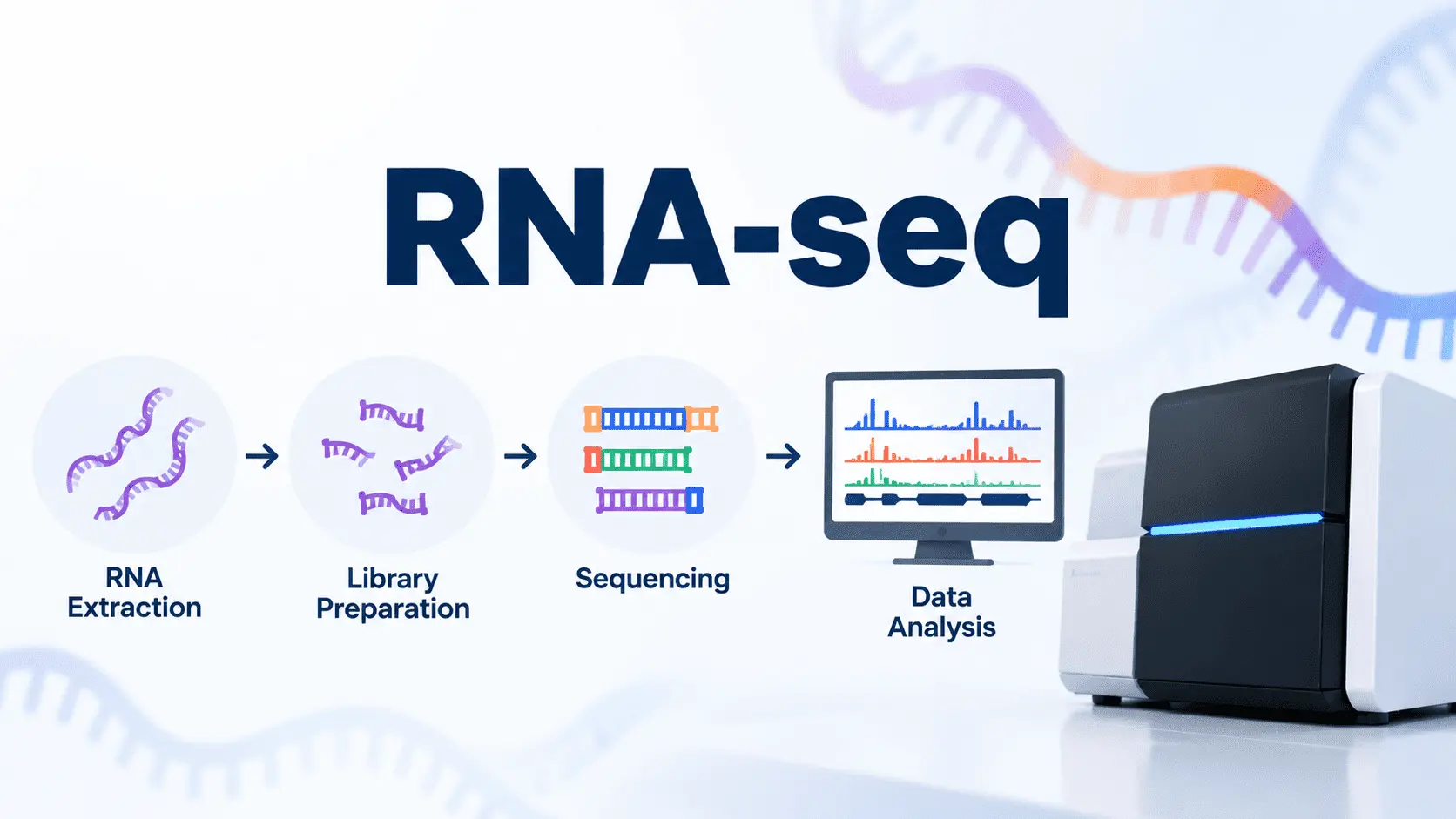
RNA-seq, short for RNA sequencing, is a next generation sequencing (NGS) approach used to study the RNA molecules present in a biological sample. By sequencing RNA-derived molecules and analyzing the resulting data, researchers can investigate which genes are expressed, how strongly they are expressed, and how transcripts differ between biological conditions.
Unlike traditional methods that measure a predefined group of genes, RNA-seq can provide a broad view of the transcriptome. This makes it a powerful tool for discovering previously unknown transcripts, identifying differentially expressed genes, studying alternative splicing, and investigating changes in gene expression associated with diseases.
RNA-seq has become particularly important in cancer biology, molecular biology, genetics, developmental biology, infectious disease research, and transcriptomics. It can be performed on bulk tissue or cell populations, while more advanced approaches such as single-cell RNA-seq can investigate gene expression at the level of individual cells.
The RNA-seq workflow generally involves RNA extraction, RNA quality assessment, library preparation, sequencing, and bioinformatic analysis. Each step can influence the quality and interpretation of the final results.
This guide explains what RNA-seq is, what it measures, how the RNA-seq workflow works, how sequencing data are analyzed, its major applications, and its advantages and limitations.
What Is RNA-seq and What Does It Measure?
RNA-seq is a sequencing-based technique used to characterize the transcriptome of a biological sample.
The transcriptome refers to the complete collection of RNA molecules produced by cells or tissues under particular biological conditions. Unlike the genome, which is relatively stable, the transcriptome can change substantially depending on cell type, developmental stage, environmental conditions, disease state, or treatment.
For example, two cell types may contain essentially the same genome but express very different sets of genes. RNA-seq allows researchers to investigate these differences by measuring RNA transcripts.
What can RNA-seq reveal?
RNA-seq can provide information about several aspects of RNA biology.
One major application is gene expression analysis. Researchers can compare transcript abundance between samples to determine which genes are expressed at higher or lower levels under different conditions.
For example, researchers studying cancer may compare tumor tissue with normal tissue to identify genes whose expression changes during tumor development.
RNA-seq can also provide information about alternative splicing. A single gene can sometimes produce multiple RNA transcripts through different combinations of exons. RNA sequencing can help identify these different transcript isoforms.
Another application is the discovery of novel transcripts. Because RNA-seq does not necessarily depend on a predefined collection of probes, sequencing data can reveal transcripts that were not previously annotated.
RNA-seq can also be used to investigate non-coding RNAs, including certain long non-coding RNAs and other RNA species, depending on the library preparation strategy.
In addition, sequencing data can sometimes reveal gene fusions, particularly when transcripts originating from two different genomic regions are joined together.
RNA-seq versus traditional gene expression methods
Before RNA-seq became widely used, researchers frequently relied on methods such as microarrays and quantitative PCR to study gene expression.
qPCR is highly useful when researchers want to measure the expression of a relatively small number of specific genes. However, it requires prior knowledge of the target genes and appropriate primer design.
Microarrays can measure the expression of thousands of genes simultaneously, but they generally depend on predefined probes.
RNA-seq provides a broader approach because researchers can sequence RNA molecules across the transcriptome rather than measuring only predefined targets.
However, RNA-seq also generates substantially larger datasets and therefore requires more extensive computational analysis.
Bulk RNA-seq and single-cell RNA-seq
RNA-seq can be performed using RNA collected from a population of cells, commonly called bulk RNA-seq.
Bulk RNA-seq provides an overall expression profile for the analyzed sample. It is useful for comparing tissues, treatment groups, disease states, or experimental conditions.
However, tissues are often composed of many different cell types. An average expression measurement from the entire tissue may therefore hide important differences between individual cell populations.
Single-cell RNA sequencing (scRNA-seq) addresses this limitation by analyzing RNA expression at the level of individual cells.
This approach allows researchers to identify distinct cellular populations and investigate differences in gene expression within heterogeneous tissues.
How Does RNA-seq Work? The RNA-seq Workflow
A typical RNA-seq experiment consists of several stages, beginning with biological sample preparation and ending with sequencing data analysis.
Although protocols differ depending on the sequencing platform and research objective, the general workflow follows several common steps.
1. RNA extraction
The first step is the isolation of RNA from the biological sample.
Samples may include cultured cells, blood, tissue, microorganisms, or other biological materials.
RNA is more susceptible to degradation than DNA, so careful sample handling is essential. RNases, which are enzymes capable of degrading RNA, are widespread in the environment.
Researchers therefore use appropriate RNase-free materials, reagents, and working conditions to preserve RNA integrity.
The extracted RNA is then assessed for both quantity and quality.
2. RNA quality and integrity assessment
RNA quality can strongly influence downstream RNA-seq results.
Researchers commonly evaluate RNA concentration and integrity before proceeding with library preparation.
Highly degraded RNA may produce biased sequencing results because certain RNA fragments can become overrepresented.
RNA quality assessment can involve spectrophotometric or fluorometric measurements as well as specialized instruments that estimate RNA integrity.
The appropriate quality requirements depend on the sequencing protocol and sample type.
3. RNA selection or depletion
A biological sample contains many different types of RNA. In many eukaryotic cells, ribosomal RNA (rRNA) represents a large proportion of total RNA.
Because rRNA may dominate sequencing reads without providing the information of interest, researchers often remove or reduce rRNA before sequencing.
Two common approaches are poly(A) selection and rRNA depletion.
Poly(A) selection
Many mature messenger RNAs contain a polyadenylated tail at their 3′ end.
Poly(A) selection uses this feature to enrich for polyadenylated RNA, particularly mRNA.
This approach is useful when the primary research objective is to study protein-coding transcripts.
However, transcripts that do not contain a poly(A) tail may be excluded or underrepresented.
rRNA depletion
An alternative is to remove ribosomal RNA while retaining a broader range of other RNA species.
rRNA depletion can therefore be useful when researchers want to investigate non-coding RNAs or partially degraded RNA samples.
The appropriate method depends on the biological question and the type of RNA researchers want to study.
4. RNA fragmentation
RNA molecules may be fragmented into smaller pieces before library construction.
The appropriate fragment size depends on the sequencing technology and experimental design.
Fragmentation makes the RNA molecules compatible with many short-read sequencing workflows.
In some RNA-seq protocols, fragmentation occurs before cDNA synthesis, while other workflows use different strategies.
Long-read RNA sequencing approaches may instead attempt to preserve longer RNA-derived molecules, allowing researchers to investigate complete transcripts or isoforms.
5. cDNA synthesis
Most short-read RNA-seq workflows convert RNA into complementary DNA (cDNA).
This is accomplished using reverse transcriptase.
The resulting cDNA is more stable and compatible with subsequent library preparation and sequencing.
The cDNA molecules retain sequence information derived from the original RNA molecules.
6. RNA-seq library preparation
The cDNA is then converted into a sequencing library.
During library preparation, adapters are attached to the DNA fragments. These adapters contain sequences required for amplification, attachment to the sequencing platform, or sequencing itself.
Sample-specific indexes may also be incorporated.
Indexing allows multiple samples to be combined in the same sequencing run. This process is known as multiplexing.
After sequencing, computational analysis can separate reads according to their index sequences.
7. Sequencing
The prepared RNA-seq library is introduced into a sequencing platform.
Short-read platforms can sequence millions of fragments simultaneously.
Depending on the experimental design, sequencing can be single-end or paired-end.
In single-end sequencing, each fragment is sequenced from one end.
In paired-end sequencing, both ends of a fragment are sequenced. This provides additional information that can be useful for transcript alignment, alternative splicing analysis, and other applications.
8. Generation of sequencing reads
The sequencing instrument produces a large collection of sequence reads.
These reads represent portions of the original RNA-derived molecules.
The raw data are commonly stored in formats such as FASTQ, which contain nucleotide sequences together with quality information for each base.
At this stage, the experiment has generated the raw sequencing information, but substantial computational processing is still required before biological conclusions can be made.
Experimental design and biological replicates
Good RNA-seq experiments require careful experimental design.
Researchers should define the biological question, experimental groups, controls, sample numbers, and potential confounding factors before sequencing.
Biological replicates are particularly important because they allow researchers to estimate biological variation and perform appropriate statistical analyses.
Technical quality alone cannot compensate for insufficient biological replication.
RNA-seq Data Analysis and Interpretation
One of the defining characteristics of RNA-seq is the large quantity of data generated. Computational analysis is therefore an essential component of the workflow.
The exact analysis pipeline depends on the research question, sequencing technology, organism, and experimental design.
Quality control of raw reads
The first stage is usually quality control.
Researchers inspect the quality of the sequencing reads to identify potential problems such as low-quality bases, adapter contamination, unusual sequence composition, or other technical issues.
Low-quality reads or problematic portions of reads may be removed or trimmed.
Quality control should be performed before downstream analysis because poor-quality data can affect alignment and expression measurements.
Alignment to a reference genome
After quality control, sequencing reads can be aligned to a reference genome.
Alignment software attempts to determine where each read originated within the genome.
Because RNA transcripts are generated through splicing, RNA-seq alignment differs from straightforward genomic DNA alignment.
Some reads may span exon-exon junctions and therefore require specialized algorithms capable of handling spliced transcripts.
Alternatively, reads can be aligned directly to a reference transcriptome.
Transcript assembly and quantification
Once reads have been mapped, researchers can estimate the abundance of transcripts or genes.
Expression can be quantified using different approaches and statistical frameworks.
Common measures include read counts, TPM, FPKM, and RPKM.
Read counts represent the number of sequencing reads assigned to a gene or feature.
TPM, or transcripts per million, provides a normalized measure of transcript abundance.
FPKM and RPKM are other historical normalization measures, although different analysis workflows may favor other approaches depending on the experimental design.
Importantly, these metrics should not be treated as interchangeable because they are calculated differently and have different applications.
Differential gene expression analysis
One of the most common RNA-seq applications is differential gene expression analysis.
Researchers compare gene expression between experimental groups.
For example, a cancer study might compare gene expression between tumor and non-tumor tissue.
The analysis identifies genes whose expression differs between groups while accounting for biological variation and statistical uncertainty.
Results are often reported using measures such as log2 fold change and adjusted statistical significance values.
A gene with a positive fold change may have higher expression in one condition, whereas a negative fold change indicates lower expression relative to the comparison group.
Statistical correction for multiple testing is important because thousands of genes may be analyzed simultaneously.
Functional and pathway analysis
Identifying differentially expressed genes is often only the beginning.
Researchers may subsequently perform gene ontology or pathway analysis to determine whether particular biological processes or molecular pathways are enriched among the identified genes.
For example, an RNA-seq experiment involving cancer cells may identify changes in genes associated with cell proliferation, DNA repair, immune signaling, or metabolism.
This additional analysis helps connect gene-level changes with broader biological processes.
Visualizing RNA-seq results
Several graphical approaches are commonly used to interpret RNA-seq data.
A heatmap can display expression patterns across multiple genes and samples.
A volcano plot can show the relationship between fold change and statistical significance.
A principal component analysis (PCA) plot can help visualize similarities and differences between samples based on their overall expression profiles.
An MA plot can display changes in gene expression in relation to average expression levels.
These visualizations are useful for identifying overall patterns, potential outliers, and differences between experimental groups.
Interpreting RNA-seq results carefully
RNA-seq measures RNA abundance, not protein abundance directly.
A gene can show increased RNA expression without producing a proportional increase in protein.
Post-transcriptional regulation, translation efficiency, protein degradation, and other biological processes can influence the final protein level.
Therefore, RNA-seq findings may need to be complemented with other experimental approaches, such as qPCR, Western blotting, proteomics, or functional assays.
Applications of RNA-seq in Research and Medicine
RNA-seq has become a widely used technology for investigating gene regulation and transcriptome changes across many areas of biology.
RNA-seq in cancer research
Cancer biology is one of the major fields in which RNA-seq is applied.
Cancer cells frequently display substantial changes in gene expression compared with normal cells.
RNA-seq can help researchers characterize these changes across thousands of genes simultaneously.
For example, researchers can compare the transcriptomes of tumor and adjacent non-tumor tissues to identify genes associated with tumor development.
RNA-seq can also be used to investigate differences between cancer subtypes.
Some tumors that appear similar based on morphology may have distinct molecular characteristics. Transcriptomic profiling can help identify these molecular differences.
RNA-seq is also useful for studying tumor heterogeneity, treatment responses, signaling pathways, and potential molecular biomarkers.
In addition, RNA sequencing can help detect transcript-level events such as gene fusions and abnormal splicing that may contribute to cancer biology.
Gene expression profiling
RNA-seq provides a comprehensive approach for studying gene expression.
Researchers can investigate how cells respond to different treatments, environmental conditions, developmental signals, or disease processes.
For example, cells can be exposed to a drug and their transcriptomes compared with untreated control cells.
Genes whose expression changes after treatment may provide clues about the biological pathways affected by the intervention.
Alternative splicing and transcript isoforms
A single gene can produce multiple RNA transcripts through alternative splicing.
These transcript isoforms can differ in their exon composition and potentially encode proteins with different functions.
RNA-seq can provide information about alternative splicing events and transcript structures.
Long-read RNA sequencing can be particularly useful for studying full-length transcripts because longer reads can connect distant regions of the same RNA molecule.
Non-coding RNA research
Not all RNA molecules encode proteins.
Cells contain numerous classes of non-coding RNA involved in gene regulation and other cellular processes.
Depending on the library preparation strategy, RNA-seq can be used to investigate certain non-coding RNA populations.
This makes transcriptome sequencing useful for studying the broader RNA landscape rather than focusing exclusively on messenger RNA.
Infectious disease research
RNA-seq can be used to study both pathogens and host responses.
Researchers can investigate how host cells alter gene expression following infection and characterize RNA produced by viruses and other organisms.
Transcriptomic analysis can provide insights into host-pathogen interactions, immune responses, and molecular mechanisms associated with infection.
Developmental biology
Gene expression changes substantially during development.
RNA-seq allows researchers to compare transcriptomes across developmental stages and identify genes and pathways associated with differentiation and tissue formation.
This makes RNA sequencing useful for studying processes ranging from embryonic development to tissue regeneration.
Single-cell RNA-seq
Single-cell RNA-seq has expanded transcriptomic analysis by allowing researchers to investigate gene expression at the level of individual cells.
This is particularly useful for complex tissues containing multiple cell populations.
For example, a tumor may contain cancer cells, immune cells, stromal cells, endothelial cells, and other populations.
Bulk RNA-seq provides an average signal across these populations, whereas single-cell RNA-seq can help identify distinct cellular populations and their transcriptional characteristics.
Advantages and Limitations of RNA-seq
RNA-seq offers several important advantages, but researchers must also consider its technical and analytical limitations.
Advantages of RNA-seq
One major advantage is its broad transcriptome coverage.
RNA-seq can analyze thousands of genes simultaneously rather than requiring researchers to select a small number of targets in advance.
Another advantage is its ability to detect both known and potentially novel transcripts.
RNA-seq can also provide information about alternative splicing, transcript isoforms, and certain non-coding RNAs.
The technique has a broad dynamic range, allowing researchers to investigate transcripts with different abundance levels.
Another important benefit is flexibility.
RNA-seq can be adapted to different organisms, sample types, experimental conditions, and research questions.
It can also be combined with other technologies to provide complementary molecular information.
RNA degradation
RNA is relatively unstable and can degrade during sample collection, transportation, storage, or extraction.
Degraded RNA can affect library complexity and introduce bias into sequencing results.
For this reason, sample handling and RNA quality assessment are critical.
Library preparation bias
RNA-seq results can be influenced by the library preparation method.
For example, poly(A) selection favors polyadenylated transcripts, whereas rRNA depletion retains a broader collection of RNA molecules.
Fragmentation, reverse transcription, amplification, and other steps can also introduce biases.
Researchers therefore need to select a library preparation strategy that matches their biological question.
Large amounts of data
RNA-seq generates large datasets that require computational storage and analysis.
Researchers may need specialized software, computational infrastructure, and bioinformatics expertise.
The complexity increases when experiments involve many samples, single-cell sequencing, long-read sequencing, or multiple layers of genomic analysis.
Batch effects
Technical differences between sequencing runs, reagent batches, operators, laboratories, or sample processing dates can introduce batch effects.
These technical differences may sometimes resemble genuine biological differences.
Experimental design should therefore minimize unnecessary batch variation, and appropriate statistical methods may be used to account for known sources of technical variation.
Biological interpretation
RNA-seq can identify genes whose expression changes, but determining the biological meaning of those changes may require additional experiments.
An association between gene expression and disease does not necessarily demonstrate that the gene causes the disease.
Functional validation is therefore important when researchers want to establish biological mechanisms.
RNA abundance does not equal protein abundance
Another limitation is that RNA-seq measures transcripts rather than proteins.
Gene expression is regulated at multiple levels after transcription.
Consequently, transcript abundance and protein abundance may not always correlate strongly.
Combining RNA-seq with complementary methods can provide a more complete picture of cellular biology.
Conclusion
RNA-seq is a powerful next generation sequencing approach for studying the transcriptome and investigating gene expression at a large scale.
The technique generally begins with RNA extraction and quality assessment, followed by RNA selection or depletion, fragmentation, cDNA synthesis, library preparation, and sequencing. The resulting reads then undergo computational processing, including quality control, alignment, transcript quantification, and differential expression analysis.
RNA-seq can reveal much more than changes in the expression of individual genes. Depending on the experimental design, it can also provide information about alternative splicing, transcript isoforms, non-coding RNAs, novel transcripts, and other features of RNA biology.
Its applications extend across cancer research, transcriptomics, infectious disease research, developmental biology, genetics, and precision medicine. More advanced approaches such as single-cell RNA-seq and long-read RNA sequencing have further expanded the ability to investigate cellular heterogeneity and transcript structure.
Despite its advantages, RNA-seq requires careful sample preparation, experimental design, quality control, and bioinformatic analysis. RNA degradation, library preparation bias, batch effects, sequencing errors, and the complexity of biological interpretation can all influence the final results.
Overall, RNA-seq has become an important tool in modern molecular biology because it enables researchers to examine gene activity across the transcriptome and uncover molecular changes that may not be apparent using targeted techniques alone.


