

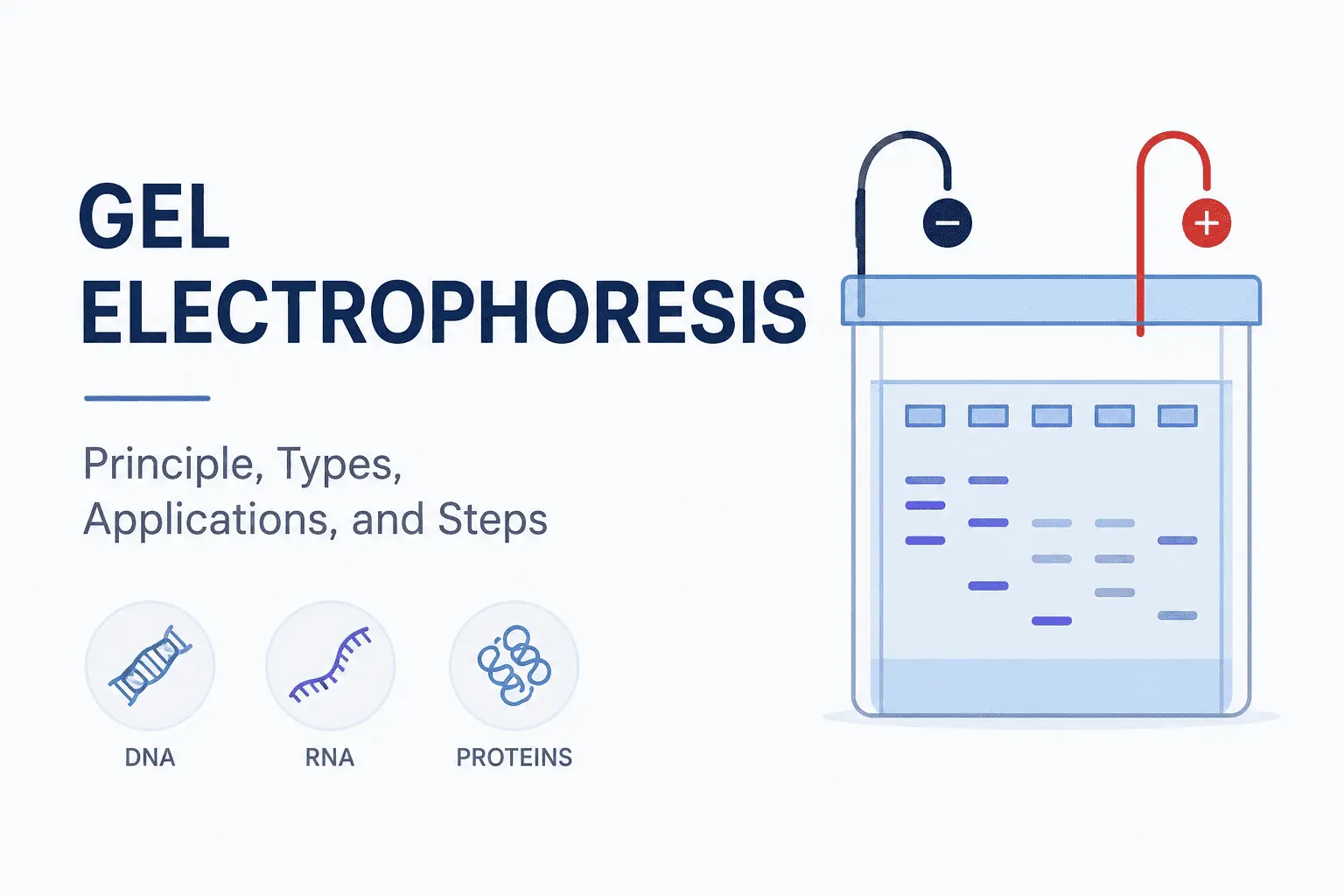
Gel electrophoresis is one of the most important laboratory techniques in molecular biology, biochemistry, and genetics. It allows scientists to separate DNA, RNA, or proteins based on their size and electrical charge. The technique is widely used in research laboratories, clinical diagnostics, forensic science, and biotechnology to analyze genetic material and proteins.
This article explains the principle of gel electrophoresis, its main types, how it works, and its most common applications.
What Is Gel Electrophoresis?
Gel electrophoresis is a laboratory method used to separate charged molecules by applying an electric current through a gel matrix. The gel acts as a molecular sieve, allowing smaller molecules to move more quickly than larger ones.
Principle of Gel Electrophoresis
The technique relies on the movement of charged molecules in an electric field. DNA and RNA molecules carry a negative charge because of their phosphate backbone, so they migrate toward the positively charged electrode (anode). Smaller fragments encounter less resistance as they pass through the gel pores, allowing them to travel farther than larger fragments in the same amount of time.
After separation, the molecules are stained with specialized dyes and visualized under ultraviolet or blue light, producing distinct bands that can be analyzed.
Types of Gel Electrophoresis
Several forms of gel electrophoresis are available, each designed for specific laboratory applications.
Agarose Gel Electrophoresis
This method is the most commonly used method for separating DNA and RNA fragments. Agarose is a natural polysaccharide that forms a porous gel suitable for resolving nucleic acids of various sizes. Depending on the agarose concentration, the gel can separate both large and small DNA fragments with good resolution.
Common applications include:
- PCR product analysis
- Restriction enzyme digestion
- DNA fragment sizing
- RNA quality assessment
- Molecular cloning
Polyacrylamide Gel Electrophoresis (PAGE)
Polyacrylamide gel electrophoresis (PAGE) provides much higher resolution than agarose gels and is ideal for separating small DNA fragments and proteins.
A specialized form called SDS-PAGE uses the detergent sodium dodecyl sulfate (SDS) to denature proteins and separate them primarily according to molecular weight. SDS-PAGE is widely used before Western blotting and other protein analysis techniques.
How Gel Electrophoresis Works: Step-by-Step
Although protocols may vary depending on the sample type, the general workflow is similar across most laboratories.
- Prepare the gel. Agarose or polyacrylamide is dissolved and poured into a casting tray with a comb to create sample wells.
- Prepare the samples. DNA, RNA, or protein samples are mixed with a loading buffer containing tracking dyes and density agents.
- Load the samples. The prepared samples and a molecular weight marker (ladder) are carefully pipetted into the wells.
- Apply an electric field. The gel is placed in an electrophoresis chamber filled with running buffer, and an electric current is applied.
- Separate the molecules. Negatively charged molecules migrate toward the positive electrode, with smaller fragments moving faster through the gel matrix.
- Visualize the results. After electrophoresis, the gel is stained using appropriate dyes, such as ethidium bromide or safer fluorescent alternatives, and examined under a gel imaging system.
- Interpret the bands. The migration pattern is compared with the molecular weight marker to estimate fragment sizes and evaluate sample quality.
Applications, Advantages, and Limitations of Gel Electrophoresis
Gel electrophoresis is an essential tool across many areas of biological research and medicine.
Common Applications
Researchers use gel electrophoresis for numerous purposes, including:
- Verifying PCR amplification products
- Measuring DNA fragment size
- Analyzing restriction enzyme digests
- Assessing RNA integrity before sequencing
- Separating proteins for biochemical studies
- DNA fingerprinting in forensic investigations
- Genetic testing and mutation analysis
- Supporting molecular cloning and gene editing experiments
Advantages
Gel electrophoresis offers several important benefits:
- Simple and easy to perform
- Cost-effective laboratory technique
- Reliable and highly reproducible
- Suitable for DNA, RNA, and protein analysis
- Provides clear visual results
- Compatible with many downstream molecular biology techniques
Limitations
Despite its widespread use, gel electrophoresis has some limitations:
- Limited ability to distinguish fragments with extremely similar sizes
- Primarily provides qualitative or semi-quantitative information
- Requires appropriate staining methods for visualization
- Sample quality can significantly affect the results
- Running and imaging the gel may be time-consuming for large numbers of samples
Frequently Asked Questions
What is gel electrophoresis used for?
Gel electrophoresis is used to separate and analyze DNA, RNA, and proteins. It is commonly employed in molecular biology research, clinical diagnostics, forensic science, and biotechnology.
Why does DNA move toward the positive electrode?
DNA contains negatively charged phosphate groups along its backbone. When an electric field is applied, the negatively charged DNA molecules migrate toward the positively charged electrode.
What is the difference between agarose gel and PAGE?
Agarose gels are mainly used for separating DNA and RNA fragments, while polyacrylamide gels (PAGE) provide higher resolution and are commonly used for proteins and small nucleic acid fragments.
Can gel electrophoresis separate both RNA and proteins?
Yes. Agarose gels are commonly used for RNA analysis, while polyacrylamide gels—especially SDS-PAGE—are widely used for separating proteins based on their molecular weight.
Conclusion
Gel electrophoresis remains one of the foundational techniques in molecular biology. By separating DNA, RNA, and proteins according to their size and charge, it enables researchers to verify experimental results, evaluate sample quality, and investigate genetic and protein-related questions. Whether used for PCR analysis, genetic testing, forensic investigations, or protein characterization, gel electrophoresis continues to play a critical role in modern biological and biomedical research.


