

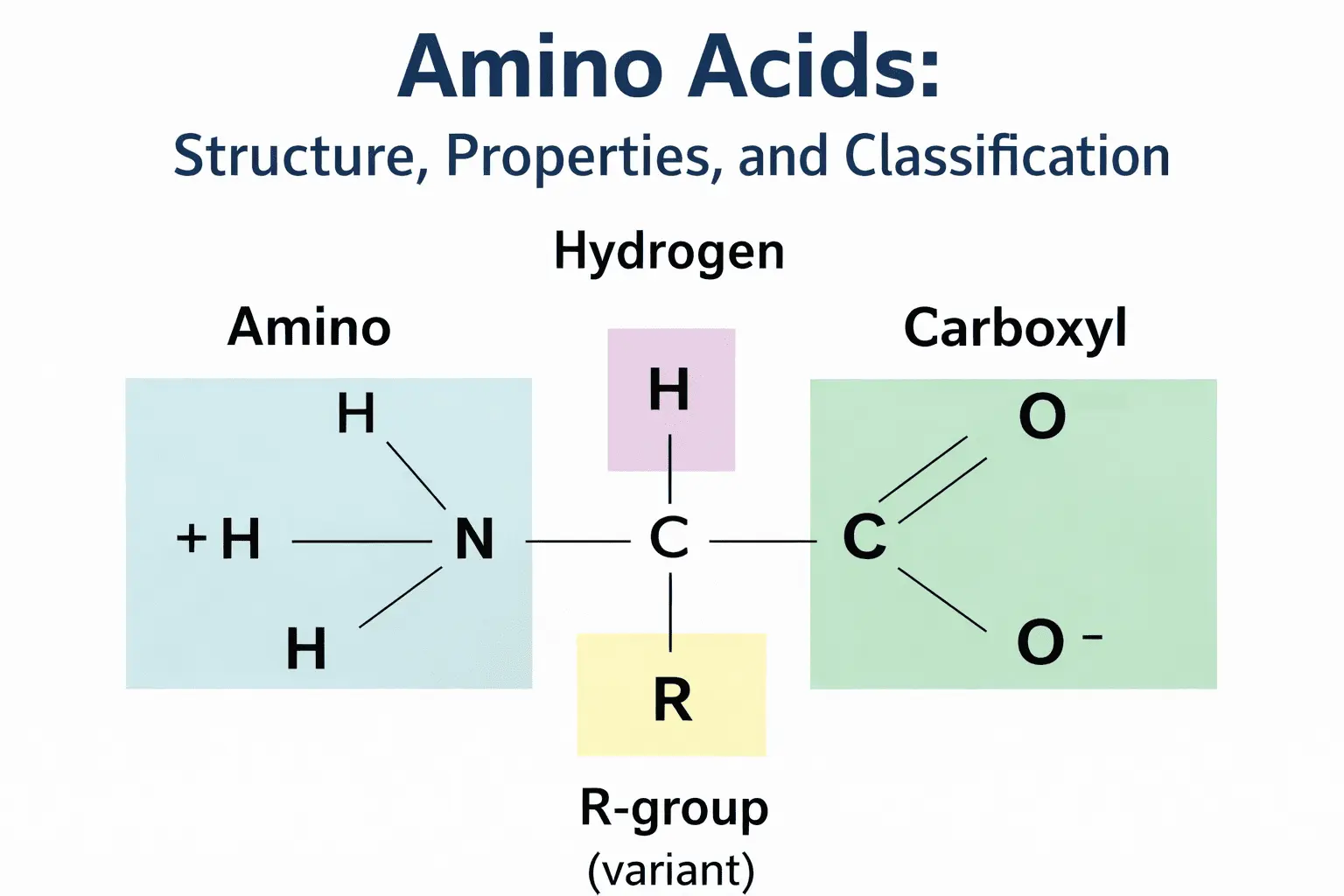
Amino acids are small organic molecules that serve as the fundamental building blocks of proteins, the macromolecules responsible for structure and activity in all living systems. From enzymes and receptors to cytoskeletal elements, the diversity of protein function arises directly from the chemical structure of amino acids.
In biochemistry, amino acids are not studied only for their biological roles, but primarily for their molecular architecture, ionization behavior, and side-chain diversity. Each amino acid shares a common structural framework, yet subtle differences in their side chains generate a wide range of physicochemical properties, influencing protein folding, stability, and interactions.
This article explores amino acids from a structural biochemistry perspective, focusing on their general structure, chemical and physicochemical properties, and classification based on side-chain characteristics and biosynthetic origin.
General Structure of Amino Acids
Amino acids share a common structural framework that defines their chemical behavior and their ability to assemble into proteins. Despite the diversity of amino acids found in nature, this conserved structure is the foundation of protein chemistry.
Core Components of an Amino Acid
Each standard amino acid consists of five key components arranged around a central carbon atom:
- α-carbon (Cα):
The central carbon atom that serves as the backbone of the amino acid. - Amino group (–NH₂):
A basic functional group capable of accepting a proton. - Carboxyl group (–COOH):
An acidic functional group capable of donating a proton. - Hydrogen atom (–H):
Attached to the α-carbon, contributing to molecular symmetry. - Side chain (R group):
A variable group that differs between amino acids and determines their chemical properties.
This general formula can be represented as:
NH₂–CH(R)–COOH
The α-Amino Acid Configuration
In biological systems, amino acids are predominantly α-amino acids, meaning that both the amino group and the carboxyl group are attached to the same α-carbon.
Key structural features of α-amino acids include:
- Alignment along a common backbone, enabling peptide bond formation
- Structural compatibility for linear polypeptide chains
- Consistent geometry essential for secondary and tertiary protein structures
This conserved configuration allows amino acids to link through peptide bonds, forming polypeptides and, ultimately, functional proteins.
Zwitterionic Nature of Amino Acids
In aqueous solutions at physiological pH, amino acids exist primarily as zwitterions, molecules carrying both a positive and a negative charge simultaneously.
- The amino group becomes protonated (–NH₃⁺)
- The carboxyl group becomes deprotonated (–COO⁻)
This internal charge separation gives amino acids:
- High water solubility
- Unique acid–base behavior
- Structural stability in biological environments
The zwitterionic form is central to understanding amino acid reactivity, solubility, and interactions within proteins.
Chemical and Physicochemical Properties of Amino Acids
The behavior of amino acids in biological systems is governed by their chemical structure and the ionizable groups they contain. These features determine how amino acids respond to changes in pH, interact with other molecules, and contribute to protein structure.
Acid–Base Properties and pKa Values
Amino acids are amphoteric molecules, meaning they can act as both acids and bases. This property arises from the presence of:
- An acidic carboxyl group (–COOH)
- A basic amino group (–NH₂)
- In some cases, an ionizable side chain
Each ionizable group has a characteristic pKa value, which represents the pH at which the group is half protonated and half deprotonated.
Key structural consequences:
- At low pH, amino acids carry a net positive charge
- At high pH, amino acids carry a net negative charge
- The exact charge state depends on the number and type of ionizable groups
These acid–base properties are fundamental to amino acid reactivity and protein chemistry.
Isoelectric Point (pI)
The isoelectric point (pI) is the pH at which an amino acid has no net electrical charge.
Structural significance of pI:
- Zwitterionic form dominates at pI
- Minimal solubility often occurs near pI
- Charge neutrality affects molecular interactions
General trends:
- Neutral amino acids have pI values near physiological pH
- Acidic amino acids have lower pI values
- Basic amino acids have higher pI values
Understanding pI is essential in techniques such as electrophoresis and protein purification.
Chirality and Optical Activity
Most amino acids are chiral molecules, meaning they exist in two non-superimposable mirror-image forms.
- The α-carbon is asymmetric (except in glycine)
- Amino acids occur as L- and D-isomers
- Proteins are composed almost exclusively of L-amino acids
Chirality influences:
- Protein folding geometry
- Enzyme–substrate specificity
- Molecular recognition processes
Polarity, Solubility, and Side-Chain Effects
The side chain (R group) plays a major role in determining amino acid polarity and solubility.
Based on structural features, side chains may be:
- Hydrophobic, containing nonpolar hydrocarbon groups
- Hydrophilic, containing polar or charged functional groups
Structural implications:
- Polar amino acids interact favorably with water
- Nonpolar amino acids tend to cluster in protein interiors
- Side-chain interactions drive higher-order protein structure
This combination of acid–base behavior, chirality, and side-chain chemistry explains the diverse physicochemical properties of amino acids and their central role in protein architecture.
Classification of Amino Acids Based on Side Chains
The side chain (R group) is the defining feature that distinguishes one amino acid from another. Variations in side-chain structure determine polarity, charge, hydrophobicity, and chemical reactivity, which in turn influence protein folding and molecular interactions. Based on these structural characteristics, amino acids are commonly classified into three major groups.
Nonpolar (Hydrophobic) Amino Acids
Nonpolar amino acids have side chains composed mainly of hydrocarbon groups, making them poorly soluble in water.
Structural characteristics:
- Lack of charged or strongly polar functional groups
- Side chains dominated by alkyl or aromatic rings
- Limited hydrogen-bonding capacity
Examples include:
- Glycine
- Alanine
- Valine
- Leucine
- Isoleucine
- Methionine
- Phenylalanine
Structural role in proteins:
- Tend to cluster in the interior of proteins
- Contribute to hydrophobic core formation
- Stabilize tertiary protein structure
Polar Uncharged Amino Acids
Polar uncharged amino acids possess side chains that contain electronegative atoms such as oxygen, nitrogen, or sulfur, allowing hydrogen bond formation without carrying a net charge at physiological pH.
Structural characteristics:
- Presence of hydroxyl (–OH), amide (–CONH₂), or sulfhydryl (–SH) groups
- Moderate water solubility
- Ability to form hydrogen bonds
Examples include:
- Serine
- Threonine
- Asparagine
- Glutamine
- Cysteine
- Tyrosine
Structural role in proteins:
- Commonly found on protein surfaces
- Participate in hydrogen bonding networks
- Contribute to structural flexibility and stability
Charged Amino Acids
Charged amino acids contain side chains that are ionized at physiological pH, giving them either a positive or negative charge.
Acidic Amino Acids (Negatively Charged)
Structural features:
- Side chains containing additional carboxyl groups
- Net negative charge at neutral pH
Examples:
- Aspartic acid
- Glutamic acid
Structural role:
- Participate in electrostatic interactions
- Often involved in active sites and salt bridges
Basic Amino Acids (Positively Charged)
Structural features:
- Side chains containing amino or guanidinium groups
- Net positive charge at neutral pH
Examples:
- Lysine
- Arginine
- Histidine
Structural role:
- Interact with negatively charged molecules
- Play key roles in protein–protein and protein–DNA interactions
This side-chain–based classification highlights how small structural differences among amino acids lead to significant variations in chemical behavior and protein architecture.
Nutritional and Biosynthetic Classification of Amino Acids
In addition to their classification based on side-chain chemistry, amino acids can also be grouped according to their biosynthetic origin and nutritional requirement. This classification reflects the ability (or inability) of the human body to synthesize specific amino acids, which is closely linked to their structural complexity and metabolic pathways.
Essential Amino Acids
Essential amino acids are those that cannot be synthesized de novo in sufficient amounts by the human body and must therefore be obtained from the diet.
Structural considerations:
- Often possess complex carbon skeletons
- Require multi-step biosynthetic pathways absent in humans
- Metabolically expensive to synthesize
Essential amino acids include:
- Histidine
- Isoleucine
- Leucine
- Lysine
- Methionine
- Phenylalanine
- Threonine
- Tryptophan
- Valine
Their structural diversity contributes significantly to the chemical variability of proteins.
Non-Essential Amino Acids
Non-essential amino acids can be synthesized by human cells using intermediates from central metabolic pathways.
Structural features:
- Simpler carbon backbones
- Derived from glycolysis or the citric acid cycle
- Often formed by transamination reactions
Examples include:
- Alanine
- Aspartic acid
- Glutamic acid
- Asparagine
- Glutamine
- Serine
These amino acids play key roles in nitrogen metabolism and serve as precursors for other biomolecules.
Conditionally Essential Amino Acids
Conditionally essential amino acids are normally synthesized in adequate amounts but become essential under specific physiological or pathological conditions.
Situations increasing demand:
- Rapid growth (infancy and childhood)
- Severe illness or trauma
- Metabolic stress or malnutrition
Common examples include:
- Arginine
- Cysteine
- Glutamine
- Tyrosine
- Proline
Structurally, these amino acids often depend on precursors that may be limited during stress, reducing their endogenous production.
This nutritional and biosynthetic classification complements structural classifications by linking amino acid chemistry to metabolic capacity and dietary dependence, providing a broader biochemical perspective.
Conclusion
Amino acids are the fundamental molecular units of proteins, and their importance in biochemistry arises from their shared structural framework combined with remarkable side-chain diversity. The presence of amino and carboxyl functional groups confers unique acid–base behavior, while variations in the R group determine polarity, charge, and reactivity.


