

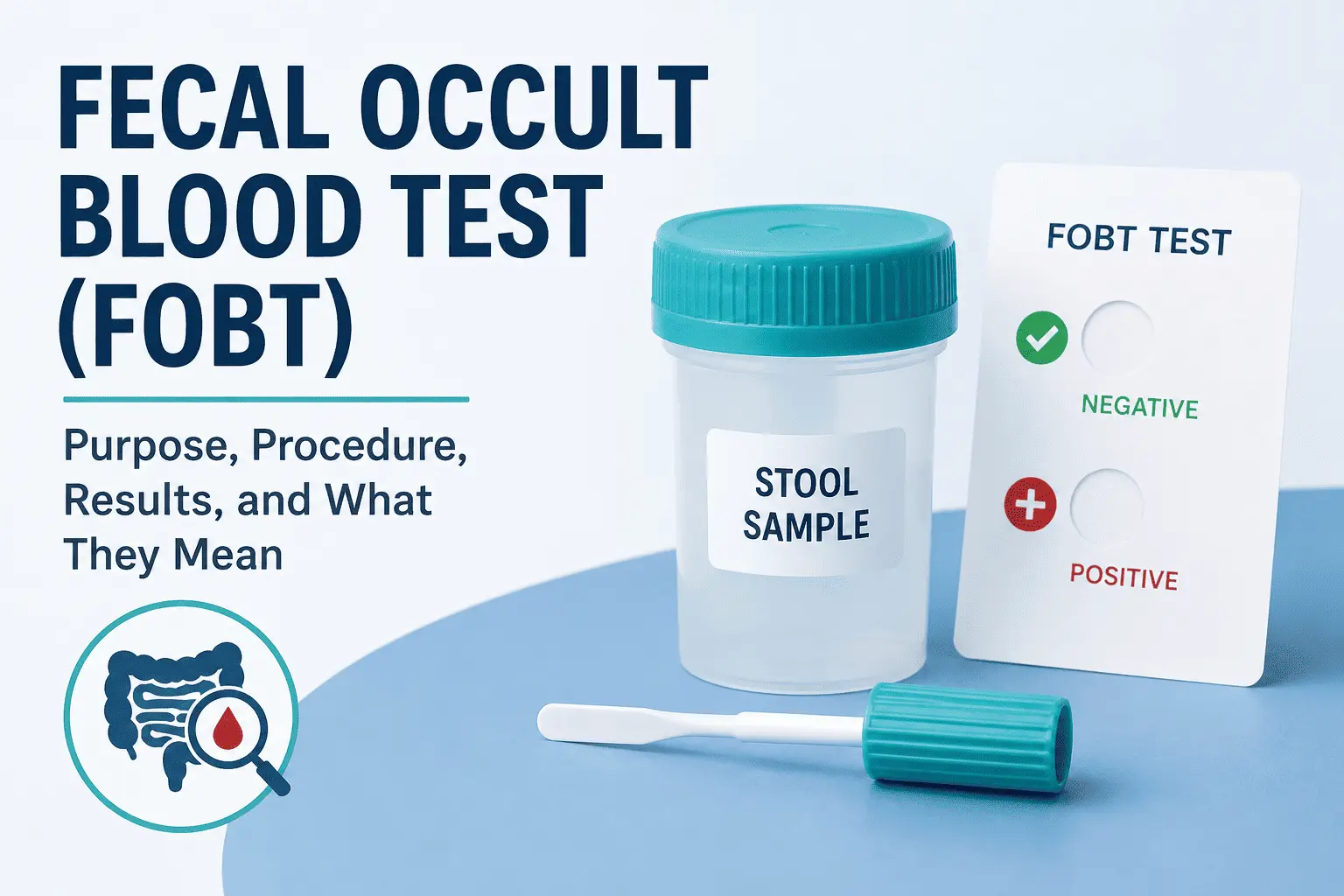
A fecal occult blood test (FOBT) is a simple, non-invasive test that detects hidden (occult) blood in stool. It is commonly used to screen for colorectal cancer and to help identify bleeding in the digestive tract that may not be visible to the naked eye.
Although a positive FOBT does not necessarily mean you have cancer, it indicates that further evaluation may be needed to determine the source of the bleeding. Early detection can play a key role in diagnosing and treating gastrointestinal conditions before they become more serious.
In this article, you’ll learn what a fecal occult blood test is, why it is performed, how to prepare for and complete the test, what the results mean, and its clinical uses, benefits, limitations, and potential risks.
What Is a Fecal Occult Blood Test (FOBT)?
A fecal occult blood test (FOBT) is a screening test used to detect tiny amounts of blood in the stool that cannot be seen with the naked eye. The word occult means “hidden,” referring to blood that is only detectable using specialized laboratory methods.
Healthcare providers commonly use FOBT to screen for colorectal cancer. Because the test is simple, non-invasive, and can often be completed at home, it has become an important tool in preventive healthcare.
Definition and Purpose
The primary purpose of a fecal occult blood test is to identify hidden blood in stool before it becomes noticeable. While blood in the stool does not always indicate a serious condition, it can be an early warning sign of diseases affecting the gastrointestinal (GI) tract.
It is important to remember that an FOBT is a screening test, not a diagnostic test. A positive result means additional testing—usually a colonoscopy—is needed to identify the exact cause of the bleeding.
How the Test Works
The test works by analyzing a small stool sample for microscopic traces of blood that are invisible to the naked eye.
Depending on the type of FOBT used, the test detects blood in different ways:
- Guaiac-based FOBT (gFOBT): Detects the peroxidase activity of hemoglobin, a protein found in red blood cells.
- Fecal immunochemical test (FIT): Uses antibodies that specifically recognize human hemoglobin from the lower gastrointestinal tract.
If blood is detected, the test result is reported as positive. If no blood is found, the result is negative. However, because bleeding can occur intermittently, a negative result does not completely rule out disease.
Types of FOBTs
There are two main types of fecal occult blood tests used in clinical practice.
Guaiac-Based Fecal Occult Blood Test (gFOBT)
The guaiac-based fecal occult blood test (gFOBT) is the traditional form of FOBT. It uses a chemical reaction involving guaiac paper to detect the peroxidase activity of hemoglobin in the stool.
Advantages
- Widely available
- Relatively inexpensive
- Well established for colorectal cancer screening
Limitations
- Requires dietary restrictions before testing
- Certain medications may interfere with results
- Can produce false-positive or false-negative results
- Less specific than FIT
Fecal Immunochemical Test (FIT)
The fecal immunochemical test (FIT) is a newer and more specific stool blood test. It uses antibodies to detect human hemoglobin, making it more accurate for identifying bleeding from the colon and rectum.
Advantages
- No dietary restrictions in most cases
- Higher specificity for lower gastrointestinal bleeding
- Better detection of colorectal cancer and advanced adenomas
- Easier for patients to complete
Limitations
- May miss bleeding originating from the upper digestive tract
- A positive result still requires follow-up with colonoscopy
Today, FIT has largely replaced gFOBT in many colorectal cancer screening programs1 because of its improved accuracy and convenience.
When Is the Test Recommended?
A healthcare provider may recommend an FOBT for routine screening or to investigate possible gastrointestinal bleeding.
Common situations include:
- Routine colorectal cancer screening for adults at average risk
- Evaluation of unexplained iron-deficiency anemia
- Investigation of suspected gastrointestinal bleeding
- Monitoring individuals with an increased risk of colorectal cancer
- Follow-up evaluation when digestive symptoms suggest possible bleeding
How to Prepare for and Perform a Fecal Occult Blood Test
Proper preparation and sample collection are important for obtaining accurate results. The exact instructions may vary depending on whether you are taking a guaiac-based fecal occult blood test (gFOBT) or a fecal immunochemical test (FIT), so always follow the instructions provided with your test kit or by your healthcare provider.
Preparing for the Test
Preparation requirements depend on the type of FOBT being performed.
For Guaiac-Based FOBT (gFOBT)
Certain foods and medications can affect test results. Your healthcare provider may recommend avoiding the following for several days before the test:
- Red meat (such as beef, lamb, and liver)
- Certain raw fruits and vegetables, such as broccoli, cauliflower, radishes, and turnips
- Vitamin C supplements and large amounts of vitamin C-rich foods
- Nonsteroidal anti-inflammatory drugs (NSAIDs), including aspirin and ibuprofen, if medically appropriate
Do not stop taking prescription medications unless your healthcare provider specifically advises you to do so.
For Fecal Immunochemical Test (FIT)
The FIT generally requires little or no special preparation.
In most cases:
- No dietary restrictions are necessary.
- Most medications do not interfere with the test.
- Simply follow the sample collection instructions included with the kit.
Collecting the Stool Sample
Most FOBTs are designed to be completed at home using a stool collection kit.
To collect the sample:
- Collect a stool sample without allowing it to mix with urine or toilet water.
- Use the collection stick or sampling device provided in the kit.
- Place the sample into the collection container or on the test card, as instructed.
- Seal and label the sample if required.
Some gFOBT kits require samples from multiple bowel movements, while many FIT kits require only a single sample.
Sending the Sample to the Laboratory
After collecting the sample:
- Store it according to the instructions provided with the kit.
- Return or mail the sample to the designated laboratory or healthcare facility as soon as possible.
- Make sure all required forms and patient information are included.
Prompt delivery helps ensure the sample remains suitable for testing.
How Long Does It Take to Get Results?
Results are usually available within a few days, although turnaround times vary depending on the laboratory and healthcare provider.
Your healthcare provider will review the results and explain what they mean. If the test is positive, additional testing—most commonly a colonoscopy—is typically recommended to identify the source of the bleeding.
Understanding Fecal Occult Blood Test Results
A fecal occult blood test (FOBT) result is reported as either negative or positive. While the test can detect hidden blood in the stool, it cannot identify the exact source or cause of the bleeding. Your healthcare provider will interpret the results based on your symptoms, medical history, and other risk factors.
What a Negative Result Means
A negative result means that no hidden blood was detected in the stool sample at the time of testing.
In most cases, this suggests there is no active gastrointestinal bleeding. However, a negative result does not completely rule out colorectal cancer or other digestive conditions because:
- Some polyps and cancers do not bleed continuously.
- Bleeding may occur intermittently and be missed during sample collection.
- Very small amounts of blood may not be detected.
If you have persistent symptoms such as unexplained weight loss, or changes in bowel habits, your healthcare provider may recommend additional testing even if your FOBT is negative.
What a Positive Result Means
A positive result means that hidden blood was found in the stool sample.
This does not necessarily mean you have colorectal cancer. Many non-cancerous conditions can also cause bleeding in the digestive tract. A positive result simply indicates that further evaluation is needed to determine the source of the bleeding.
Common Causes of Hidden Blood in Stool
Hidden blood in stool can result from a variety of conditions, including:
- Colorectal cancer
- Colon polyps
- Hemorrhoids
- Inflammatory bowel disease (Crohn’s disease or ulcerative colitis)
- Diverticular disease
- Peptic ulcers
- Gastrointestinal infections
- Anal fissures
Some medications, such as nonsteroidal anti-inflammatory drugs (NSAIDs), may also contribute to gastrointestinal bleeding in some individuals.
False-Positive and False-Negative Results
Although FOBT is a valuable screening tool, no test is perfect.
A false-positive result occurs when the test detects blood even though there is no significant gastrointestinal disease. Possible reasons include:
- Hemorrhoids or anal fissures
- Menstrual blood contamination
- Certain foods or medications (particularly with gFOBT)
- Bleeding from non-cancerous conditions
A false-negative result occurs when hidden bleeding is present but the test does not detect it. This may happen because:
- Bleeding is intermittent.
- The amount of blood is too small to detect.
- The stool sample does not contain blood from the bleeding site.
These limitations are why regular screening and appropriate follow-up are important.
What Happens After a Positive Test?
A positive FOBT usually requires additional testing to identify the cause of the bleeding.
In most cases, the next step is a colonoscopy, which allows the doctor to examine the inside of the colon and rectum. During the procedure, suspicious polyps can often be removed, and tissue samples (biopsies) can be collected if needed.
Depending on the findings and your symptoms, your healthcare provider may recommend further evaluation or treatment. Following up after a positive FOBT is essential, as early diagnosis can improve the outcomes of many gastrointestinal conditions, including colorectal cancer.
FAQs
FOBT is a general term for stool tests that detect hidden blood. FIT is a newer type of FOBT that uses antibodies to detect human blood and is generally more accurate than the traditional guaiac-based FOBT (gFOBT).
For adults at average risk of colorectal cancer, FIT is typically recommended once a year. Follow your healthcare provider’s recommendations based on your age and risk factors.
Yes. Bleeding from hemorrhoids can result in a positive FOBT.
Dietary restrictions are usually required only for the guaiac-based FOBT (gFOBT). FIT generally does not require any dietary changes.
No. A positive result only indicates that blood was detected in the stool. Many non-cancerous conditions can also cause a positive result.
Contact your healthcare provider. A colonoscopy is usually recommended to determine the source of the bleeding.
Yes. Most FOBT kits are designed for convenient home sample collection.
FOBT is an effective screening tool, especially FIT, but it is not 100% accurate and cannot diagnose the cause of bleeding on its own.
Medical Disclaimer: This content is for informational and educational purposes only and does not constitute medical advice. It is not intended to replace professional medical consultation, diagnosis, or treatment. Always seek the advice of a qualified healthcare provider with any questions regarding a medical condition.


, including its purpose, preparation, procedure, results, benefits, limitations, and FAQs.)