

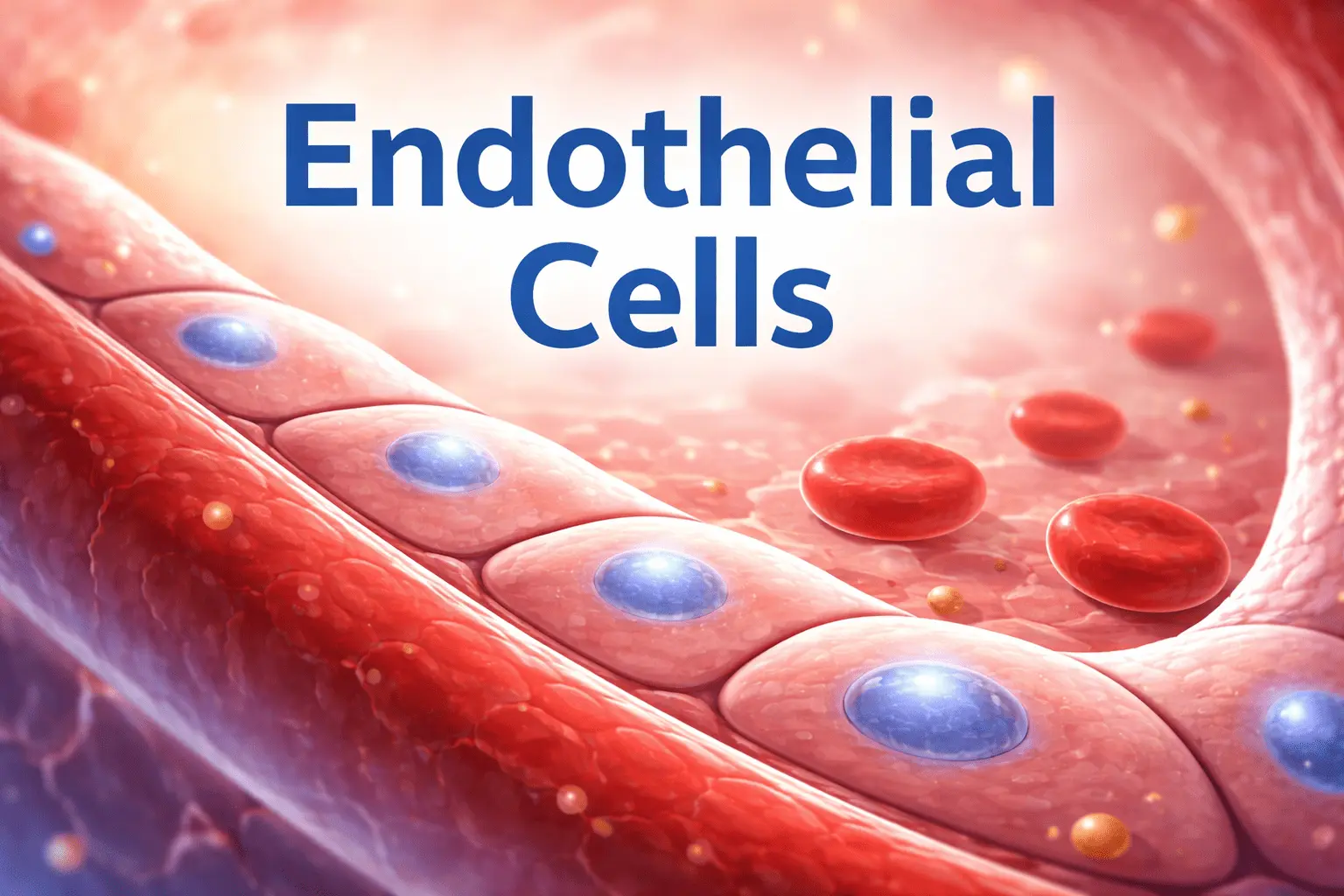
Endothelial cells are highly specialized, squamous cells that form a continuous monolayer lining the interior surface of blood vessels and lymphatic vessels. Although historically considered a passive barrier between blood and tissues, endothelial cells are now recognized as dynamic regulators of vascular homeostasis, tissue perfusion, and microenvironmental balance. Positioned strategically at the interface between circulating blood and underlying tissues, they orchestrate transport, signaling, coagulation, and vascular remodeling.
During embryogenesis, endothelial cells arise from mesoderm-derived angioblasts and assemble into primitive vascular networks through vasculogenesis, followed by angiogenesis-driven expansion. In adult tissues, they remain metabolically active and responsive to mechanical, biochemical, and metabolic cues.
In cancer biology, endothelial cells acquire additional relevance due to their role in tumor angiogenesis, abnormal vascular architecture, and therapy resistance.
This article explores:
- The structural organization of endothelial cells
- Their core cellular functions
- Barrier and transport mechanisms
- Endothelial dysfunction and pathological remodeling
1. Structural Organization of Endothelial Cells
1.1 Morphology and Polarity
Endothelial cells form a simple squamous epithelium-like monolayer lining the vascular lumen. They are extremely thin—sometimes less than 1 μm in thickness—facilitating efficient exchange between blood and tissues. Despite their flattened morphology, they exhibit pronounced cellular polarity:
- Apical (luminal) surface: Faces circulating blood and contains glycocalyx structures that regulate shear stress sensing and molecular interactions.
- Basal surface: Anchored to the basement membrane and interacts with pericytes and extracellular matrix components.
The cytoskeleton, composed of actin filaments, intermediate filaments (vimentin), and microtubules, provides mechanical stability while allowing rapid morphological remodeling in response to shear stress and inflammation.
1.2 Endothelial Junctional Complexes
Intercellular junctions are critical for vascular integrity and barrier function. Endothelial cells possess three principal types of junctions:
- Tight junctions: Composed of claudins, occludin, and junctional adhesion molecules. These regulate paracellular permeability.
- Adherens junctions: Dominated by VE-cadherin, essential for maintaining endothelial cohesion.
- Gap junctions: Formed by connexins, enabling electrical and metabolic communication between adjacent cells.
The dynamic regulation of these junctions determines vascular permeability under physiological and pathological conditions.
1.3 Basement Membrane and Extracellular Matrix
Endothelial cells rest upon a specialized basement membrane composed primarily of:
- Collagen type IV
- Laminin
- Fibronectin
- Heparan sulfate proteoglycans
This matrix not only provides structural support but also acts as a signaling platform influencing survival, differentiation, and migration.
Pericytes, embedded within the basement membrane, interact closely with endothelial cells to stabilize capillaries and regulate vascular maturation.
1.4 Structural Heterogeneity
Endothelial cells exhibit remarkable heterogeneity depending on organ-specific requirements:
- Continuous endothelium: Found in muscle, lung, and brain; characterized by tight junctions and low permeability.
- Fenestrated endothelium: Present in kidney glomeruli and endocrine glands; contains pores (fenestrae) to facilitate filtration.
- Sinusoidal (discontinuous) endothelium: Located in liver and bone marrow; highly permeable with large intercellular gaps.
This structural diversity underlies functional specialization across vascular beds.
2. Core Cellular Functions of Endothelial Cells
2.1 Regulation of Vascular Tone
Endothelial cells actively regulate vessel diameter by secreting vasoactive molecules.
- Nitric oxide (NO): A potent vasodilator synthesized by endothelial nitric oxide synthase (eNOS). NO diffuses to smooth muscle cells, activating guanylate cyclase and inducing relaxation.
- Endothelin-1: A powerful vasoconstrictor peptide.
The balance between these opposing factors maintains vascular tone and systemic blood pressure.
Shear stress from blood flow is a major regulator of NO production, demonstrating how mechanical signals are translated into biochemical responses.
2.2 Control of Hemostasis
Under physiological conditions, endothelial cells maintain an anti-thrombotic surface by:
- Expressing anticoagulant molecules (e.g., thrombomodulin)
- Producing prostacyclin (PGI2)
- Limiting platelet adhesion
Upon injury, endothelial cells shift toward a pro-thrombotic phenotype, exposing subendothelial matrix and expressing adhesion molecules that promote clot formation. This dual capacity ensures rapid response to vascular damage while preventing inappropriate thrombosis.
2.3 Angiogenesis and Vascular Remodeling
Angiogenesis—the formation of new blood vessels from pre-existing ones—is driven by endothelial activation.
Key steps include:
- Endothelial cell activation by growth factors
- Degradation of basement membrane
- Migration and proliferation
- Tube formation and lumen development
Angiogenesis is essential during embryonic development, wound healing, and menstrual cycling. However, dysregulated angiogenesis contributes to tumor progression, where abnormal endothelial proliferation generates disorganized and leaky vessels.
2.4 Endocrine and Paracrine Functions
Beyond structural and mechanical roles, endothelial cells function as endocrine-like cells. They secrete:
- Growth factors
- Cytokines and Chemokines
- Adhesion molecules
These mediators influence smooth muscle cells, fibroblasts, and surrounding stromal cells. Through this signaling network, endothelial cells coordinate tissue repair and vascular adaptation.
3. Barrier Function and Molecular Transport Mechanisms
3.1 Selective Permeability
One of the defining features of endothelial cells is their role as a semipermeable barrier. They regulate:
- Fluid exchange
- Nutrient delivery
- Waste removal
Fluid movement across the endothelium is governed by hydrostatic and oncotic pressures (Starling forces), ensuring balanced tissue hydration.
3.2 Paracellular Transport
Paracellular transport occurs between adjacent endothelial cells and is tightly controlled by junctional complexes.
During inflammation, cytokine signaling induces junctional remodeling, increasing permeability. This allows plasma proteins and immune cells to access affected tissues.
Dynamic control of tight and adherens junctions ensures reversible permeability changes rather than permanent barrier disruption.
3.3 Transcellular Transport
Transcellular transport occurs through vesicular mechanisms:
- Caveolae-mediated transcytosis
- Receptor-mediated transport
- Vesicular trafficking across the cytoplasm
Caveolae are flask-shaped membrane invaginations enriched in caveolin proteins. They facilitate albumin transport and macromolecule trafficking across the endothelial layer.
This mechanism is particularly important in tissues requiring controlled macromolecular exchange.
3.4 Specialized Barriers
Certain vascular beds exhibit enhanced barrier specialization.
The blood-brain barrier, for example, consists of endothelial cells with extremely tight junctions, minimal transcytosis, and strong pericyte support. This ensures neural protection by limiting toxin entry.
Organ-specific permeability differences reflect functional adaptation rather than uniform structure.
4. Endothelial Dysfunction and Cellular Remodeling
4.1 Oxidative Stress and Inflammation
Endothelial dysfunction often begins with oxidative stress. Excess reactive oxygen species (ROS):
- Reduce nitric oxide bioavailability
- Promote inflammation
- Increase vascular permeability
Chronic oxidative stress contributes to vascular diseases, including atherosclerosis and hypertension.
4.2 Endothelial-to-Mesenchymal Transition (EndMT)
Endothelial-to-mesenchymal transition (EndMT) is a phenotypic shift where endothelial cells lose junctional proteins and acquire mesenchymal characteristics.
Features include:
- Reduced VE-cadherin expression
- Increased migratory capacity
- Extracellular matrix production
EndMT contributes to fibrosis, vascular stiffening, and pathological remodeling.
4.3 Endothelial Cells in the Tumor Microenvironment
In tumors, endothelial cells form structurally abnormal vasculature characterized by:
- Irregular branching
- Poor pericyte coverage
- Increased leakiness
These defects result in hypoxia, heterogeneous drug delivery, and therapy resistance.
Tumor-associated endothelial cells also display altered metabolic and signaling profiles, further promoting tumor progression.
Conclusion
Endothelial cells are far more than passive vessel lining cells. They are structurally specialized, metabolically active regulators of vascular homeostasis. Through precise control of permeability, vascular tone, coagulation, and angiogenesis, they maintain systemic equilibrium.
Their remarkable heterogeneity allows adaptation to organ-specific demands, while their dynamic plasticity enables rapid responses to injury and stress. However, when dysregulated, endothelial cells contribute to vascular disease, fibrosis, and tumor progression.
References
Textbooks
- Alberts, B., Johnson, A., Lewis, J., Morgan, D., Raff, M., Roberts, K., & Walter, P. (2022). Molecular Biology of the Cell (7th ed.). Garland Science.
- Ross, M. H., & Pawlina, W. (2020). Histology: A Text and Atlas (8th ed.). Wolters Kluwer.
- Junqueira, L. C., & Carneiro, J. (2021). Junqueira’s Basic Histology: Text & Atlas (16th ed.). McGraw-Hill Education.
- Mescher, A. L. (2021). Junqueira’s Basic Histology (16th ed.). McGraw-Hill Education.
- Kumar, V., Abbas, A. K., & Aster, J. C. (2021). Robbins & Cotran Pathologic Basis of Disease (10th ed.). Elsevier.
Review Articles
- Aird, W. C. (2007). Phenotypic heterogeneity of the endothelium: I. Structure, function, and mechanisms. Circulation Research, 100(2), 158–173. https://doi.org/10.1161/01.RES.0000255691.76142.4a
- Potente, M., Gerhardt, H., & Carmeliet, P. (2011). Basic and therapeutic aspects of angiogenesis. Cell, 146(6), 873–887. https://doi.org/10.1016/j.cell.2011.08.039
- Pober, J. S., & Sessa, W. C. (2007). Evolving functions of endothelial cells in inflammation. Nature Reviews Immunology, 7(10), 803–815. https://doi.org/10.1038/nri2171
- Dejana, E., Tournier-Lasserve, E., & Weinstein, B. M. (2009). The control of vascular integrity by endothelial cell junctions. Developmental Cell, 16(2), 209–221. https://doi.org/10.1016/j.devcel.2009.01.004
- Carmeliet, P., & Jain, R. K. (2011). Molecular mechanisms and clinical applications of angiogenesis. Nature, 473(7347), 298–307. https://doi.org/10.1038/nature10144
Endothelial cells are specialized cells that form a single-cell layer lining the interior surface of blood and lymphatic vessels, regulating vascular tone, permeability, and blood flow.
Endothelial progenitor cells (EPCs) are circulating stem-like cells derived mainly from the bone marrow that contribute to vascular repair and new blood vessel formation (angiogenesis).
No, endothelial cells are not epithelial cells. Although both form protective linings, endothelial cells line blood vessels and originate from mesoderm, whereas epithelial cells cover body surfaces and cavities.
Endothelial function regulates vascular homeostasis by controlling vasodilation, inflammation, coagulation, permeability, and angiogenesis.
Endothelial cell damage can be caused by oxidative stress, chronic inflammation, high blood pressure, diabetes, smoking, and elevated cholesterol levels.


