

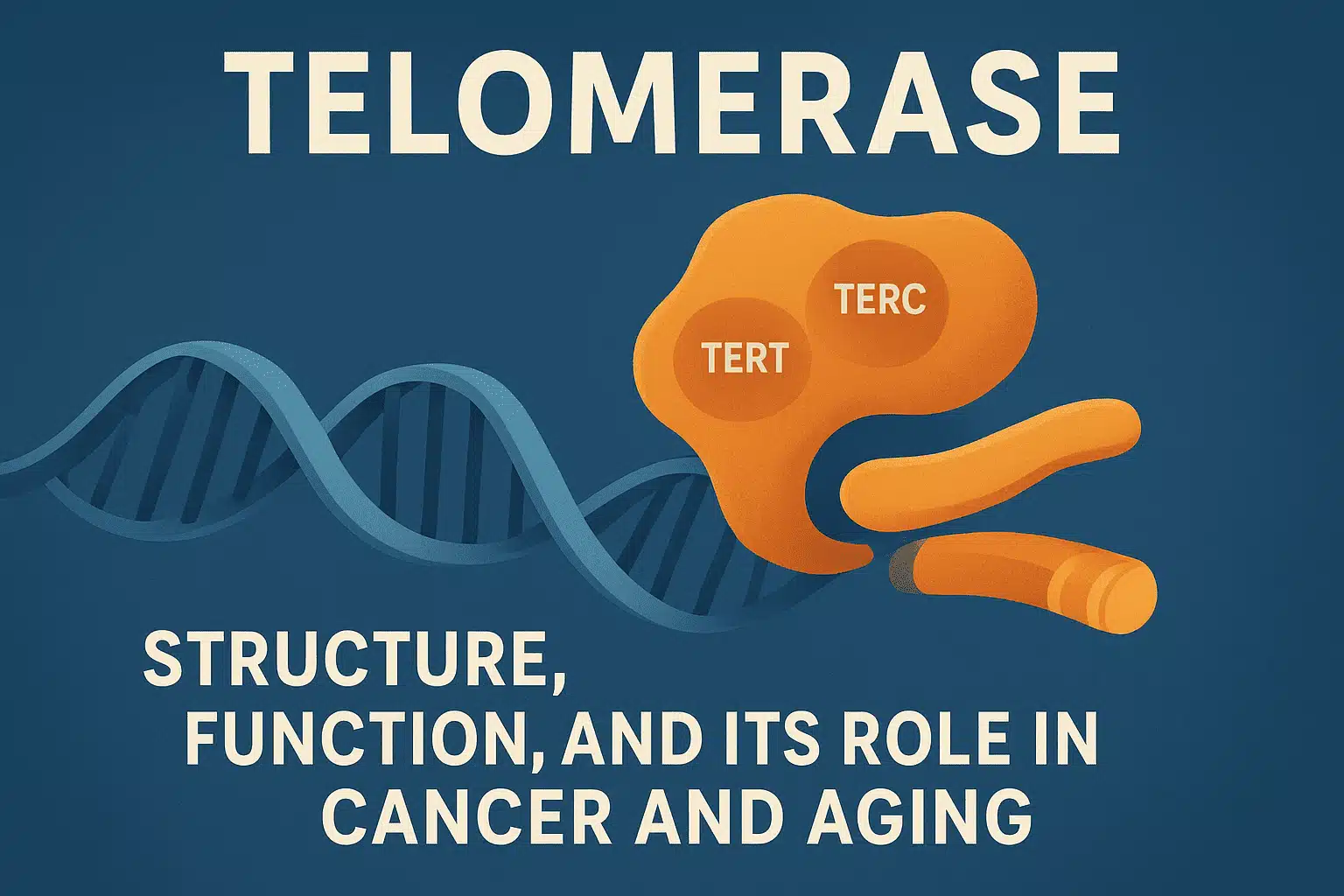
Telomerase is a specialized enzyme that maintains the length of telomeres—the protective caps at the ends of chromosomes. By adding repetitive DNA sequences, telomerase prevents telomere shortening during cell division, ensuring chromosomal stability and extended cellular lifespan. While essential in germ cells and stem cells, abnormal telomerase activation in cancer cells contributes to uncontrolled growth and cellular immortality.
In this article, we’ll explore the structure, function, and mechanism of telomerase, its role in aging and cancer, and the therapeutic strategies being developed to target or harness this powerful enzyme.
What Are Telomeres?
Definition and Structure of Telomeres
Telomeres are specialized nucleoprotein structures found at the ends of linear chromosomes. They consist of repetitive DNA sequences (TTAGGG in humans) bound to specific protective proteins. Together, these components form a cap that safeguards chromosome ends from degradation, fusion, or recognition as broken DNA strands.
Each telomere is associated with a group of proteins known as the shelterin complex, which includes TRF1, TRF2, POT1, TIN2, TPP1, and RAP1. This complex stabilizes telomere structure and regulates access of enzymes, such as telomerase, to chromosome ends.
Structurally, telomeres form a T-loop configuration, where the single-stranded overhang folds back and invades the double-stranded region, effectively hiding the chromosome terminus from the DNA damage response machinery.
The End-Replication Problem
During DNA replication, the DNA polymerase enzyme can only synthesize new DNA in one direction (5′→3′) and requires an RNA primer to initiate synthesis. On the lagging strand, once the final RNA primer is removed, there is no way to fill in the resulting gap at the chromosome’s end.
This limitation, known as the end-replication problem, causes a small portion of telomeric DNA to be lost during each cell division. Over time, this progressive shortening leads to critically short telomeres, triggering cellular aging or programmed cell death.
Telomere Shortening and Cellular Aging
Telomere length is a key determinant of a cell’s replicative potential. In somatic cells, which lack active telomerase, telomeres shorten with each division, eventually reaching a critical threshold that halts further replication—a phenomenon described as the Hayflick limit.
Shortened telomeres activate DNA damage signaling pathways involving p53 and p21, leading to cellular senescence or apoptosis. This process is thought to contribute to tissue aging, reduced regenerative capacity, and increased susceptibility to age-related diseases.
In contrast, cells that maintain telomerase activity—such as germ cells, stem cells, and certain immune cells—can preserve their telomere length, allowing continuous division and regeneration.
Biological Functions of Telomeres
Telomeres perform several vital functions within the cell:
- Protect chromosome ends from being recognized as DNA breaks.
- Prevent chromosomal fusions and rearrangements, maintaining genomic stability.
- Regulate cellular lifespan by acting as a molecular clock that limits the number of cell divisions.
- Facilitate proper chromosome replication by providing a buffer zone of noncoding DNA that absorbs replication-related loss.
Telomeres and Disease
Abnormal telomere maintenance is linked to a range of human diseases. Excessive telomere shortening is associated with premature aging syndromes (such as dyskeratosis congenita) and degenerative disorders. Conversely, inappropriate activation of telomere maintenance mechanisms—especially through telomerase reactivation—is a hallmark of cancer, granting tumor cells unlimited replicative potential.
Thus, understanding the structure and dynamics of telomeres provides crucial insight into the balance between cellular aging, genomic stability, and tumorigenesis.
What Is Telomerase?
Definition and Discovery
Telomerase is a specialized ribonucleoprotein enzyme that extends the ends of chromosomes by adding repetitive DNA sequences to telomeres. Its primary function is to counteract telomere shortening that occurs during DNA replication, ensuring chromosome stability and prolonged cellular lifespan.
The enzyme was discovered in 1985 by Carol Greider and Elizabeth Blackburn, who identified its activity in Tetrahymena thermophila, a single-celled protozoan. Their groundbreaking discovery revealed that telomere length is not fixed but can be actively maintained by a cellular enzyme—an insight that revolutionized molecular and cancer biology.
Composition and Structure of Telomerase
Telomerase functions as a multi-component ribonucleoprotein complex composed of both RNA and protein subunits, each playing a distinct role in telomere synthesis and stabilization.
- Telomerase Reverse Transcriptase (TERT):
- The catalytic protein subunit of telomerase, responsible for synthesizing new DNA sequences at chromosome ends.
- It exhibits reverse transcriptase activity, using RNA as a template to produce DNA.
- Contains several domains, including the RNA-binding domain, reverse transcriptase domain, and C-terminal extension for catalytic function.
- Telomerase RNA Component (TERC):
- Acts as the template for telomere elongation by providing the RNA sequence complementary to the telomeric DNA repeat (in humans: 5′-CUAACCCUAAC-3′).
- Serves as a structural scaffold for assembling the telomerase complex.
- Accessory Proteins:
- Include dyskerin (DKC1), NOP10, GAR1, and NHP2, which stabilize the RNA component and assist in the assembly and localization of telomerase to telomeres.
- The enzyme interacts with the shelterin complex (TRF1, TRF2, POT1, TIN2, TPP1, RAP1), which protects telomeres and regulates telomerase access to chromosome ends.
Mechanism of Action
Telomerase functions as a reverse transcriptase, meaning it synthesizes DNA from an RNA template. The process can be summarized as follows:
- Binding: Telomerase binds to the single-stranded overhang of the telomere.
- Extension: Using its RNA template (TERC), telomerase extends the telomere by adding DNA repeats (TTAGGG in humans) to the 3′ end.
- Translocation: The enzyme then shifts position along the telomere and repeats the process multiple times, progressively elongating the chromosome end.
- Completion: After extension, conventional DNA polymerases fill in the complementary strand, restoring telomere length.
Through this mechanism, telomerase maintains telomere integrity, allowing cells to bypass the replication limit imposed by the end-replication problem.
Regulation of Telomerase Activity
Telomerase expression and activity are tightly regulated in human cells.
- In somatic cells, telomerase is typically repressed, leading to gradual telomere shortening.
- In contrast, germ cells, stem cells, and certain immune cells express telomerase at low to moderate levels to sustain long-term proliferation.
- In cancer cells, telomerase becomes aberrantly reactivated, enabling uncontrolled division and contributing to cellular immortality.
Key regulators include transcription factors like c-Myc, Sp1, and estrogen receptor α, which can activate the hTERT promoter. Epigenetic mechanisms such as DNA methylation and histone modification also influence telomerase expression.
Biological Significance
Telomerase is essential for:
- Maintaining chromosomal stability and preventing end-to-end fusions.
- Preserving cellular renewal capacity in stem and germ cells.
- Enabling tumor progression through reactivation in cancer cells.
Its dual nature—supporting normal tissue regeneration while promoting tumor cell immortality—makes telomerase a central player in both aging and cancer biology.
Structure and Components of Telomerase
Overview
The telomerase enzyme is a large ribonucleoprotein complex (RNP) composed of RNA and protein subunits that work together to elongate chromosome ends. Its unique structure allows it to function as a reverse transcriptase, synthesizing telomeric DNA using its own RNA as a template. Understanding its molecular composition is essential to grasp how telomerase maintains telomere length and contributes to cellular immortality.
1. Telomerase Reverse Transcriptase (TERT) — The Catalytic Core
The telomerase reverse transcriptase (TERT) subunit is the catalytic engine of the enzyme. It is responsible for the synthesis of telomeric DNA repeats and defines the enzymatic activity of telomerase.
Structure and Domains of TERT:
TERT is a multi-domain protein consisting of several functionally distinct regions:
- TEN Domain (Telomerase Essential N-terminal domain): Facilitates the binding of telomerase to the single-stranded DNA overhang at the chromosome end.
- TRBD (Telomerase RNA-Binding Domain): Anchors the telomerase RNA component (TERC) and positions the RNA template for DNA synthesis.
- RT Domain (Reverse Transcriptase Domain): Contains conserved motifs common to all reverse transcriptases, including the catalytic aspartate residues responsible for nucleotide addition.
- CTE (C-terminal Extension): Contributes to enzyme stability and the proper folding of the catalytic core.
Collectively, these domains enable telomerase to perform its specialized function—adding DNA repeats to telomeres with high fidelity.
2. Telomerase RNA Component (TERC) — The Template and Scaffold
The telomerase RNA component (TERC), also known as hTR in humans, is a non-coding RNA molecule of approximately 450 nucleotides. It serves two critical functions:
- Template Function: Provides the RNA sequence complementary to the telomeric DNA repeat (5′-CUAACCCUAAC-3′ in humans), guiding the addition of TTAGGG repeats to chromosome ends.
- Structural Role: Acts as a scaffold for assembling the telomerase complex, positioning the TERT catalytic subunit and associated proteins for efficient elongation.
TERC is stabilized by multiple accessory proteins, ensuring its proper folding and localization within the Cajal bodies—nuclear domains where telomerase assembly occurs.
3. Accessory Proteins — The Assembly and Stability Factors
Telomerase activity and stability depend on several core proteins that associate with TERC and TERT:
- Dyskerin (DKC1): A core component that binds and stabilizes TERC, protecting it from degradation. Mutations in dyskerin are associated with dyskeratosis congenita, a disorder characterized by defective telomere maintenance.
- NOP10, NHP2, and GAR1: Form a complex with dyskerin, assisting in RNA maturation and telomerase assembly.
- TCAB1 (Telomerase Cajal Body Protein 1): Directs telomerase to Cajal bodies for maturation and to telomeres during the S phase of the cell cycle.
These proteins ensure that telomerase is properly assembled, localized, and functionally active at chromosome ends.
4. The Shelterin Complex — The Telomere Guardian
Although not a direct component of telomerase, the shelterin complex plays a vital regulatory role in telomerase function. It binds specifically to telomeric DNA and protects chromosome ends from unwanted DNA repair activities.
The shelterin complex includes:
- TRF1 (Telomeric Repeat-Binding Factor 1) and TRF2: Bind to double-stranded telomeric DNA.
- POT1 (Protection of Telomeres 1): Binds to the single-stranded 3′ overhang.
- TPP1 and TIN2: Act as bridging factors linking POT1 to TRF1 and TRF2, stabilizing the entire structure.
- RAP1: Regulates telomere length and contributes to telomere protection.
Among these, TPP1 directly interacts with telomerase, recruiting it to telomeres and enhancing its processivity—the ability to add multiple DNA repeats during a single binding event.
5. Holoenzyme Organization and Function
Together, TERT, TERC, and the accessory proteins form the telomerase holoenzyme, a functional unit that operates in coordination with the shelterin complex.
- Assembly: Occurs in the nucleus, particularly within Cajal bodies.
- Activation: Triggered during the S phase of the cell cycle when DNA replication takes place.
- Recruitment: The enzyme is guided to telomeres through interactions between TPP1 (shelterin) and TERT.
Once bound to a telomere, telomerase extends the 3′ overhang by reverse transcribing new DNA repeats, thereby counteracting the natural shortening that accompanies each cell division. Summar
Mechanism of Telomerase Action
The activity of telomerase is a finely tuned molecular process that ensures the maintenance and elongation of chromosomal ends — the telomeres. Understanding its mechanism is essential to appreciate how cells maintain genetic stability and how telomerase reactivation contributes to cancer progression.
1. Telomere Shortening During DNA Replication
Each time a cell divides, the DNA replication machinery cannot fully replicate the very ends of linear chromosomes. This limitation, known as the end-replication problem, causes telomeres to gradually shorten with every cell cycle.
Without a compensatory mechanism, this shortening eventually triggers replicative senescence, a state where cells stop dividing.
Telomerase counters this by adding telomeric repeats (TTAGGG in humans) to the 3′ end of the lagging strand, restoring lost sequences and preserving chromosomal integrity.
2. Binding of Telomerase to the Telomere
The process begins when the telomerase complex recognizes and binds to the 3′ single-stranded overhang of the telomere.
Specific telomere-binding proteins, such as those in the shelterin complex (TRF1, TRF2, POT1, TPP1, TIN2, RAP1), help recruit and regulate telomerase access to telomeric DNA.
This interaction ensures that telomerase acts only when needed and avoids uncontrolled elongation.
3. Reverse Transcription of Telomeric Repeats
Telomerase functions as a reverse transcriptase enzyme. Using its internal RNA component (TERC) as a template, the TERT catalytic subunit adds complementary DNA repeats (TTAGGG) to the 3′ end of the telomere.
This process involves the following steps:
- Primer binding – the 3′ overhang of telomeric DNA aligns with the RNA template in TERC.
- Extension – TERT synthesizes new DNA repeats complementary to the RNA sequence.
- Translocation – after one repeat is added, the enzyme shifts along the DNA to add another, allowing continuous elongation.
4. Completion and Capping of the Telomere
Once sufficient repeats are added, telomerase dissociates from the DNA.
The telomere is then re-capped by the shelterin complex, which protects the end from being recognized as a DNA break. This prevents unwanted repair processes like end-to-end chromosomal fusion or DNA damage signaling.
5. Regulation of Telomerase Activity
Telomerase activity is tightly controlled at multiple levels:
- Transcriptional regulation – TERT expression is the primary control point, as it is silenced in most somatic cells.
- Post-translational modifications – phosphorylation and ubiquitination influence TERT stability and localization.
- Protein–protein interactions – associations with chaperones and shelterin components modulate enzyme activation.
Such regulation ensures that telomerase is active only in cells that require long-term proliferation, such as stem cells, germline cells, and certain immune cells, while remaining silent in most somatic tissues.
Regulation of Telomerase Activity in Normal vs. Cancer Cells
The activity of telomerase is a critical determinant of cellular lifespan. While it ensures chromosome stability and long-term proliferation in specific cell types, its dysregulation can lead to uncontrolled cell growth and tumor formation. Understanding how telomerase is regulated differently in normal and cancer cells provides key insights into both aging and oncogenesis.
1. Telomerase Regulation in Normal Cells
In most somatic cells, telomerase activity is repressed after embryonic development. These cells rely on a finite number of divisions before telomere shortening triggers replicative senescence — a natural mechanism to prevent uncontrolled proliferation.
Transcriptional Control of TERT
The TERT gene, which encodes the catalytic subunit of telomerase, is the main point of regulation. Its promoter is tightly silenced by:
- Epigenetic modifications such as DNA methylation and histone deacetylation.
- Transcriptional repressors including p53, Mad1, and Menin.
As a result, mature somatic cells express little to no TERT, rendering telomerase inactive.
Post-Transcriptional and Post-Translational Regulation
Even when TERT mRNA is present, additional layers of control affect its stability and localization:
- Alternative splicing can generate non-functional variants of TERT.
- Phosphorylation and ubiquitination influence enzyme stability and nuclear import.
Together, these mechanisms ensure that telomerase is active only in cells where regeneration or long-term division is essential, such as:
- Stem cells (to maintain tissue renewal),
- Germline cells (to ensure fertility),
- Activated lymphocytes (for immune response).
2. Deregulation of Telomerase in Cancer Cells
Unlike normal cells, cancer cells reactivate telomerase, granting them replicative immortality — one of the hallmarks of cancer.
TERT Promoter Mutations
One of the most frequent mechanisms in cancer is the appearance of TERT promoter mutations. These mutations create new binding sites for transcription factors (like ETS/TCF), leading to increased TERT expression and persistent telomerase activation.
These mutations are particularly common in:
- Melanoma,
- Glioblastoma,
- Bladder cancer,
- Hepatocellular carcinoma.
Epigenetic Reactivation
In many tumors, TERT promoter hypermethylation paradoxically enhances transcription, protecting it from repressor binding.
Furthermore, histone acetylation opens chromatin structure, making TERT more accessible to activators like c-Myc.
Oncogenic Signaling Pathways
Several cancer-related pathways stimulate telomerase activation:
- c-Myc directly upregulates TERT transcription.
- PI3K/AKT and MAPK pathways stabilize TERT protein and promote its nuclear localization.
- Wnt/β-catenin signaling enhances TERT promoter activity.
These oncogenic signals integrate to maintain persistent telomerase activity, allowing tumor cells to divide indefinitely.
3. Functional Consequences of Dysregulated Telomerase
In cancer, sustained telomerase activity leads to:
- Unlimited cell division and bypass of senescence,
- Enhanced DNA repair and stress resistance,
- Chromosomal stability, reducing lethal telomere fusions,
- Resistance to apoptosis, contributing to therapy resistance.
However, this immortality comes at the cost of genomic instability and tumor aggressiveness, making telomerase an attractive target for anticancer therapies.
4. Telomerase in Aging vs. Cancer: A Biological Paradox
Telomerase embodies a biological paradox:
- In aging, low telomerase activity contributes to tissue degeneration and cellular senescence.
- In cancer, excessive telomerase activity drives malignant transformation and immortality.
Thus, telomerase must be precisely balanced—too little leads to premature aging, and too much results in cancer.
Summary
In summary, normal cells tightly suppress telomerase to prevent uncontrolled growth, while cancer cells reawaken it to achieve immortality. The reactivation mechanisms—through promoter mutations, epigenetic changes, and oncogenic pathways—make telomerase both a biomarker and a therapeutic target in oncology.
FAQ
1. What is the main function of telomerase?
Telomerase adds DNA repeats to chromosome ends (telomeres), preventing their shortening during cell division.
2. Why is telomerase active in cancer cells?
Cancer cells reactivate telomerase to maintain telomere length, allowing unlimited cell divisions.
3. Can telomerase be used to treat aging?
Potentially, but activating telomerase could increase cancer risk — it requires precise control.
4. What are telomerase inhibitors?
They are drugs that block telomerase activity to limit cancer cell growth, such as imetelstat.
5. What cells naturally express telomerase?
Germ cells, stem cells, and certain immune cells naturally have active telomerase.


