

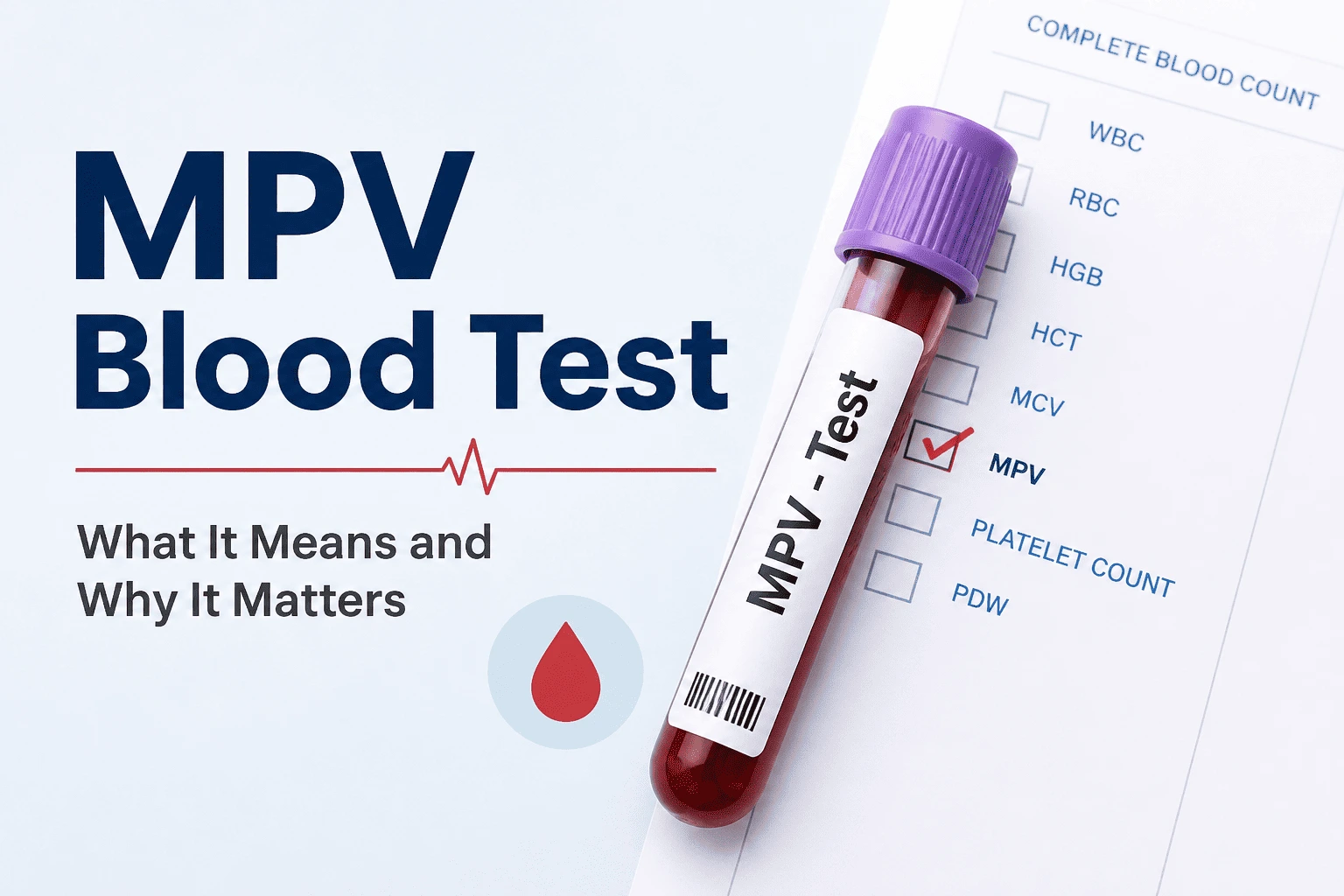
The MPV blood test is a common laboratory measurement that provides important insight into your overall health, particularly your blood’s ability to clot. MPV stands for Mean Platelet Volume, which refers to the average size of your platelets—tiny blood cells that play a crucial role in stopping bleeding and maintaining vascular integrity.
Doctors often include the MPV value as part of a routine complete blood count (CBC), making it a quick and accessible way to assess platelet function. While it may seem like a small detail, changes in MPV levels can help detect a wide range of conditions, from bleeding disorders to inflammatory diseases and even cardiovascular risks.
In this article, you’ll learn what the MPV blood test measures, its normal range, and what high or low values might indicate.
What Is an MPV Blood Test?
The MPV blood test measures the average size of platelets in your bloodstream. MPV stands for Mean Platelet Volume, and it is an important parameter reported as part of a complete blood count (CBC).
Platelets, also known as thrombocytes, are small cell fragments produced in the bone marrow. Their primary function is to help stop bleeding by forming clots when blood vessels are injured. However, not all platelets are the same size—some are larger and more active, while others are smaller and less reactive.
This is where the MPV blood test becomes useful. It provides insight into platelet production and activity:
- Higher MPV indicates larger, younger platelets that are typically more active
- Lower MPV suggests smaller, older platelets that may be less functional
By evaluating platelet size, the MPV blood test can help doctors understand how well your bone marrow is producing platelets and whether your body is responding to certain conditions, such as inflammation or platelet destruction.
It’s important to note that MPV is not interpreted alone. Healthcare providers usually assess it alongside the platelet count and other blood parameters to get a complete picture of your health.
Why Is the MPV Blood Test Done?
Since platelets play a key role in blood clotting, changes in their size can help identify underlying health issues.
Common reasons for an MPV blood test include:
1. Diagnosing bleeding disorders
If you experience frequent nosebleeds, easy bruising, or prolonged bleeding, MPV can help determine whether platelet abnormalities are involved.
2. Evaluating clotting problems
Abnormal platelet activity may increase the risk of unwanted blood clots, which can lead to serious conditions like thrombosis.
3. Assessing bone marrow function
Since platelets are produced in the bone marrow, MPV can provide insight into whether platelet production is normal, increased, or decreased.
4. Detecting inflammatory conditions
Inflammation can affect platelet size and activity. MPV is sometimes used as an indirect marker in inflammatory diseases.
5. Monitoring existing medical conditions
Doctors may track MPV levels over time in patients with chronic diseases to evaluate progression or response to treatment.
6. Part of routine health screening
Because it is included in a CBC test, MPV is often checked even when there are no specific symptoms, helping detect issues early.
Normal MPV Blood Test Range
The MPV blood test range refers to the typical values of Mean Platelet Volume found in healthy individuals. MPV is measured in femtoliters (fL), which indicates the average size of platelets in your blood.
What is a normal MPV value?
In most laboratories, the normal MPV range is approximately:
- 7.5 to 11.5 fL
However, this range is not universal. It can vary slightly depending on:
- The laboratory equipment used
- Testing methods
- Population differences
For this reason, it’s always important to compare your result with the reference range provided on your lab report.
How to interpret MPV results
A normal MPV value generally indicates that platelet production and function are within a healthy range. But interpretation should never rely on MPV alone.
Doctors usually consider:
- Platelet count
- Other complete blood count (CBC) parameters
- Clinical symptoms and medical history
For example:
- A normal MPV with an abnormal platelet count may still require further investigation
- MPV values at the high or low end of normal may have clinical significance depending on the context
What Does a High MPV Mean?
A high MPV blood test result indicates that your platelets are, on average, larger than normal. Larger platelets are typically younger and more active, which may suggest that your body is producing and releasing platelets rapidly—often in response to increased demand or platelet loss.
What causes a high MPV?
Several conditions and factors can lead to elevated MPV levels, including:
1. Increased platelet destruction
When platelets are destroyed faster than normal, the bone marrow compensates by producing new, larger platelets. This can occur in conditions like thrombocytopenia.
2. Cardiovascular diseases
High MPV has been associated with an increased risk of heart disease and clot formation, as larger platelets are more prone to aggregation.
3. Inflammatory conditions
Chronic inflammation can stimulate platelet production, leading to an increase in MPV.
4. Vitamin deficiencies
Deficiencies in vitamin B12 or folate may affect platelet production and size.
5. Bone marrow activity
An overactive bone marrow may release larger, immature platelets into circulation.
Should you be concerned about high MPV?
A high MPV does not automatically mean there is a serious problem. Its significance depends on:
- Your platelet count
- Other blood test results
- Your symptoms and medical history
For example:
- High MPV + low platelet count may suggest increased platelet destruction
- High MPV + normal platelet count may simply reflect temporary changes
What Does a Low MPV Mean?
A low MPV blood test result means that your platelets are, on average, smaller than normal. Smaller platelets are typically older and less active, which may indicate reduced platelet production or a slower turnover rate in the body.
What causes a low MPV?
Several conditions and factors can lead to decreased MPV levels, including:
1. Reduced platelet production
When the bone marrow is not producing enough new platelets, the circulating platelets tend to be smaller and older.
2. Bone marrow disorders
Certain conditions affecting the bone marrow can impair platelet formation, leading to low MPV.
3. Chronic diseases
Long-term illnesses may influence platelet production and size.
4. Infections
Some infections can temporarily suppress bone marrow activity, resulting in smaller platelets.
5. Certain medications
Drugs that affect bone marrow function or platelet production may lower MPV.
Should you be concerned about low MPV?
A low MPV is not always a cause for concern, especially if other blood parameters are normal. Its interpretation depends on:
- Platelet count
- Other complete blood count (CBC) values
- Clinical symptoms
For example:
- Low MPV + low platelet count may suggest decreased production in the bone marrow
- Low MPV + normal platelet count may not be clinically significant
MPV Blood Test and Platelet Count Relationship
The MPV blood test is most useful when interpreted together with the platelet count. While MPV tells you the average size of platelets, the platelet count shows how many platelets are present in your blood. Looking at both values together provides a clearer picture of platelet production, destruction, and overall function.
Platelet size and number are closely linked to how your body regulates clotting. When one value changes, the other often helps explain why.
Common MPV and platelet count patterns
1. High MPV + Low Platelet Count
- Suggests increased platelet destruction or consumption
- The bone marrow responds by releasing larger, younger platelets
- Seen in conditions like immune thrombocytopenia
2. Low MPV + Low Platelet Count
- Indicates reduced platelet production
- Bone marrow may not be producing enough new platelets
- Can be associated with bone marrow disorders or suppression
3. High MPV + Normal Platelet Count
- May reflect increased platelet turnover
- Could be a temporary response to stress, inflammation, or recovery from platelet loss
4. Low MPV + Normal Platelet Count
- Often not clinically significant
- May occur without any underlying disease
How to Prepare for an MPV Blood Test
Preparing for an MPV blood test is usually simple, as this test does not require special preparation in most cases. It is commonly performed as part of a routine complete blood count (CBC).
Do you need to fast?
- Fasting is typically not required for an MPV blood test alone
- However, if your doctor orders additional tests (such as glucose or lipid levels), you may be asked to fast for 8–12 hours
Medications and supplements
Some medications and supplements can affect platelet size or function. You should:
- Inform your doctor about any prescription or over-the-counter medications
- Mention supplements such as vitamin B12, folate, or iron
- Follow your doctor’s instructions about whether to pause any medications before the test
Avoid alcohol and smoking
- Alcohol can temporarily affect platelet function
- Smoking may influence blood parameters
- It’s a good idea to avoid both for at least 24 hours before the test, if possible
Stay hydrated
- Drinking enough water can make blood collection easier
- Dehydration may slightly affect test results
Timing considerations
MPV values can change depending on how quickly the blood sample is analyzed after collection. While this is handled by the laboratory, it highlights why consistent testing conditions are important when monitoring MPV over time.
How the MPV Blood Test Is Performed
The MPV blood test is a quick and routine procedure that involves drawing a small sample of blood. It is usually done as part of a complete blood count (CBC) and takes only a few minutes.
Step-by-step procedure
1. Preparation
A healthcare professional will ask you to sit comfortably and may tie an elastic band (tourniquet) around your upper arm to make your veins more visible.
2. Cleaning the site
The skin, usually on the inside of your elbow, is cleaned with an antiseptic to reduce the risk of infection.
3. Blood collection
A sterile needle is inserted into a vein, and a small amount of blood is collected into a test tube. You may feel a slight pinch, but the discomfort is minimal and brief.
4. Finishing up
Once enough blood is collected, the needle is removed, and pressure is applied to the site to stop any bleeding. A small bandage is then placed over the area.
What happens after the blood draw?
- The sample is sent to a laboratory for analysis
- MPV is measured using automated hematology analyzers
- Results are usually available within a few hours to a day
Are there any risks?
The MPV blood test is very safe. Possible minor side effects include:
- Slight pain or discomfort at the puncture site
- Mild bruising
- Rarely, dizziness or fainting
MPV Blood Test vs Other Platelet Indices
The MPV blood test is just one part of a broader group of measurements known as platelet indices. These parameters are typically included in a complete blood count (CBC) and provide a more detailed picture of platelet characteristics and function.
Key platelet indices explained
1. MPV (Mean Platelet Volume)
- Measures the average size of platelets
- Indicates platelet production and activity
- Larger platelets are generally more reactive
2. Platelet Count (PLT)
- Measures the total number of platelets in the blood
- Helps identify thrombocytopenia (low platelets) or thrombocytosis (high platelets)
3. PDW (Platelet Distribution Width)
- Reflects the variation in platelet size
- High PDW means greater variability, which may indicate abnormal platelet production or activation
4. Plateletcrit (PCT)
- Represents the total volume of platelets in the blood (similar to hematocrit for red blood cells)
- Provides insight into overall platelet mass
Why MPV alone is not enough
While the MPV blood test provides valuable information, it cannot fully explain platelet abnormalities on its own. For example:
- A high MPV may have different meanings depending on the platelet count
- PDW can help determine whether platelet size variation is significant
- PCT adds context about the overall platelet volume in circulation
FAQs
A normal MPV is typically between 7.5 and 11.5 fL, but ranges may vary slightly by laboratory.
Not always. It can indicate increased platelet activity, but must be interpreted with other test results.
Low MPV may result from reduced platelet production, bone marrow issues, infections, or certain medications.
MPV alone cannot diagnose cancer, but abnormal levels may be seen in some conditions and require further evaluation.
No, fasting is usually not required unless other tests are being done at the same time.
Medical Disclaimer: This content is for informational and educational purposes only and does not constitute medical advice. It is not intended to replace professional medical consultation, diagnosis, or treatment. Always seek the advice of a qualified healthcare provider with any questions regarding a medical condition.


